Guy Staveley
The LighthouseGuy Staveley is the resident physician on Combe Island, where a deliberately small medical practice has given him refuge from the professional guilt he carries over a child’s death. The island’s isolation seems at first to suit a man who doubts his own judgment; as crisis follows crisis, however, his conduct shows both the cost of that retreat and the competence it has not erased.
Identity and Life on Combe Island
Staveley came to Combe Island after leaving a London general practice. The explanation given for his departure is grave: he made a wrong diagnosis, and a child died. In Conistone’s account, the island offered a practice where the worst emergency might be someone falling off a cliff, beyond the doctor’s responsibility. That description makes his new post sound almost like an attempt to escape the consequences of medicine. Staveley’s own later account makes clear that he does not accept such an easy division between his former work and his present one.
On the island, he is both its physician and Rupert Maycroft’s unofficial deputy. Maycroft asks for him to be present during the official account of events after Nathan Oliver’s death, explaining that Staveley may be able to add details. Adam Dalgliesh recognizes that Maycroft also wants a witness to the conversation, but Staveley’s presence establishes how closely medical and administrative responsibilities overlap in this small community. He is not simply a doctor summoned when someone falls ill: in the island’s emergencies, he becomes a central source of practical authority.
The Death of Winston Collins and the Burden of Guilt
When Jo Staveley tells her husband that his former colleagues want him back in practice, she argues that the death of the boy belongs to the past and that his former patients still ask for him. She also points to the circumstances that surrounded the case, including the mother’s repeated calls and the racial accusations that followed. Staveley does not allow either circumstance to excuse him. He insists on remembering the child as Winston Collins, rather than as an anonymous case, and rejects using accusations of racial unfairness to displace his own responsibility.
His account is specific: Winston died of peritonitis, and Staveley believes he should have gone when the boy’s mother called. He recognizes the basic medical rule involved, that a doctor must not take chances with a child, and regards the failure as his own. His guilt is not a general fear of making mistakes; it is attached to a particular child, a particular illness, and a particular decision not to visit. That precision explains why reassurance alone cannot release him from it.
Jo presses him to consider the difference between continuing to punish himself and accepting that medicine involves mistakes and misjudgments. Staveley’s reply is not that she is wrong about the realities of medical work, but that he will not make the grieving mother or public controversy bear the responsibility he believes is his. When she asks whether he intends to remain on Combe indefinitely, tending to Nathan Oliver’s hypochondria and waiting for an accident, he says that the island is the only job he presently feels able to cope with. His withdrawal is therefore both a professional retreat and an attempt to live within the limits imposed by guilt.
Marriage to Jo Staveley
Staveley’s marriage to Jo is affectionate but not founded on the same experience of love for both partners. He has loved her from their first meeting and believes he is incapable of easily changing that attachment. Jo had set out a different understanding of their marriage before they went together to the registry office: she loved him and expected to go on loving him, but had previously experienced being in love as torment and humiliation. She chose instead a quiet life with someone she respected, liked, and wanted beside her.
After twenty years of marriage, Staveley finds her return to the island both familiar and moving. She has been back for four weeks, and resumes their shared life as if she had never been away. He is grateful for her generous sexuality and wishes he could communicate that gratitude more directly. His private response to her presence is tender, but the relationship still contains an asymmetry he understands: he believes there will never be another woman for him, while he knows that Jo’s feelings are different.
Jo also acts as the person who challenges the arrangement Staveley has made with his guilt. During her visit to London, she sees his former colleagues and brings back their invitation, reminding him that his absence affects not only his own sense of purpose but also patients who want him back. Her argument does not make him return. It does, however, expose the tension between a life that feels manageable and a professional capacity that may still be needed. When the two later care for others together on Combe, their partnership takes practical form as well as emotional one.
The Murder Investigation and the Island’s Emergencies
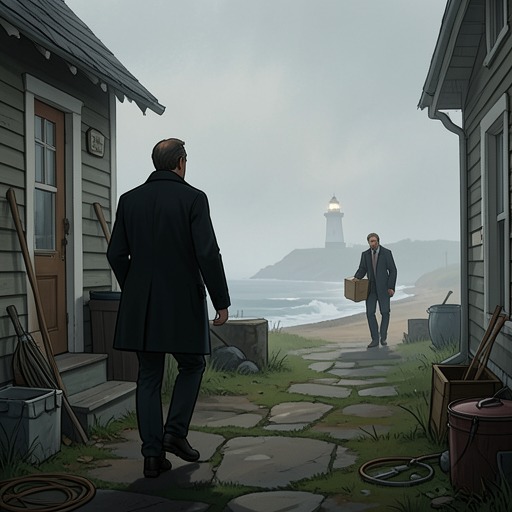
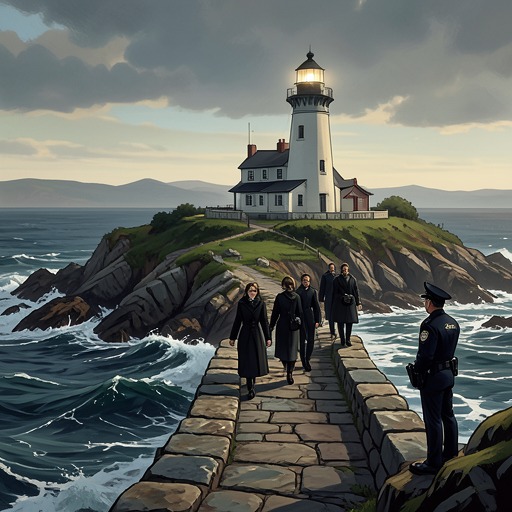
After Nathan Oliver’s body is found hanging at the lighthouse, Staveley is among those who reach the scene. Jago Tamlyn has caught the body, laid it on the path, loosened the rope, and judged that resuscitation would be pointless. Staveley confirms what happened as the group gathers. Maycroft then sends Jago and Dan Padgett to fetch a stretcher and sheet; he and Staveley wait, turning away from the body because they have nothing with which to cover it and find it indecent to stare at the distorted face.
The response is practical even amid shock. As the body is carried back to the house, Maycroft tells Jago to return the rope to the lighthouse without touching its knot or noose, since it may be evidence at the inquest. Staveley is not presented as the person directing the investigation, but his presence in the first response and his work alongside Maycroft place him within the island’s effort to manage both the dead and the living. Later, after the discovery, he remains beside Maycroft while the secretary gives an account of events and appears so stunned that he walks and speaks almost like an automaton. The contrast between that immediate shock and his later steadiness under medical pressure is central to his arc.
SARS and the Return of Professional Authority
Staveley’s medical judgment becomes especially consequential when Raimund Speidel’s condition worsens. He informs Dalgliesh that Speidel can no longer be interviewed and has been moved to the sickroom; when the illness worsens further, he arranges for Speidel to be transferred to a hospital in Plymouth, since Combe has no facilities to nurse someone seriously ill. The subsequent confirmation that Speidel has SARS turns an individual medical emergency into a danger for the entire island.
In a call to Dalgliesh, Staveley reports the diagnosis, warns that Dalgliesh and Jo are particularly at risk because of their close contact with Speidel, and explains that quarantine is the sensible response. He is also in contact with the authorities. His voice is calm and reassuringly authoritative, markedly different from the uncertain, withdrawn figure first encountered by the investigators. At a meeting with residents and visitors, he explains how SARS is thought to spread, identifies close contact as the principal risk, and recommends that everyone on Combe accept voluntary quarantine for about ten days. He stresses that the island is home for its residents, not a place from which they are being exiled, and makes the public-health restriction intelligible in terms of their shared circumstances.
His authority is not unlimited. When Dalgliesh contracts the infection, Staveley says he may have to transfer him to the mainland if his temperature remains high, because the island lacks facilities for a dangerously ill patient. He has already requested oxygen and other equipment, and Jo and he are managing Dalgliesh’s care for the time being. Dalgliesh wants to stay, and Kate Miskin challenges Staveley over whether a doctor should take responsibility. After a silence and an unspoken exchange with Jo, Staveley agrees that Dalgliesh can remain. The decision does not erase the danger or the limits of the island’s resources; it shows him weighing those limits against a patient’s insistence and accepting the responsibility he had initially resisted.
Care, Competence, and Change
Staveley’s work with Jo extends beyond the outbreak. After Kate is injured during the hostage crisis, he and Jo treat her in the sickroom. With Jo supporting her, Staveley pulls Kate’s dislocated shoulder back into its socket; he also dresses raw patches on her arms and thighs and diagnoses a broken rib, which must be left to heal on its own. Kate is grateful for their skill, though their gentleness makes the painful treatment harder to endure emotionally. The scene gives his medical ability a concrete, unheroic form: skilled hands, necessary pain, and care offered without display.
Staveley does not resolve his guilt over Winston Collins or decide to return to mainland practice. The evidence instead shows a more limited change: the island post he chose because he could cope with it becomes a place where his judgment and composure matter profoundly. He handles a death, helps coordinate an outbreak response, sets boundaries around what the island can safely treat, and cares for an injured investigator. His retreat remains real, but it is no longer the whole measure of him. The doctor who feared responsibility proves capable of exercising it when the needs of others leave no comfortable distance.