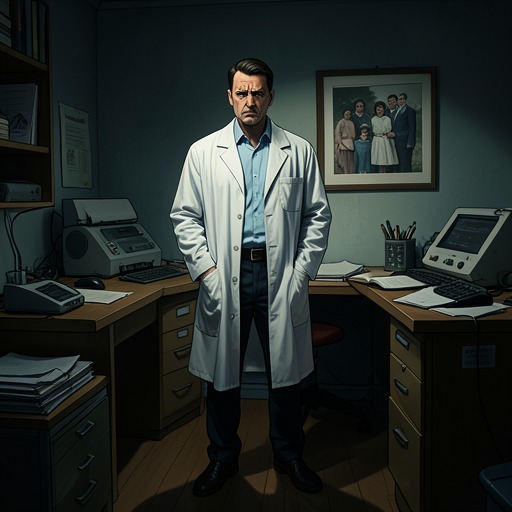
Mark Yelland–Monica Yelland marriage
The LighthouseMark Yelland and Monica Yelland’s marriage reaches its decisive rupture through a letter Monica leaves for Mark to find during his solitary stay on Combe Island. She announces that she will leave with their children, Sophie and Henry, and end the marriage; he discovers that her preparations have been underway without his knowledge. His first response is unexpectedly calm, and his deepest regret concerns losing daily closeness with the children rather than losing the marriage. That composure does not last: the letter’s news intrudes on the isolation he had sought, and his anger turns toward Nathan Oliver, whom he decides he must confront.
Marriage and competing priorities
The letter presents the marriage through a clear imbalance of priorities. Monica says that Mark will not give up his work, while she is no longer willing to sacrifice herself or the children to what she regards as his obsession. Her account is not simply that he has been absent at one particular moment: she says he has never understood the terror she has lived with for herself, Sophie, and Henry. She makes the children’s safety central to her decision, explaining that she has found a local school able to take them at short notice and that they can stay with her mother, where there is room, a familiar nursery, and a garden they have always enjoyed.
Monica frames departure as a decision delayed too long, not as an impulse created by Mark’s latest absence. She has chosen to leave before the children begin secondary education, and she does not demand an immediate legal settlement. Separation or divorce can wait until Mark returns; she will send the name of her solicitor after she has settled. The practical sequence—new school, a place to stay, and arrangements for the children—makes plain that the separation is already in motion even though Mark has not been consulted about it.
The letter and the hidden preparation
Monica explains that she could not speak to Mark directly or hand him the letter before he left. She expects that he will be able to read it in peace, without having to pretend to care more than he does, and that writing will spare her the need to keep justifying a decision she should have reached years earlier. The letter thus anticipates not only his absence but a lack of emotional response she believes has long characterized their relationship. Its composed practical tone carries an accusation: she considers herself and the children to have ranked below his work.
Mark finds the letter between the two top books he has unpacked and reads it again slowly, attending to each word as if rereading might disclose some hidden meaning. On its first reading, he was surprised both by how calmly he took the news and by the fact that he had not known Monica was planning to leave. The preparations sharpen that shock. Monica and her mother have acted as allies; the children have been prepared for the move, and a school has been found, while Mark remained unaware. He even wonders whether his mother-in-law helped compose the letter, whose matter-of-fact coherence seems more characteristic of her than of Monica. He briefly imagines the two women sitting together over an early draft. The thought registers his sense of exclusion, but the evidence does not establish who wrote or revised the letter beyond Monica’s having sent it.
Mark’s response and the interrupted retreat
The news arrives in a place Mark has deliberately made private. He has brought only the necessities, along with carefully selected books and CDs, and on his two previous visits he spoke to no one for either two-week stay. Food was delivered according to written instructions; he had no wish to join the other visitors for the formal evening meal at the house. Although he once wondered whether he could endure such solitude, he found that it was liberating rather than painful, and that it helped him return from professional traumas changed in ways he could not explain. The retreat is therefore not merely a convenient setting for receiving difficult news: it is a form of recovery whose quiet the letter now disturbs.
At first, Mark feels no strong resentment toward Monica. He regrets the loss of Sophie and Henry more than the end of the marriage, and his complaint is that Monica could have chosen a better moment instead of adding worry to his holiday. Gradually, however, a cold anger takes possession of him, described as though a noxious substance were curdling his peace. The movement from contained disappointment to consuming bitterness is the emotional turn of the episode. The letter does not make him decide to repair the marriage or contest the children’s move; instead, it dislodges him from the solitude he had hoped would heal him.
Oliver as the new focus of anger
Mark’s anger becomes directed toward Nathan Oliver. Oliver’s presence on the island is, in Mark’s view, fortunate, as is Rupert Maycroft’s having mentioned the other visitors when they met on the quay. Mark decides to change his plans, contact Mrs. Burbridge, and ask who is booked for dinner at the house. If Oliver is among them, Mark will break his solitude and attend. He believes there are things he needs to say to Oliver and that saying them may ease the bitterness enough for him to return alone to Murrelet Cottage and resume the healing retreat.
The connection is consequential but not fully explained in this episode: Mark’s marital crisis redirects his anger toward Oliver, while the specific grievances behind the intended confrontation belong to the surrounding story. What is established here is the collision between two kinds of separation. Monica has planned a practical departure with the children, while Mark has chosen temporary withdrawal from professional life and other visitors. Her letter makes his private retreat porous to family loss; his response, in turn, pulls him toward a confrontation rather than deeper solitude. The marriage’s future is left unresolved in this passage: Monica intends to end it, but no completed divorce or subsequent settlement is described.