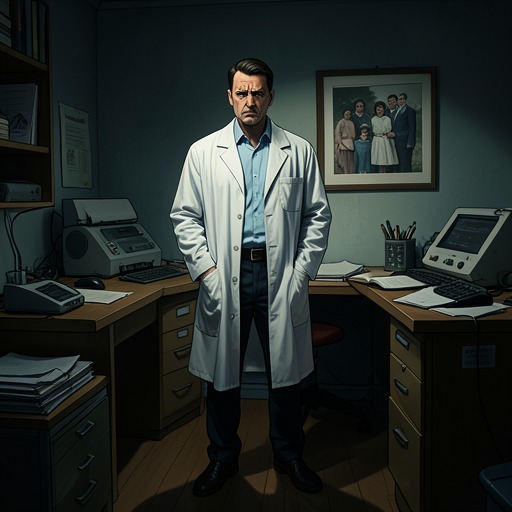
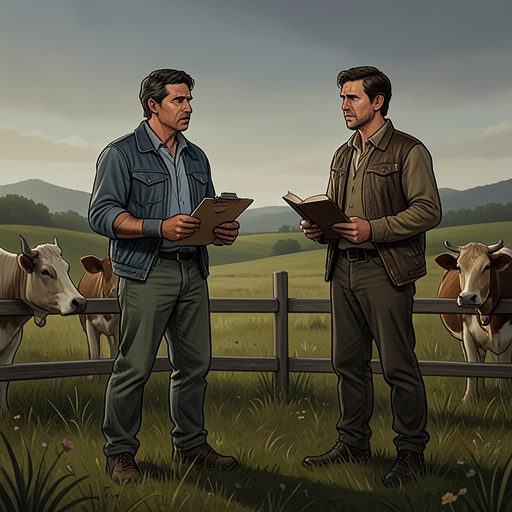
Nathan Oliver and Mark Yelland’s confrontation
The LighthouseNathan Oliver and Mark Yelland’s confrontation turns a dinner-table dispute over animal research into a private, uneasy exchange about suffering, responsibility, and the limits of understanding it. The argument is also a last encounter: after hearing Oliver speak of his end as close, Yelland leaves believing he has met a man approaching suicide, a conclusion that gives the conversation a darker meaning in light of Oliver’s death.
Causes and Stakes
The dispute takes place against several pressures in Oliver’s final days on Combe Island. He had complained of being over-tired and thought he might be anaemic, so Guy Staveley arranged a blood test and additional tests on the sample. Joanna Staveley, Guy’s wife and a nurse, took the blood. The sample was then lost overboard by Dan Padgett while he was taking his mother’s clothes to the Oxfam shop in Newquay. Although the loss was accidental, Oliver reacted violently. The failed tests could not settle the health concern that had prompted them, and the incident preceded the dinner argument that Guy remembered as one of the most uncomfortable meals he had sat through.
A second pressure came from Oliver’s objections to the work of Mark Yelland, director of the Hayes-Skolling Laboratory. Their disagreement was not simply about a particular experiment: Oliver’s criticism put Yelland’s research and his treatment of animals under moral scrutiny. Oliver left dinner before it was over, saying he wanted the launch that afternoon. He did not explicitly say that he meant to leave the island, but Guy understood the implication. It was the last time Guy saw him alive.
The Dinner Argument and Its Aftermath
The accounts of who initiated the dinner argument are uncertain. Rupert Maycroft thought Mark Yelland might have begun it, but admitted that his memory was unclear and that either man could have started the exchange. Yelland later confirmed that the argument had been acrimonious. He had arranged to attend dinner because he knew Oliver would be there, intending to challenge him about his new book and make him justify what he had written. That literary challenge became entangled with his anger about the laboratory.
When Oliver left, Yelland followed him. He acknowledged that this encounter had not been reported to Dalgliesh by either Maycroft or Guy, a significant omission in reconstructing Oliver’s last movements. Yelland said that he was tired and had drunk too much wine, though not enough to consider himself drunk; he did not believe he had been thinking clearly. He had two conflicting aims: to make some kind of peace with a writer whose dedication to his craft he understood and admired, and to warn him that further interference with the laboratory or its staff could bring a legal injunction. Yelland also made clear that he would not actually have sought one, since the publicity would have defeated the laboratory’s need to avoid attention.
The Argument About Suffering
Yelland explained his work through a hypothetical experiment involving five primates. He said they would be properly fed, exercised, played with, and cared for; their deaths, he argued, would be easier than death in nature and might help relieve, or even cure, painful and intractable diseases affecting large numbers of people. He framed the moral question as an arithmetic of suffering: if using five animals could spare fifty thousand others a lifetime of suffering, or save their lives, would the sacrifice be justified? If that reasoning could apply among animals, he asked, why should it not apply to experiments intended to help human beings?
Oliver refused the premise that writing about suffering gave him authority to claim that he understood it. Yelland appealed to him as a humane novelist who understood suffering; Oliver replied that he wrote about it but could not feel another’s pain vicariously, and that if he could feel it, he could not write about it. He was not persuaded to debate the suffering of others, human or animal. His answer draws a sharp distinction between artistic representation and lived experience: a novelist may render suffering without possessing it or being able to inhabit it on another person’s behalf.
Oliver’s Last Words and Yelland’s Conclusion
The conversation shifted from argument to exhaustion. Oliver told Yelland that both men did what they had to do, that neither had a choice, and that for him the end was very close. Yelland remembered the intensity of Oliver’s weariness and thought he had passed beyond caring. The remark made the earlier signs of distress—his reaction to the lost blood sample, his departure from dinner, and his implied wish to leave—seem to Yelland like evidence of a man at the limit of endurance.
Yelland left Oliver there and later became convinced that Oliver had killed himself, despite acknowledging that he might be attaching too much importance to the final words. That certainty sits alongside the possibility he himself admits: Oliver’s death may have been murder. The scene therefore supplies both an emotionally persuasive interpretation and a reason not to treat it as settled fact. Yelland’s account reveals a genuine encounter marked by admiration, anger, and regret, but his conclusion rests on what Oliver said and on Yelland’s reading of his weariness—not on seeing what happened afterward.