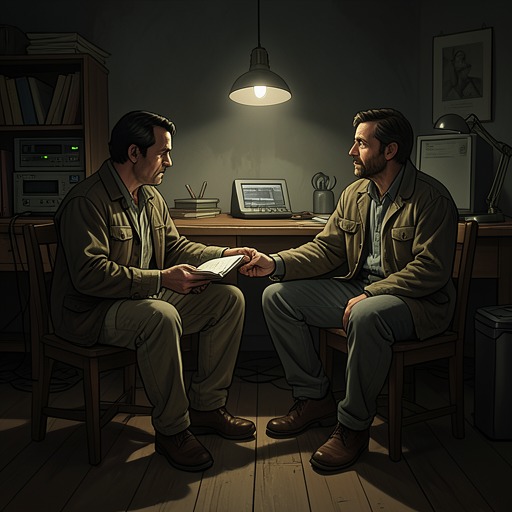
Nathan Oliver catches Miranda and Dennis together and rejects their plans
The LighthouseNathan Oliver catches Miranda Oliver and Dennis Tremlett in their concealed refuge below the cliffs and responds not with accommodation but with a demand that they leave. Their attempt to preserve their relationship while remaining in his service collapses under his anger: the discovery exposes both the intimacy they hid and their dependence on the household and work he controls.
The Hidden Refuge
Miranda and Dennis have found a hollow on the lower cliff, about a hundred yards south of Combe Island Chapel and less than three yards from a sheer forty-foot drop to a small inlet. High granite rocks enclose it, and reaching it means clambering and sliding down a steep slope strewn with boulders and tangled bushes. The boughs offer handholds, making the descent manageable even for Dennis, who is partially lame, but the difficulty also helps conceal the place. Someone would have to peer down from the friable cliff edge to see them.
Miranda has treated that possibility as too unlikely to trouble her. Desire and the optimism of hope have made the danger seem almost protective: the precarious setting enhances her feeling of invulnerability and gives their lovemaking an erotic edge. Dennis tries to share her confidence, supplying the enthusiasm he knows she expects. Their refuge is thus both an intimate space they have made for themselves and a place whose apparent privacy depends on not being seen from above.
Discovery on the Cliff
After their urgent physical need has been satisfied, the lovers lie close together but are distant in thought, facing the sky. Their clothes are scattered beside them, with Miranda’s binoculars thrown over the heap. Dennis’s heightened attention to the island’s sounds and smells belongs to the quiet aftermath of their intimacy; the sudden interruption comes from above. As Miranda stretches over him, she freezes, her face turning white with fear. Dennis struggles free and reaches for his jeans before looking up.
At first he sees only a dark, motionless figure blocking the light at the upper edge of the cliff. Recognition resolves the threat: the watcher is Nathan Oliver. The staging of the moment makes the refuge’s vulnerability immediate. The same overlook that had seemed an improbable danger has become the vantage point from which Miranda’s father sees her with Dennis. The secret is no longer theirs to manage privately.
Miranda’s Appeal and Oliver’s Anger
The confrontation continues indoors. When Miranda faces her father, his expression appears rigid and lifeless; only the pulse above his right eye betrays the bitterness he is struggling to control. She says they had not meant him to discover the affair in this way. Oliver answers with scorn, saying he already knew in San Francisco that she had found someone, but condemning her choice of Dennis as a poor, disabled employee. He also invokes her age, his will, her expected inheritance, and her domestic skills in a degrading calculation of the advantages she might have offered another man.
Miranda had expected a difficult discussion, but had hoped they could reason together and decide what would be best for everyone. That hope disappears under the force of his anger. She tells him that she and Dennis love each other and want to marry. Oliver points out that they are both adults and do not require his consent, then asks whether Dennis has any legal impediment to marriage. His response does not amount to acceptance: the practical question is followed by rejection of the future they have imagined.
A Future Oliver Refuses
Miranda proposes that marriage need not alter her father’s life. She and Dennis could work by the day; they could find a reliable woman to take over her household duties so Oliver would not be alone at night, and they could accompany him on tour as before. She insists that nothing need change. Oliver rejects both the arrangement and its premise. He says he does not need a daily woman or a night nurse, and that help could be hired if required. He has no intention of employing a married couple, making Dennis’s position—and Miranda’s continued place in the household—part of the conflict.
Miranda then identifies the work and care she believes Oliver is discounting. On tour, she checks his hotel room, runs his bath, complains when arrangements are wrong, helps organise signing sessions, protects his public reputation, and ensures he gets the food and wine he likes. She also stresses Dennis’s value as Oliver’s secretary and copy-editor, describing him as more than an employee: he edits beyond the copy-editing level, helps with plotting, and serves as a sounding board. Her appeal reveals how much Oliver’s household and literary life rely on the very couple whose relationship he refuses to accommodate.
The Ultimatum
Oliver tells Miranda to decide with Dennis what they intend to do. If she chooses a life with him, Oliver says he will not expect her back at the London house and wants Dennis to return the flat’s keys. Until then, she must tell no one. Although the island is small, Oliver says there should be room enough for them to avoid one another during the next twenty-four hours. He has another ten days booked at Combe House, where he can take his meals, and plans to book the launch for the following afternoon. He expects Miranda and Dennis to be on it.
The encounter therefore ends not with a negotiated compromise but with a deadline and a forced choice. Miranda’s proposal had tried to keep love, family care, and work together; Oliver treats those ties as arrangements he can terminate. His final instructions extend the rupture beyond employment and residence to secrecy, requiring that they tell no one while they prepare to leave. The scene’s decisive reversal is that the lovers’ hidden place, chosen as a refuge from scrutiny, becomes the beginning of their expulsion from the life they had hoped to preserve.