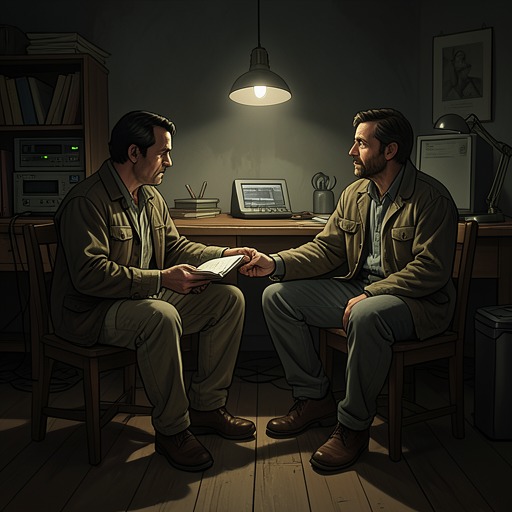
Nathan Oliver—Dennis Tremlett
The LighthouseNathan Oliver and Dennis Tremlett’s relationship was a twelve-year collaboration in which the practical intimacy of editing grew into a bond of mentorship and profound gratitude. Tremlett was Oliver’s copy-editor and secretary, but he described the work as a privilege and Oliver as the writer from whom he had learned how to read and think about fiction. The relationship was unequal in authority and confidence: Oliver did not make a confidant of him, yet entrusted him with a distinctive part of his writing process. After Oliver’s death, Tremlett’s devotion to the man and to the work became difficult to separate from the mystery of the missing, burned proofs.
From freelance editor to full-time assistant
Tremlett first worked for Oliver as a freelance copy-editor, mostly for Oliver’s publisher. He had been ill often, he explained, and found it difficult to secure more regular employment. After Tremlett copy-edited one of Oliver’s books, Oliver recognized his meticulousness and took him on full-time. Tremlett had then worked for him for twelve years, a span he remembered as the best years of his life.
Oliver’s support extended beyond assigning work. He paid for Tremlett to attend evening classes and learn computer skills, helping him adapt to the practical demands of the job. Tremlett’s account presents the relationship as a source of both employment and education: Oliver gave him a place in the daily life of a working writer, while Tremlett contributed care and precision to the labor that surrounded the books. He said he owed Oliver everything, though he also made clear that the older man could be impatient and did not treat him as a confidant. Tremlett did not resent that reserve; in his account, gratitude and professional closeness did not depend on personal disclosure.
A shared method of revision
Oliver’s working habits made Tremlett a close participant in the making of the novels. Oliver insisted on receiving galley proofs, preferring to revise at that stage rather than on the manuscript. He continued to edit extensively after the text had been set in type, sometimes changing a novel even between printings. He would not use a publisher’s editor: the two men worked together instead.
Their division of labor was precise. Oliver wrote alterations in pencil on his set of proofs, and Tremlett copied them in ink onto his own. This routine made Tremlett more than a detached reader, while preserving Oliver’s authorship and control: the judgments and changes were Oliver’s, and Tremlett carefully transferred them. Oliver’s refusal to regard a novel as unquestionably perfect meant that their work could continue beyond an initial publication. The proofs were therefore both working documents and a record of an ongoing exchange between writer and assistant.
When Adam Dalgliesh asked about the burned proofs, Tremlett emphasized how important they were. Oliver, he said, would never have burned them. Both Oliver’s set and Tremlett’s copy were missing; they had been kept in the top drawer of Oliver’s desk, which was not locked because Oliver had seen no need to secure it. The destruction thus implicated objects at the center of the pair’s shared practice. It did not, by itself, establish who had taken or burned them, but it turned the intimate record of their collaboration into a question in the investigation.
Literary admiration and apprenticeship
Tremlett described Oliver as a genius and insisted that Oliver did not need his help. That judgment coexisted with a more specific account of his contribution: Oliver sometimes asked whether a piece of action seemed believable or reasonable, and Tremlett answered as a reader. He did not claim to have shaped the plotting; indeed, he thought Oliver did not much enjoy plotting. Their collaboration, as Tremlett represented it, rested less on shared authorship than on Oliver’s occasional testing of narrative plausibility and Tremlett’s attentive response.
Tremlett’s admiration was also literary. He recalled words by T. S. Eliot as fitting Oliver: “Leaving one still with the intolerable wrestle / With words and meanings.” He contrasted Oliver with the modern Henry James, a description others used. Tremlett recognized the long, complicated sentences but believed that, unlike James’s sentences as he read them, Oliver’s illuminated rather than obscured truth. His account joined personal loyalty to a considered view of the writing: the novels mattered not simply because he had helped produce them, but because he believed their difficulty disclosed something true.
Grief, Miranda, and the unresolved bond
After Oliver’s death, Tremlett appeared devastated, with grief or fear, or both. He said that he could not imagine life without Oliver and was close to tears when he spoke of their years together. Adam Dalgliesh found the grief genuine, but did not treat it as proof that Tremlett could not be involved in the killing. He also distinguished mourning Oliver’s talent from mourning Oliver himself, an ambiguity sharpened by the burned proofs: they could represent not only the loss of a mentor but also the destruction of the work to which Tremlett had devoted so much care.
The interview also disclosed that Tremlett was engaged to Miranda Oliver, Oliver’s daughter. She introduced him as her father’s copy-editor and secretary and said that she and Tremlett planned to marry; Adam Dalgliesh had not been told of the engagement. Tremlett sat beside Miranda, and their fingers briefly touched before he put his hands under the table. The scene places his private attachment to Oliver’s family alongside his professional attachment to Oliver, without resolving what either means for the case. His account establishes a deep apprenticeship and a long daily partnership, but leaves the central uncertainty intact: grief for Oliver, grief for his talent, and the significance of the missing proofs cannot be cleanly disentangled.