Paternity, Legitimacy, and Fatherhood
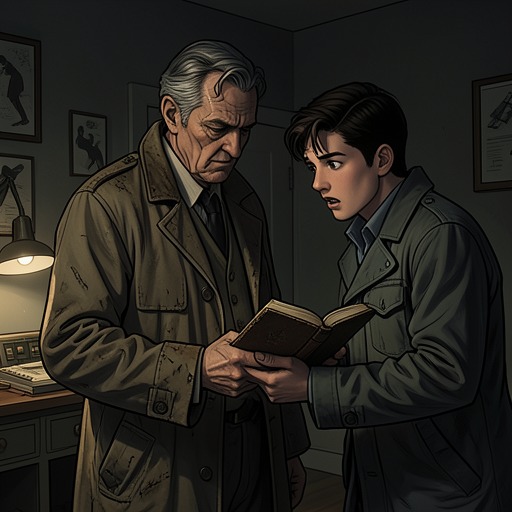
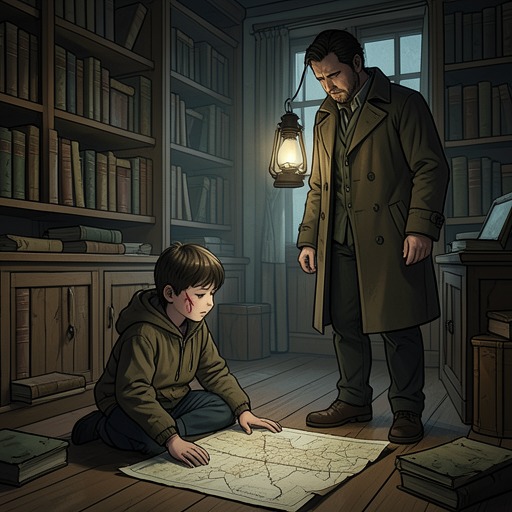
The LighthousePaternity, Legitimacy, and Fatherhood is the hidden family question at the centre of Nathan Oliver’s murder: Dan Padgett is his son, though neither man has lived with that knowledge until shortly before their fatal confrontation. The revelation makes biological descent more than a matter of identity. It becomes a claim to acknowledgment and material responsibility, set against Oliver’s insistence that parenthood creates no continuing obligation to an adult child. The resulting violence grows from a history in which secrecy, poverty, and social humiliation have already shaped the lives of mother and son.
A concealed relationship
For much of the investigation, the relevant family history appears peripheral. Adam Dalgliesh’s recollections include Dan Padgett’s deprived childhood, while other clues point toward the people who arrived on Combe Island. The eventual solution reverses that emphasis: the decisive question is not simply who came to the island, but who had left. Martha Padgett, carried away in her coffin, can no longer speak for herself, yet her death has changed what her son knows and what he may demand of Nathan Oliver.
Before she died, Martha confided to Adrian Boyde that Dan was Oliver’s son. Boyde had helped minister to her and was one of the few people she and Mrs. Burbridge regarded as a priest to whom she could entrust a secret under the seal of the confessional. The confidence therefore placed Boyde between a mother’s disclosure and a son’s right to know. He could not simply reveal what Martha had told him; Adam Dalgliesh reasons that he must have urged her to tell Dan herself. The secret was not just withheld by one man from another: its transmission was constrained by the promise of secrecy surrounding the circumstances in which it had been disclosed.
Martha and Dan had arrived on Combe Island in June 2003. Earlier that year, in April, Oliver had spoken publicly about making regular visits to the island, breaking the Trust’s agreement that information about it remain confidential. Adam Dalgliesh considers whether the interview made Martha hope that her son might meet his father and that Oliver might eventually acknowledge him. This remains an inference, not a confirmed account of Martha’s intentions. The timing nevertheless links Oliver’s public disclosure to the possibility of a meeting that had been difficult to arrange while his whereabouts were concealed.
Proof, stigma, and the search for identity
The distinction between biological certainty and social recognition runs through the evidence. At the time Dan was born, DNA testing had not yet been discovered. Adam Dalgliesh supposes that Oliver may have told Martha he would not acknowledge the child and that she could not prove the paternity; if so, she may have accepted that denial for years. In the later circumstances Dalgliesh reconstructs, knowledge of DNA testing and Martha’s awareness that she was dying gave the old secret a new urgency. The novel does not establish every part of this history as fact, but it shows how changing possibilities of proof could alter what a concealed parentage meant.
The physical clues make that change concrete. During a search of Dan’s cottage, Kate Miskin and Francis Benton-Smith find an envelope hidden in a cavity behind a loose brick. It holds the birth certificates of Bella Martha Padgett, born on 6 June 1962, and Wayne Daniel Padgett, born on 9 March 1978. The father’s name is blank on Dan’s certificate. The document confirms the absence of an official paternal identity, while the different names preserve traces of a family history in which even the use of first names was controlled: Adam Dalgliesh reflects that Dan’s aunt had insisted that he and his mother not use theirs.
Other concealed evidence connects the question of parentage to a testable biological claim. The investigators find a phial labelled with Oliver’s name and the date, together with a sample of hair wrapped in tissue and hidden beneath foil in a tub of butter. Adam Dalgliesh has inferred that Dan knew hair roots were needed for DNA testing; the hair, the blood sample, and the birth certificate together turn a long-denied relationship into something that can be investigated materially. The apparent loss of Oliver’s blood sample had also misdirected the inquiry: Dalgliesh realizes it had never been in the bag, and that Dan had let old shoes, handbags, and library books fall into the sea instead.
From inheritance to confrontation
The evidence helps explain why Dan might have approached Oliver, but it does not make every aspect of his plan certain. Adam Dalgliesh reconstructs the murder as an impulsive confrontation: Dan may have seen Oliver going purposefully toward the lighthouse and treated the meeting as an opportunity to reveal his parentage, show that he had proof, and demand acknowledgment and financial provision. Dalgliesh connects this possibility to Dan’s confidence about a different future. The reconstruction gives the encounter a double stake: Dan seeks both the truth of who his father is and a change in what that father owes him.
The account Dan later gives makes Oliver’s refusal explicit. Oliver told him that, had Dan been a child, he would have accepted some responsibility for his support, but that he owed an adult Dan nothing. He also disparaged the circumstances of Dan’s conception and dismissed him as a contemptible blackmailer. Dan then attacked him, fastening his hand around Oliver’s throat. The exchange sets two incompatible definitions of fatherhood against one another: Oliver treats support as a limited duty owed only to a child, while Dan arrives seeking recognition and provision as the son he believes Oliver has denied.
Oliver’s response is not merely a refusal of money. By rejecting the relationship and degrading Dan at the moment Dan presents it, he denies the identity Dan has come to assert. Yet the novel does not frame biological descent as an automatic guarantee of affection or a simple answer to every question of responsibility. It shows instead that a fact of birth can be withheld, contested, and finally used as leverage, while the moral and emotional obligations attached to that fact remain fiercely disputed. The encounter’s violence follows from that collision, not from proof alone.
The inheritance of humiliation
Dan’s claim emerges against a childhood shaped by rejection. Francis Benton-Smith describes him as having been resented and humiliated from birth; he was made to change his name, and even his mother’s name, Bella, was treated as unacceptable by the aunt who controlled their household. Kate Miskin imagines a bleak domestic life in which Dan and his mother lived under that aunt’s petty power, alongside the burden of gratitude imposed by charitable schooling and a succession of failed jobs. Her account is imaginative reconstruction rather than a complete verified biography, but it places the missing father within a wider pattern of dependence and social shame.
Kate’s reflection also complicates any attempt to treat Dan’s deprivation as an explanation that removes his responsibility. She recognizes the injuries of his upbringing and the possibility that Martha’s silence condemned him to years of humiliation, yet insists that many illegitimate, ill-treated, resented, and unwanted children do not become killers. The novel holds sympathy and judgment together: inherited hardship helps make Dan’s grievance intelligible, but does not make murder inevitable or excuse it.
The family secret is therefore both an answer and a source of further damage. It identifies Oliver as Dan’s biological father and clarifies the demand behind the lighthouse confrontation, but it cannot restore the recognition withheld through Dan’s childhood or turn a belated claim into a lived relationship. Martha’s attempt, possibly made in her final months, to bring son and father into the same place ends not in reconciliation but in two violent deaths: Oliver is murdered, and Boyde, who knew the secret and may have tried to persuade Dan to confess, is also killed. Paternity supplies the case’s concealed motive; the novel’s deeper concern is the human cost of treating fatherhood as a fact that can be denied without consequence.