Pentworthy
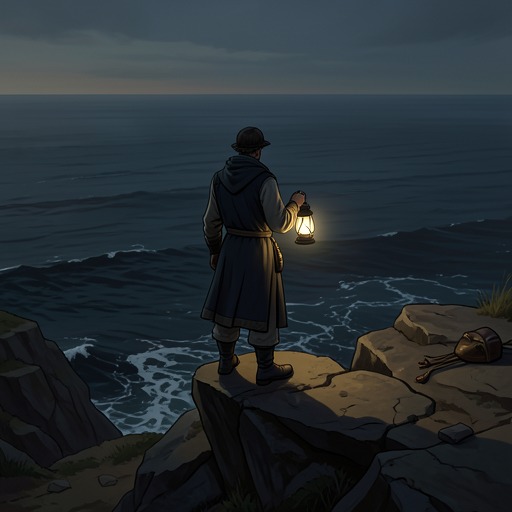
The LighthousePentworthy is a coastal town linked to Combe Island through both practical journeys and stories carried between generations. Its seafront is where Jago Tamlyn encountered Millie begging; its pub and the accounts of older residents also figure in the islanders’ recollections of Saul Oliver and a death at sea. The place matters less as a fully described setting than as a point of contact: people arrive there in search of help, and island history is recalled there in fragments that were never proved in court.
Setting and Connections
Pentworthy is described through a handful of identifiable locations: a seafront, a pub, and a fish-and-chip shop. Jago was visiting a friend there on a day off from Combe Island when, returning from the pub, they saw Millie begging by the sea. The town is also connected to the nearby village where Millie had lived with her paternal grandmother, and to Plymouth, where she had earlier left her mother’s home to live with that grandmother. The account establishes these places as parts of Millie’s history, without suggesting that her homelessness began in Pentworthy.
The town’s links to the island are not limited to individual travel. Jago could telephone Rupert Maycroft from Pentworthy to ask whether Millie might temporarily be given a room and work on Combe Island. At another point, the island’s workers discuss Dan Padgett’s expected departure for London, where he intends to undertake training and has applied for a degree course. Pentworthy is thus situated in a wider movement between the island and the mainland, although the evidence does not make it Dan’s destination or identify it as his home.
Millie’s Encounter with Jago
Millie’s meeting with Jago begins with immediate material need. She was begging on the seafront, appeared hungry, and was taken by Jago and his friend to a fish-and-chip shop, where she ate ravenously. There she told them how a sequence of losses had left her without a home. Her father had left when she was very young, and she had never got on with her mother or her mother’s successive boyfriends. She left Peckham for her paternal grandmother’s home in a village outside Plymouth; after two years, her grandmother developed Alzheimer’s disease and went into a care home. Millie then had nowhere to stay.
After the landlord sought to remove the family and Millie had no money for rent, she lived rough until her money ran out. She had apparently told social services that she was going back to Peckham, but no one checked; she was no longer legally a juvenile, and the account suggests that the authorities were too busy. When Jago met her in Pentworthy, her immediate hunger made visible the consequences of this chain of failed or ending arrangements. The meeting becomes the occasion for Jago to intervene, rather than a solution available within the town itself.
Jago asked Rupert Maycroft to let him bring Millie to Combe Island temporarily, until he could work out what should happen next. A vacant room in the stable block and a need for help in the kitchen made temporary accommodation and employment possible. Mrs. Plunkett later explains that Maycroft appointed Millie to assist Mrs. Burbridge with the linen and help in the kitchen. Another account describes her doing sewing work as well. The placement provided shelter and work, but island residents also recognized that Combe Island was not necessarily a suitable permanent place for a young woman who needed a proper job and the company of people her own age.
The Island’s Response
Jago’s request carries weight because he is indispensable to Combe Island, as well as because his concern for young people is known. His compassion has a history: his sister hanged herself after being seduced and made pregnant by a married man, an event described as occurring about six years earlier. Mrs. Plunkett thinks Jago never recovered from the loss and wonders whether Millie reminded him of his sister. She also considers it clear that his interest in Millie was not sexual. These details give his intervention both a practical basis and a personal context, without making Millie’s circumstances identical to his sister’s.
Maycroft’s decision had practical as well as humane grounds. The vacant room and kitchen work allowed Millie to be taken on, while Jago’s importance to the island made it difficult for Maycroft simply to refuse his request. Millie’s employment was therefore an improvised response to a crisis she had brought to the seafront: Pentworthy is where she was found, while the island becomes the place where temporary shelter and work could be arranged. Her prospects remain unsettled in the account; the job is not presented as a complete answer to her need for a more suitable future.
Local Memory and the Saul Oliver Story
Pentworthy also holds an older, contested history. Jago says his father learned about Saul Oliver as he grew up, drawing much of the story from Saul himself when Saul was drunk. There were also older people in Pentworthy who knew about Saul and kept stories about him. According to the account Jago repeats, his grandfather never returned to Pentworthy alive: Saul killed him and threw his body overboard, then claimed that the death was an accident. Jago insists that his grandfather was a better seaman than Saul and was not the kind of man to suffer an accident aboard a boat. But nothing was proved.
The story reaches the reader through layers of recollection rather than official confirmation: Jago reports what his father learned, his father had heard much from Saul, and local people preserved their own version. Pentworthy consequently becomes a repository for suspicion as well as a place of ordinary need. The contrast is sharp: the town’s seafront supplies the concrete scene of Millie’s hunger, while its older residents’ stories keep an unverified death alive in collective memory. In both strands, what the islanders know about a person depends on testimony passed from one individual to another, with practical consequences in Millie’s case and unresolved accusation in Saul Oliver’s.