Privacy
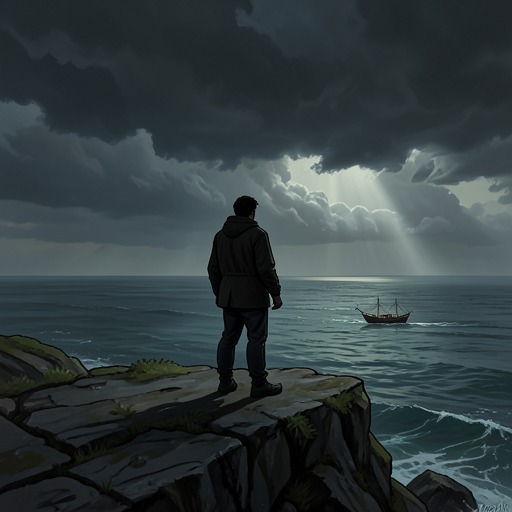
The LighthousePrivacy in the novel is not simply a matter of keeping secrets: it is the silence and security people seek, the boundary an investigation must cross, and a fragile condition that public events can overturn. Combe Island offers visitors a refuge from intrusion, but the murder of Nathan Oliver makes the claims of privacy impossible to separate from the claims of justice. Later, the island’s quarantine and the expected arrival of the press turn that tension into a practical loss of seclusion.
Silence as refuge
A woman living on Combe Island describes its appeal to Adam Dalgliesh as a deliberate purchase of silence. Visitors know what to expect, she says, and the quiet does not come cheaply. She imagines the exhaustion of answering another question, hearing another phone ring, or seeing another face; in contrast, island visitors can sleep with doors and windows open, without a security guard or police watching their movements. Privacy here means relief from both social demands and the watchfulness associated with terrorism and kidnapping.
Dalgliesh asks whether Nathan Oliver’s death will end that sense of safety. The woman doubts it: Combe Island will recover, she says, and has forgotten worse horrors. Her answer sets the island’s privacy against the violence that threatens it. Seclusion is not proof that danger cannot reach the island; it is a valued condition that its residents believe can be restored even after catastrophe.
Investigation and the claims of truth
That refuge becomes contentious when Dalgliesh questions the woman about Adrian Boyde and the past. She argues that Boyde is not a serious suspect in Oliver’s death and challenges the purpose of probing a painful history unrelated to the case. In her view, questioning gives the detective power: refusing to answer makes a person look guilty, while answering violates someone’s privacy. She invokes Bacon’s account of Pilate asking what truth is and leaving without waiting for an answer, pressing Dalgliesh on whether justice and truth can justify the intrusion.
Dalgliesh answers that he respects confidences only up to a point. Murder, he argues, destroys privacy rather than leaving it intact: it affects suspects, the victim’s family, and everyone drawn into contact with the death. Above all, it destroys the victim’s privacy, and Nathan Oliver can no longer be protected. The argument turns privacy from an individual possession into a boundary already shattered by murder, one that the investigation cannot simply restore by refusing to ask questions.
The woman asks whether, if she tells him what she knows, he will accept her account as truth and leave Boyde alone. Dalgliesh will not promise that. He says instead that knowing the facts will help him question Boyde without causing unnecessary distress, because causing pain is not the purpose of the investigation. His response does not erase the conflict: the disclosure she is being asked to make remains an intrusion, even when it may reduce the distress of a later interview.
The investigator’s divided privacy
Dalgliesh’s own private life reflects the same tension. On a Sunday morning on Combe Island, he looks east and thinks of Emma Lavenham. He longs to hear her voice but knows she will not phone while he is working, and he decides not to call her either. Their unspoken arrangement separates the lover who is a detective from the lover who is a poet: when his work takes him into difficult, uncharted territory, Emma does not question or explore it.
Dalgliesh wonders whether her silence recognizes the separateness of their working lives, or whether she understands that his poetry draws on the pain and broken lives he encounters as a detective. He also recognizes an uncomfortable contradiction in himself. He guards his own privacy, yet has chosen a profession that requires him to violate the privacy of others, both dead and living. The case does not resolve that contradiction; it makes its cost visible in the distance between his private attachments and his public duty.
Publicity and the island’s exposed seclusion
The later decision to accept voluntary quarantine brings a more public threat to Combe Island’s privacy. Rupert Maycroft warns that news of the situation will reach radio and television bulletins at one o’clock and calls it the end of privacy on the island. Although the telephones are ex-directory, he expects that some people may discover the numbers. New Scotland Yard’s public-relations branch will handle publicity about the murders, using the limited statement that investigations are proceeding and that it is still early days.
The murder investigation and the island’s exposure also affect what can be reported and seen. Nathan Oliver’s inquest has been postponed and is likely to be adjourned when it takes place. Residents interested in the publicity may be able to persuade Mrs. Plunkett to let them watch her television; newspapers, along with necessary supplies, are due to arrive by helicopter. Maycroft anticipates their arrival with reluctance, distinguishing the practical need for supplies from the intrusion that the press will bring.
Mark Yelland asks whether temporary staff on the mainland will be harassed by journalists. Maycroft doubts that their names are generally known and expects little help for the press if reporters contact them. He says there is no reasonable possibility of anyone landing on the island, and the helicopter pad will be made unusable except for a known air ambulance or supply delivery. Other helicopters may still circle overhead, creating noise the island will have to tolerate. The measures can restrict access, but they cannot restore the earlier silence: publicity has made the island’s privacy a matter of active defense rather than an assured condition.