Proofs of Oliver's final novel
The LighthouseProofs of Oliver's final novel were the galley pages on which Nathan Oliver made important revisions to his last book, working in pencil while Dennis Tremlett copied the changes in ink onto a second set. Both sets vanished from the top drawer of Oliver's desk, and charred paper and white ash in the grate at his cottage suggested that the pages had been burned. Their disappearance made the proofs both a practical loss to Oliver's literary work and a significant object in the investigation of his death.
The Proofs and Oliver's Working Method
Oliver preferred to revise his novels at the galley-proof stage rather than on the manuscript. He insisted on having proofs, a practice that made the process more difficult for his publishers and more expensive for him. The pages were not a final formality: Oliver used them as the occasion for substantial editing, and sometimes continued altering a novel between printings. His inability to regard a book as quite perfect kept revision open even after the manuscript had been completed.
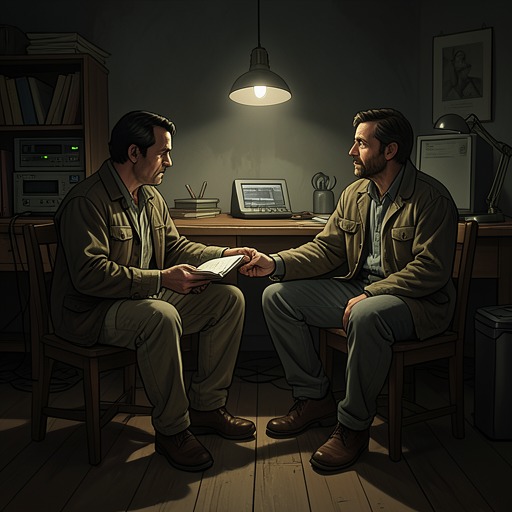
The work was collaborative in a specific, closely divided way. Oliver wrote his alterations in pencil on his own proofs; Tremlett transferred them in ink to a separate set. Oliver did not want a publisher's editor, so the editorial exchange took place between the novelist and his copy-editor and secretary. Tremlett said that Oliver sometimes asked whether a piece of action seemed believable, and that he answered him. The proofs therefore embodied not only Oliver's revisions but also the working relationship through which some of those revisions were checked and preserved.
Their Place in the Cottage
The proofs were kept in the top drawer of the heavy oak desk in Oliver's study, at the far end of the long room at the cottage. The desk stood in front of a seaward-facing window; nearby were a table with a computer and copier and shelves along two walls. The room combined study, dining area, and sitting room, but its comfortless austerity made the study's ordinary tools and papers seem particularly exposed when the detectives entered.
There had been no apparent attempt to secure the pages. Tremlett said that neither set was locked away because it would not have occurred to Oliver that this was necessary. The cottage door, too, was rarely locked on the island. Miranda Oliver said that her father might have locked it as a habit when he returned late, but could also have forgotten or not bothered; it was unlocked when she got up. In this setting, the missing proofs could have been reached without overcoming a conspicuous barrier, but the unlocked door alone did not establish who had entered or what had happened to the pages.
Burning and Disappearance
When Adam Dalgliesh and Kate Miskin visited, the grate was filled with blackened paper and white ash. There was no detectable smell of burning. The remains had not been cleared away, although Dalgliesh considered that Miranda and Tremlett might have seen no point in doing so, since Rupert Maycroft and Guy Staveley would almost certainly have reported what they had noticed. The physical traces were thus already part of the account surrounding Oliver's death before Dalgliesh asked about them directly.
Miranda identified the burned papers as the proofs of her father's last book and insisted that Oliver would not have destroyed them. She proposed that someone must have entered the cottage during the night. Her account of his movements provided the surrounding interval: Oliver returned later than she expected, just after eleven, and left the following morning at twenty past seven. She had heard him come in but said he did not come to say good night; she saw him leave from her window while she was dressing. She later found that he had made tea and eaten a banana, and assumed he had gone for an early walk before his usual cooked breakfast. The account placed the missing proofs within an overnight absence, but did not identify the person responsible for burning or removing them.
The Missing Second Set
Dalgliesh asked whether the loss was decisive if other copies existed. Tremlett explained that both sets kept in the cottage were missing: Oliver's annotated proofs and his own copy, with the alterations transferred in ink. The publishers might have had further material, but that possibility did not make the cottage copies unimportant. Tremlett said the proofs were very important precisely because Oliver did so much of his editing at that stage. What disappeared was not simply one marked-up copy but both records of the work being done between author and copy-editor.
The distinction between the two sets sharpened the mystery. Oliver's pencil marks would have shown his own proposed changes; Tremlett's ink copy would have preserved the alterations as transferred by his collaborator. Their joint absence could not be explained merely by the accidental loss of one working document. At the same time, the evidence available in the room did not establish whether the pages in the grate came from one set, both sets, or some other paper. The blackened remains signaled destruction, while the empty place in the desk and the missing copy supplied the broader loss.
Investigative and Literary Significance
The proofs altered how the cottage scene could be read. The grate's ashes were not incidental household debris once Miranda identified them as the remains of the last novel's proofs; they connected a physical act of destruction to Oliver's continuing literary work. Because he revised extensively at proof stage and sometimes returned to books after publication, the pages represented an unfinished process rather than a merely replaceable record of a completed text.
Dalgliesh treated the burning as distinct from Oliver's death. He regarded the destruction as evidence of hatred directed at the work itself, and as an act of pettiness that he had not detected in Tremlett. Yet Tremlett's visible distress did not settle the question: Dalgliesh recognized that genuine grief could coexist with other feelings, and that grief could also mislead an observer. The proofs therefore became a test of interpretation as well as a missing object. Their destruction suggested hostility toward Oliver's writing, but neither the ashes nor the emotional responses in the room, by themselves, proved who had burned them or why. In the investigation, the charred pages made literary labor materially present at the scene—and made its deliberate erasure one more fact requiring explanation.