Saul Oliver
The LighthouseSaul Oliver is a boatman and estate factotum whose concealed role in the deaths of three German officers on Combe Island casts a long shadow over his son Nathan Oliver and the island’s history. Known for his sailing skill and violence when drinking, Saul emerges in Emily Holcombe’s recollection as both the teller of a buried wartime story and a man whose own version leaves another death unresolved.
Identity and Background
Saul worked for Emily Holcombe’s family as the island’s boatman and general factotum. He was considered a fine sailor, but also a difficult man, prone to violence fuelled by drink. After his wife died, he was left to raise Nathan, then a strong-willed, withdrawn child.
Emily had known Saul and Nathan since her youth, when she visited the island as a child and adolescent. Although she got on reasonably well with Saul, the social conventions of the time discouraged anything resembling friendship between an employer’s family and a servant. Her account therefore brings personal familiarity to a relationship still shaped by class boundaries.
The Lighthouse Fire
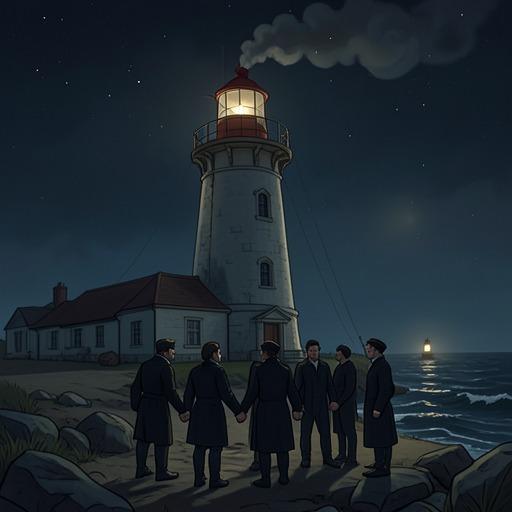
When the island was evacuated during the Second World War, Saul helped the steward move the remaining staff to the mainland. On October 10, 1940, after landing the last of them, he returned to Combe Island with Nathan in his own sailing boat. He said that he had final tasks to complete and was concerned that the house was not secure; he intended to stay one more night.
That night, three German officers from the occupied Channel Islands landed on the island. After first light they went to the top of the disused Combe Island lighthouse, apparently to look around. Saul discovered their boat and worked out where they had gone. The lighthouse’s ground floor was packed with dry straw used as animal fodder. Saul’s later account was that he set the straw alight, sending flames and smoke up into the tower. The officers could not escape onto the lantern: its railings were unsafe, and its door had been nailed shut. All three died, probably of suffocation.
Saul said he waited until the fire had burned out, found the bodies halfway up the tower, and carried them down to the boat. He then took the boat out with the dinghy from his sailing boat and scuttled it in deep water. The act concealed both the officers’ deaths and the means by which they had reached the island.
Nathan Oliver and Tom Tamlyn
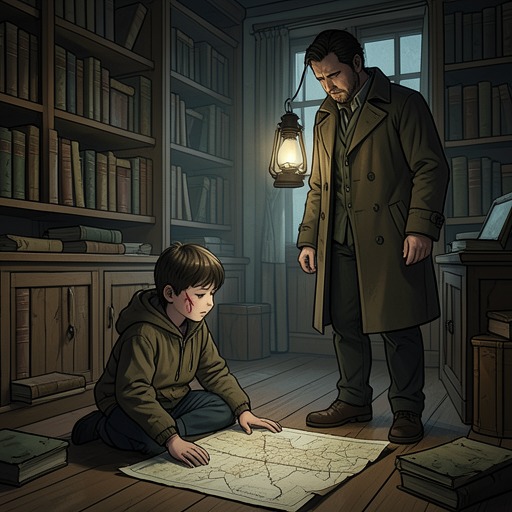
Saul’s account placed Nathan at the lighthouse during the fire. He told Emily that the boy, playing with a box of matches he had found in the house, had set the straw alight; Saul said he saw him do it. Nathan later denied being near the lighthouse. Emily believed Saul at the time but, looking back, was no longer certain. The account thus leaves open whether the fire began as Saul described it or whether the child was made part of a story told by a dying, barely coherent man.
Saul also said that Tom Tamlyn, Jago Tamlyn’s grandfather, had been with them. After the boat was scuttled, Saul and Tom returned to the island, then set out for the mainland with Nathan. On the stormy crossing, Saul’s explanation was that Tom fell overboard while helping to control the boat. Tom’s body was found six weeks later farther down the coast; what remained was insufficient to establish much, though the back of his skull had been smashed. The coroner returned an open verdict, while the Tamlyns believed Saul had murdered Tom to conceal the officers’ deaths. That suspicion is reported, not resolved.
Emily Holcombe’s Delayed Account
Emily heard Saul’s story years after the war, within two weeks of his death, when he was hardly coherent. She could not tell whether he meant to confess or boast, and she did not know why he chose her. The disclosure came long after the event and after she had lost contact with Saul; it is the principal account of what happened, but its source and the surviving uncertainty matter to how it can be understood.
Emily regarded the officers’ deaths as murder. She said she threw the evidence into the sea and saw no point in contacting the German authorities, reasoning that the men had died horribly and to no purpose and that any families would gain no comfort from the story. Her silence helped keep Saul’s actions and the circumstances of Tom Tamlyn’s death buried. When Adam Dalgliesh later questioned her, she also insisted that Raimund Speidel would not take revenge on a child, separating the old wartime crime from the investigation into Nathan’s death.