Second World War
The LighthouseThe Second World War is not merely a date in Combe Island’s past: its evacuation, violence, and concealed aftermath leave a chain of unresolved deaths that reaches into the island’s present. The fire in the disused lighthouse, the disappearance of three German officers, and the death at sea of Tom Tamlyn survive in official records and family testimony that do not quite agree. Their delayed recovery gives wartime history a direct bearing on how the characters interpret Nathan Oliver and the island itself.
Evacuation and the Island’s Wartime Past
Combe Island was evacuated during the war, although it was not considered especially vulnerable to attack. In Emily Holcombe’s account, the immediate practical problem was a lack of fuel for the launch. Her family remained through the Phoney War, but by October 1940, after the fall of France and the death of her brother at Dunkirk, her parents decided to leave for their main house near Exmoor. The evacuation of the remaining staff was handled by the steward and Saul Oliver, the island’s boatman and general factotum.
After taking the last staff members to the mainland, Saul returned to Combe Island with his four-year-old son, Nathan, saying that he had final tasks to complete and was concerned that the house was not secure. Emily’s later account places this return on 10 October 1940. Saul proposed to stay one further night. The island’s departure from ordinary life thus becomes the setting for an episode whose meaning was withheld for decades: what was described as practical care for the house was also the prelude to the lighthouse fire and the disappearance of the German visitors.
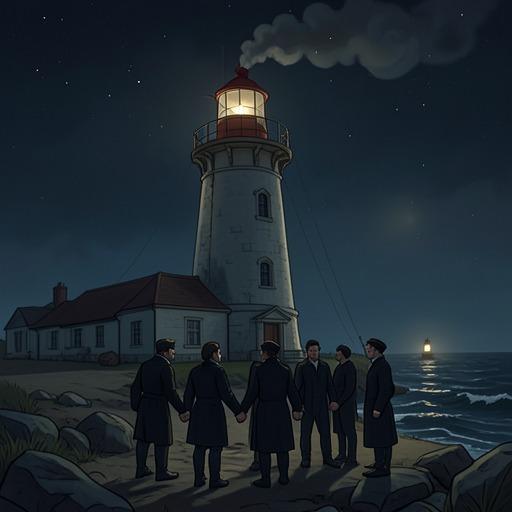
The war also left a visible mark on the island’s architecture. The old lighthouse, modelled on Smeaton’s famous lighthouse, had already been abandoned after a modern lighthouse was built at the north-west tip of Combe Island. During the island’s wartime evacuation, fire destroyed its three upper storeys, after which the building remained derelict. It was later restored with close attention to its former design. Its elegant exterior and restored height therefore conceal a history of burning and death; the building that visitors admire is also the site around which the wartime secret was organized.
The Lighthouse Fire and the Missing Officers
According to the account Emily attributes to Saul, three Germans from the occupied Channel Islands landed on Combe Island during the night of 10 October 1940. Whether they knew the island had been evacuated or found it by chance remained uncertain. Their purpose was also unresolved. Raimund Speidel later suspected that they intended to raise the German flag on the disused lighthouse, perhaps as a daring private gesture; Emily presented reconnaissance or another personal venture as possibilities rather than established fact.
After first light, the three men went to the top of the lighthouse, apparently to look over the island. Saul found their boat and guessed where they were. The ground floor of the tower held animal fodder and was packed with dry straw. Emily’s account says Saul set the straw alight. Smoke and flame rose into the upper chamber, trapping the Germans: they could not escape onto the lantern, whose railings had become unsafe, and the door had long been nailed shut to prevent accidents. All three died, probably from suffocation. Saul waited until the fire had burned out, found their bodies partway up the tower, carried them back to their boat, and scuttled it in deep water using the dinghy from his sailing boat.
The story does not settle who lit the fire. Emily said Saul later told her that Nathan, then a child, had found matches in the house and started it while playing. The boy panicked and denied having been near the lighthouse, while Saul claimed to have seen him. Emily believed Saul at the time but later questioned whether the story was true. Her uncertainty matters: the account of the fire is itself transmitted through a witness who may have been confessing, boasting, or both, rather than through a surviving independent record.
Records, Family Memory, and Silence
Raimund Speidel’s search for the truth began with a family history made deliberately indistinct. His father had been stationed with the occupying force on Guernsey. Speidel learned that his father and two fellow officers had come to Combe Island after its evacuation and never returned. The family had treated the disappearance as a convenient death on active service, avoiding the ignominy of a failed marriage and a possible divorce. Speidel had been told little about his father as a child, and questions had seemed unwelcome.
Official records offered a different kind of silence: the three young men had gone absent without leave in a thirty-foot sailing boat with an engine. They were posted as missing, believed drowned. A fellow officer, to whom Speidel’s father had confided under a promise of secrecy, later told Speidel that the men planned to raise a German flag on a small island off the Cornish coast. A retired fisherman also supplied information, though local people were suspicious of questions about Combe Island. Speidel’s account therefore joins records, a confidential recollection, and local knowledge, each incomplete in a different way.
Emily’s version came by another route. She said she had lost touch with Saul during and after the war, then heard his story years later when he was near death and hardly coherent. She could not determine whether he wanted to confess or boast, and acknowledged that his account was not wholly new to her because rumours had circulated. What she could repeat was what he chose to tell; what happened to the officers, and what part Nathan played, remained entangled with the interests and fallibility of those who carried the story forward.
The Aftermath and the Present
The officers’ disappearance was not the only unresolved consequence of that night. Saul and Tom Tamlyn returned to Combe Island after disposing of the boat and bodies, then later set out for the mainland with Nathan. Tom did not reach shore. His body was found six weeks later farther down the coast; the back of his skull had been smashed, but the body yielded little further information. Saul maintained that Tom had fallen overboard during the stormy crossing and had been injured in the accident. The coroner returned an open verdict, while the Tamlyn family continued to believe that Saul had murdered Tom to conceal what had happened on the island. The evidence in Emily’s account leaves that accusation unproved but gives it a specific possible motive.
The wartime events also explain why Combe Island’s past cannot be treated as remote background. During the present inquiry into Nathan Oliver’s death, the account of the fire raises questions about Nathan’s childhood, Saul’s actions, and what the boy might have remembered. Jago Tamlyn’s family inheritance of suspicion is sharpened by the death of his grandfather, while Raimund Speidel’s investigation brings the lost German officers back into view. Neither the official designation of missing, believed drowned nor the late family narrative supplies a complete answer.
The war’s narrative force lies in this incompleteness. A destroyed boat, a burned lighthouse, an open verdict, and a child’s disputed memory all preserve fragments without resolving them. Decades later, those fragments shape present-day suspicion: the island’s wartime history is not an explanatory key that unlocks every death, but a record of how violence can persist in family belief and public silence long after its witnesses are gone.