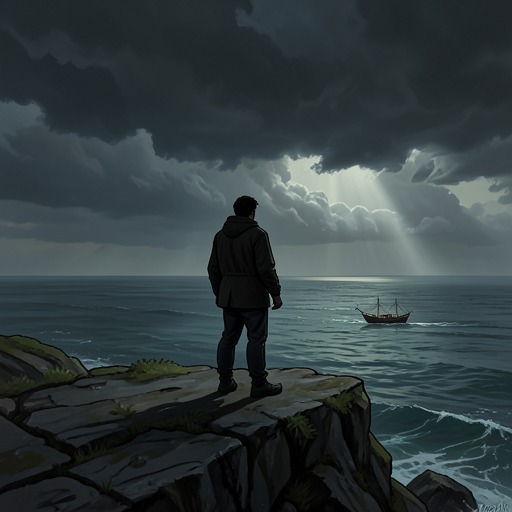
Silence and Solitude
The LighthouseSilence and Solitude is the defining promise of Combe Island: visitors come to be left alone, and the island’s daily arrangements are shaped around that desire. It is at once a purchased privilege, a practical form of security, and a means of emotional distance. The promise feels almost complete in the island’s night landscape and in the quiet routines of its cottages, but murder and the prospect of publicity reveal that solitude is never wholly beyond interruption.
The Island as a Place Apart
The island’s silence first takes visible form in Kate Miskin and Benton-Smith’s walk to Seal Cottage. They cross the headland without speaking, while the lit windows of the great house and the distant cottage lights seem only to intensify the quiet around them. After sunset, the mildness of summer gives way to the first chill of autumn. Stars make the darkness luminous enough for Kate to see the narrow path as a faint ribbon, its individual blades of grass glittering in the light. The scene makes solitude more than an absence of conversation: it is an enveloping condition in which darkness, distance, and small points of light sharpen perception.
At Seal Cottage, that remote landscape meets a carefully modest form of hospitality. Adam Dalgliesh has lit a fire; kindling crackles, wine and coffee are ready, and the cottage door stands open to the night. For Kate, the quiet review of the investigation is also a rare approach to domestic ease. The hour recalls a kind of family life she had not known as a child, and its comfort lies partly in its lack of threat or demand. The scene thus gives solitude two apparently opposed meanings: separation from ordinary social life, and the possibility of feeling safe in another person’s company without having to fill the silence.
A Deliberately Protected Privacy
The island’s privacy is maintained not merely by its remoteness but by custom. Staff are not encouraged to speak to visitors unless visitors want conversation; the practice is not presented as unfriendliness or snobbery, but as respect for guests who have come to be alone. Visitors generally arrange their own breakfasts and midday meals in cottages equipped with refrigerators and microwaves. Dan Padgett delivers supplies the night before, including eggs from the island’s hens, bread baked by a staff member, bacon, and provisions for lunch. A communal dinner is available at eight, but attendance is optional. These routines give privacy a practical structure: solitude does not require self-sufficiency, because assistance is provided in ways designed to minimize contact.
The exception of a visiting prime minister shows how security can complicate, rather than cancel, that arrangement. The visitor brought protection officers, who had to remain behind for him to be permitted to come to the island. He spent much of his stay watching a staff member work at a table, and once helped whisk eggs when invited. The anecdote suggests that solitude is not absolute isolation; small, unforced exchanges can occur within its boundaries. For other guests, however, security is part of the attraction. Kate describes the appeal of sleeping with doors and windows open without a guard or police officer watching, against a background of terrorism and kidnapping threats. When Adam asks whether Nathan Oliver’s death will destroy that sense of safety, she doubts it: the island, she says, has survived worse horrors. Her confidence makes the refuge seem durable, but the murder has already exposed the difference between feeling secure and being invulnerable.
Silence Under Investigation
The investigative team’s own working habits draw on the island’s quiet while giving it a different purpose. Kate values the late-day meetings when progress is assessed and plans are made. In the cottage, silence is not an obstacle to work but part of its rhythm: conversation can pause without making the gathering uncomfortable. For her, this measured companionship approaches the domestic steadiness she imagines family life to contain. The island’s customary quiet therefore does not mean that people must be emotionally alone; it can provide space for attention and trust.
For Adam, however, silence also marks the boundary between professional and intimate life. One calm Sunday morning, after breakfast in the stone-built cottage, he stands looking east, toward Emma. He longs to hear her voice but knows she will not phone while he is working, and he decides not to call her. Their unspoken understanding preserves his concentration and recognizes their separate working lives. Yet the distance is not uncomplicated: Adam wonders whether Emma understands that his work as a detective enters the painful, private lives of others, and that this material also feeds his poetry. The solitude that enables his work thus carries an ethical and personal tension. He guards his own privacy while his profession requires him to cross the privacy of both living people and the dead.
The Limits of the Refuge
The murder investigation brings a public crisis to an island organized around discretion. When the island accepts voluntary SARS quarantine, Dr. Staveley explains the symptoms residents should report and says that he and his wife are caring for Adam, who may later need to be transferred to Plymouth. At the same meeting, the murder of Adrian Boyde remains under the responsibility of Kate and Benton-Smith. Medical isolation and police work now share the island’s limited space: staying apart has become not only a chosen visitor’s preference but also a public-health measure.
Rupert Maycroft anticipates a further breach. The SARS news is expected to reach radio and television bulletins, and he warns that it will mean the end of the island’s privacy. The phone numbers are unlisted, but that cannot ensure they remain unknown; New Scotland Yard is handling publicity about the murders, and press attention is expected despite efforts to limit disruption. The inquest into Nathan Oliver’s death has been postponed and is likely to be adjourned, while newspapers and supplies are to be delivered by helicopter. The helicopter pad will be made unusable except for known air-ambulance arrivals and deliveries, although other helicopters may still circle overhead. These measures preserve a degree of separation without restoring the old silence. Across the island’s routines, investigation, quarantine, and publicity, solitude emerges as something actively protected—and vulnerable precisely because other people, urgent responsibilities, and public events can always cross its boundaries.