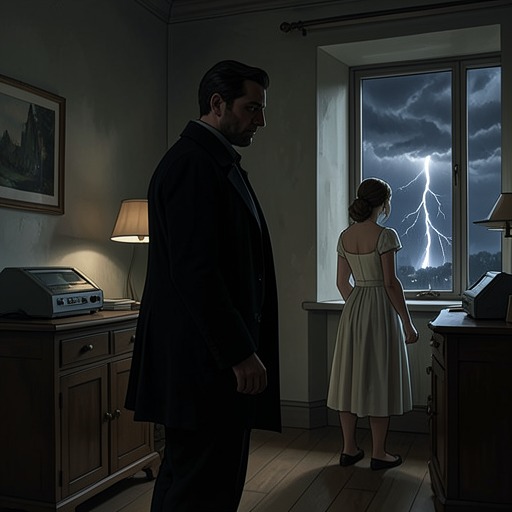
The conflict between professional duty and private life
The LighthouseThe conflict between professional duty and private life is a recurring pressure in the novel, not a problem solved by choosing one side. Work calls Adam Dalgliesh away from Emma Lavenham just as their relationship approaches a decision about marriage; Mark Yelland seeks refuge from a dangerous career, only to find that its costs have reached his family; and the investigation on Combe Island increasingly entangles police work with forensic judgment, medical care, and public health. These strands make vocation both a source of purpose and a claim on time, safety, and intimacy that private affection cannot simply cancel.
Duty, vocation, and the interrupted weekend
Dalgliesh receives the summons after a month of sixteen-hour days, when he had expected to spend two days with Emma. He recognizes that he is not compelled to take every possible murder investigation, even one whose victim is politically or socially important, and that senior officers would rather see him concentrate on larger institutional challenges: policing a multiracial society, drugs, terrorism, international crime, and a proposed national detective force. Yet those responsibilities carry their own danger. He fears becoming a bureaucrat occupied by committees, advice, and coordination rather than a detective. He also wonders whether leaving murder investigations behind would mean losing part of the ground from which his poetry grows: the gradual uncovering of truth, shared exertion, danger, and the broken lives encountered in the work.
The practical response to the summons is immediate. Dalgliesh arranges for Kate Miskin and Francis Benton-Smith to join him, cancels meetings, secures papers, and alerts the public-relations branch. His emergency bag is at his flat in Queenhithe, so he welcomes the need to stop there, but the departure still turns a planned private weekend into another absence. He has not phoned Emma from New Scotland Yard before; he expects that she will recognize what his voice means and make arrangements without him. The possibility that she may exclude him from her thoughts as he is excluded from her company gives the interruption an emotional cost beyond lost leisure.
The novel places this recurring disruption beside the relationship’s considerable intimacy. Dalgliesh and Emma have built concentrated happiness from carefully arranged meetings in their separate, overfull lives: shared meals, cultural outings, conversations, silences, and time together at his flat. His first declaration of love came in a letter, and he believes Emma accepted his proposal of marriage, but they have not discussed a date. His reluctance to raise the subject leaves him imagining that she might prefer their existing arrangement, while he questions whether asking for a legal commitment would be an attempt to bind her. Professional interruption thus aggravates an uncertainty neither work nor affection has resolved: they love one another, but have yet to establish what living together will mean.
The detective’s private cost and Kate Miskin’s response
The summons also reaches Kate Miskin at a moment of personal intimacy. After breakfast with Piers Tarrant, she watches him leave and turns her attention to the work beginning that morning. She imagines the body awaiting the police, the people who will be distressed or apprehensive, and the investigation’s later gathering, when she, Dalgliesh, and Francis Benton-Smith will test clues against one another. She admits to herself a small shame at feeling excitement and resolve in anticipation of an inquiry that requires someone’s death. The shame is sharpened by the recognition that its clues are not abstract puzzle pieces but fragments of broken lives.
This transition does not make Kate’s private concerns unreal; it shows how quickly the habits of the job claim attention. The working day begins as she waits with her bag, and her thoughts about the possible case displace reflection on the night she has just spent with Piers. Dalgliesh, for his part, worries whether Kate and Benton-Smith can work effectively together after Piers has left. He expects professional respect and cooperation rather than personal liking, trusting Kate’s intelligence to prevent open antagonism from damaging the investigation. The team’s competence is therefore presented as a working relationship that must be maintained even as personal attachments change around it.
Mark Yelland’s retreat and the reach of danger
Mark Yelland’s third visit to Combe Island initially appears to offer a different answer to the demands of work. He chooses Murrelet Cottage, whose quiet and relative isolation allow him to set aside the anxieties of his dangerous professional life. On earlier visits he spent two weeks without speaking to anyone, receiving food according to written instructions and avoiding the formal evening meal. Solitude, which he had feared might be painful, instead becomes liberating and healing; he returns to his work and relationships changed in ways he cannot explain.
That refuge is conditional. Home Office rules require a Licence Holder or deputy Licence Holder to be in the laboratory or on call, so Yelland leaves an experienced deputy in charge and expects to be contacted only in an extreme emergency. His professional responsibilities can be delegated, but his family’s exposure to danger cannot be set aside so easily. Soon after arriving, he finds a letter from Monica between the top books he has unpacked. She writes that she is ending their marriage and will take Sophie and Henry to live with her mother. A local school is ready to accept the children, and she emphasizes that she needs them to be safe. She says she has lived in terror for herself and for them, and that she will no longer sacrifice them to Yelland’s work.
Yelland is first surprised by how calmly he receives the decision, and by the preparations he had failed to notice: Monica and her mother have planned the move, found a school, and prepared the children. His regret is stronger for losing daily life with Sophie and Henry than for the end of the marriage. But the letter’s timing, arriving during what was meant to be his holiday, becomes a further injury. His anger grows as his peace collapses. The contrast with Dalgliesh is pointed: both men experience work as a powerful claim on private life, but in Yelland’s case the danger associated with his profession is the reason his wife gives for removing the children from it.
Professional boundaries and the authority of evidence
The investigation also examines duty within professions: not only whether people work, but what standards define responsible work. Edith Glenister, a highly regarded forensic pathologist, is known for careful assessments of time of death, comprehensive reports, clear court evidence, and a firm distinction between the pathologist’s role and the investigating officer’s. She insists on examining a body without first hearing the circumstances of the murder, limiting the risk that an investigative theory will shape her conclusions. Dalgliesh is intrigued by the prospect of working with her, even though he would have preferred his usual pathologist. Her independence is not a refusal to assist the police; it is a professional safeguard on which the investigation depends.
At the lighthouse, Glenister determines that the ligature mark does not establish death by hanging. The bruising on the neck, including distinct marks consistent with fingers, supports strangulation, and her examination distinguishes the fatal assault from the later hanging. She identifies a patterned surface mark that could come from a climbing rope. Her conclusions give the inquiry a decisive correction: the apparent hanging is not the cause of death but a staging after death. When Dalgliesh asks about recovering fingerprints from skin, she explains the limits of the method, the difficulty of obtaining usable ridge detail from the neck, and the contamination risks in attempting DNA analysis from bruised areas. Professional duty here means stating what the evidence can and cannot establish, rather than promising certainty the science cannot provide.
Other institutional demands likewise shape the work. Rupert Maycroft asks Guy Staveley to be present during his interview, partly to protect himself by ensuring there is a witness. Dalgliesh sees no valid reason to object. The scene shows how formal procedure and personal caution can coexist: the officer must obtain information, while the interviewee is alert to the consequences of what is said. The investigation is not conducted outside social and professional interests; its reliability depends on recognizing them and keeping the boundaries of each role visible.
Quarantine, divided responsibilities, and consequence
The later SARS crisis makes the conflict between professional obligations and private safety collective. When Raimund Speidel is confirmed to have SARS and is being treated in an isolation unit in Plymouth, Guy Staveley tells the residents that Dalgliesh has also contracted the infection and is in a sickroom on Combe Island. Staveley explains the known risks of close contact and recommends that the island’s residents accept voluntary quarantine for about ten days. The restriction asks them to give up trips to the mainland, but he frames Combe as their home rather than a place from which they have been exiled. Medical responsibility here requires explaining uncertainty as well as risk, and persuading the community to accept a protective measure before the authorities decide whether to enforce it.
For Kate and Francis Benton-Smith, quarantine does not suspend the murder inquiry. Kate reports that the two detectives do not yet know whether they are infected, while Assistant Commissioner Harkness insists that the double murders remain the police priority. He suggests technical assistance from the local force, subject to Home Office authorization and precautions to keep scene-of-crime officers and fingerprint personnel away from infected people. He assigns Kate and Benton-Smith to continue for at least three days, then reassess. His response exposes the competing jurisdictions plainly: infection control is not his department’s concern, but the investigation still has to work within the danger infection creates. Dalgliesh’s illness makes that tension personal as well as institutional.
Across these episodes, duty is neither a simple virtue nor a convenient excuse. It gives Dalgliesh a form of purpose he fears losing to administration, yet repeatedly delays the life he hopes to build with Emma. It gives Yelland work he is unwilling to abandon, while Monica judges that the resulting danger is incompatible with the children’s safety. It gives the detectives and specialists responsibilities that cannot be met by ignoring evidence, uncertainty, or infection. The novel’s recurring interruption is therefore consequential: professional work may sustain identity and protect others, but it also consumes shared time and carries risks into the very private lives its practitioners would like to keep apart.