Truth and Secrecy
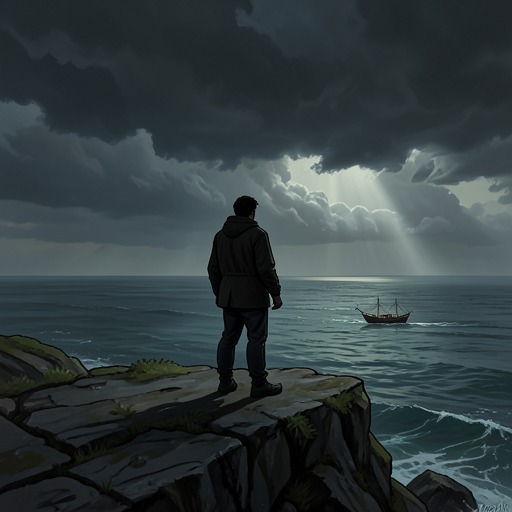
The LighthouseTruth and Secrecy is a central tension in the investigation on Combe Island: private histories and confidences shape what people will reveal, while the murder of Nathan Oliver makes complete privacy impossible. The novel tests the difference between a person’s claim to protect another and a detective’s duty to establish what happened. Its answers arrive unevenly: a witness may know only part of a story, memory may remain uncertain, and physical evidence can settle a question that testimony cannot.
Privacy Under Investigation
When a woman challenges Dalgliesh for pressing Adrian Boyde about the past, she argues that he has no serious reason to treat her friend as a suspect and accuses him of digging up private suffering for the power it gives him. Her appeal invokes the uncertainty of truth itself, but Dalgliesh answers in terms of what murder does to other people’s privacy. The crime exposes not only suspects and the victim’s family but everyone drawn into the death; above all, it removes Nathan Oliver’s own privacy, since he is beyond anyone’s protection. The investigation cannot promise to leave Adrian alone merely in exchange for a disclosure. Dalgliesh says only that knowing the facts will help him question Adrian without causing unnecessary distress.
That exchange makes confidentiality a limit to be respected, but not an absolute shield. The woman ultimately agrees to tell Dalgliesh what she knows while warning that she cannot give him the whole truth. Her distinction is important: a witness can disclose an honest account without claiming complete knowledge. The conversation also leaves the cost of investigation unsettled. Dalgliesh denies that his work is intended to cause pain, but the woman’s challenge registers the unavoidable pressure placed on people whose private lives become relevant to a murder inquiry.
Notes, Appointments, and Forensic Findings
The investigation depends on small disclosures as well as dramatic revelations. Dr. Speidel tells Dalgliesh that he had arranged to meet Nathan Oliver at the lighthouse at eight in the morning. Fever delayed his departure; he reached the locked door at six minutes past eight after walking along an under-cliff path, hoping not to be seen. This account supplies a precise encounter time and explains why Speidel went to that secluded place, but it does not by itself establish what happened to Oliver.
The appointment’s communication has its own compromised history. Millie Tranter first maintains that Speidel had not told her the note was urgent and points out that the meeting was not until eight the next morning. Pressed on whether she read the open note, she admits that she did. Her explanation—that an open note invited reading—does not erase the fact that she knew its contents. The scene shows how a seemingly minor choice about information can enter the reconstruction of a larger event: what was written, who saw it, and when it could have been delivered all bear on the timeline.
Forensic examination provides a different kind of truth, one that narrows uncertainty without pretending to explain motive. Edith Glenister initially estimates that Oliver died between half past seven and nine in the morning, probably nearer the earlier time, from the state of rigor. The marks on his neck suggest strangulation rather than death by hanging: distinct bruises on the left side are consistent with fingers, while the rope mark has a patterned surface unlike an ordinary rope. Later, Glenister reports that the autopsy confirms death by asphyxia caused by manual strangulation and that hanging came afterward. She also identifies a fracture caused by pressure to the neck and a bruise at the back of the head. An attempt had been made to wipe the rope along its length. The distinction between the initial estimate and the later findings illustrates how provisional observations become more definite as evidence accumulates.
The Island’s Buried History
A separate disclosure reaches back to the Second World War. Emily Holcombe recounts that on the night of October 10, three Germans from the occupied Channel Islands landed on Combe. They later climbed the disused lighthouse, where Saul Oliver set fire to dry straw stored on the ground floor. The flames and smoke trapped the men in the tower; all three probably suffocated. Saul carried their bodies to their boat and scuttled it in deep water. He kept a revolver, binoculars, and a compass as trophies. For years these objects were the only evidence Emily knew of, and the men were presumed drowned. Dr. Speidel’s arrival provides the first confirmation of the story beyond those souvenirs.
Even this account does not resolve every question. Saul told Emily that Jago Tamlyn had set the straw alight as a boy, playing with matches, and that he had seen him do it. Jago denied being near the lighthouse. Emily believed Saul at the time but later became unsure. She considers revenge against a child implausible for Speidel, and notes that Jago’s open dislike of Nathan Oliver does not establish that he killed him. The old story explains why Speidel sought Oliver at the lighthouse, but Emily insists that its connection to Oliver’s death is not thereby proved. The narrative keeps the distinction between a story’s relevance and its evidentiary force in view.
Secrecy as Island Custom
The history has remained largely private. Emily says that Nathan Oliver’s father told him nothing about the wartime events, and that Nathan did not speak about his island childhood until seven years before the investigation. He had begun using a clause in the Trust deed that allowed him to visit whenever he wished. The island’s convention was that visitors did not reveal its existence, a practice Nathan observed until an April 2003 interview with a Sunday broadsheet journalist was picked up by the tabloid press. Though the coverage made little of the island, it breached confidence and further irritated residents.
The island’s secrecy is therefore both custom and a source of friction. It protects a place whose history includes violence and whose residents value privacy, but it also leaves knowledge concentrated among a few people. The disclosure of the wartime account does not make every islander informed: Emily says that no one else knows unless Jago has spoken, which she doubts. A secret can be shared selectively, withheld even from those it concerns, and then revealed decades later without becoming a complete or uncontested account.
Material Evidence and the Limits of Disclosure
The search of a tub of butter in a refrigerator turns concealment into tangible evidence. Kate Miskin scrapes away the top layer and finds foil beneath it, containing two small packages: a phial labeled with Oliver’s name and the date, and a hair sample wrapped in tissue paper. Francis Benton-Smith photographs the discovery; Kate seals the items in an exhibit bag, and both officers sign the label. The hidden samples give the investigation something more stable than recollection: the handwritten identification can be checked, and the objects are documented as they are recovered.
Across these episodes, truth does not arrive as one final confession. It is built by comparing a timed appointment with a locked door, revising an estimate through autopsy findings, weighing an old accusation against uncertain memory, and preserving objects that someone concealed. Secrecy can delay that process and expose people to distress; it can also mark the boundary between what a witness knows and what the evidence can establish. The novel’s investigation presses past silence, but it does not treat disclosure alone as proof.