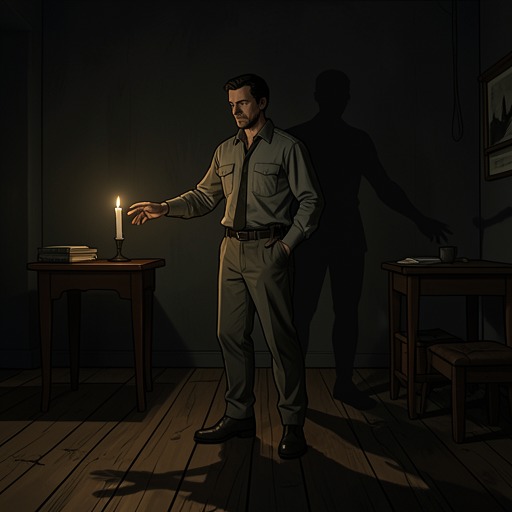
We can be our own executioner
The Lighthouse“We can be our own executioner” is Nathan Oliver’s stark description of the agency people may lose to Alzheimer’s disease. Spoken to Millie during a conversation about her grandmother, the phrase turns a discussion of memory loss into a reflection on the power to govern one’s own life.
Meaning and Context
Millie recalls telling Oliver about her grandmother’s Alzheimer’s. He responds that old people dread the disease because it takes away what he calls the greatest power human beings have, a power comparable to that of a tyrant or a god. His closing phrase casts that power as the capacity to act upon oneself: its loss is not simply forgetfulness, but a threat to self-determination.
Place in the Conversation
The phrase occurs in an exchange that also reveals Oliver’s unhappiness. Asked whether she was happy, Millie describes herself as all right except when particular losses and frustrations trouble her; Oliver says that, for him, unhappiness is the more usual condition. His words connect the fear of Alzheimer’s to the broader vulnerability of being human, without suggesting that the disease is a deliberate act of self-harm.
Narrative Significance
Millie recounts the conversation while answering questions about Oliver after his death. Her account gives the investigators a glimpse of the intimacy of their talks, but her response makes clear that she experiences the questioning as pressure: she says she liked him, calls him her friend, and insists that she is the only one who cares that he is dead. The phrase therefore belongs both to Oliver’s bleak meditation on lost agency and to Millie’s effort to make his private humanity heard.