The Resurrection of Aslan
The Lion, the Witch and the WardrobeThe Resurrection of Aslan is the hinge on which the entire story turns, the moment when the deepest magic of Narnia—unknown even to the White Witch—reverses the apparent triumph of evil and restores life from sacrificial death. After the Witch's followers had bound, shaved, mocked, and killed Aslan on the Stone Table, and after Susan and Lucy Pevensie had spent a night of utter desolation watching over his dead body, the dawn brought a transformation that shattered both the stone and the logic of the world they thought they understood.
The Night of Despair and the Dawn of Change
Susan and Lucy, having followed Aslan in secret to the Hill of the Stone Table, witnessed his humiliation and murder from a hiding place among the bushes. After the Witch's rabble departed, the two girls crept out onto the open hilltop. The moon was low, thin clouds passed across her, and they could see the shape of the great Lion lying dead in his bonds. They knelt in the wet grass, kissed his cold face, stroked his beautiful fur—what was left of it—and cried until they could cry no more. They managed to remove the muzzle from his face, but the cords had been drawn so tight by the enemies' spite that the girls could not untie the knots. Hours passed in a dead calm; they hardly noticed they were growing colder and colder. Then, as the sky on the eastern side of the hill began to lighten, Lucy noticed tiny movements in the grass at her feet. Dozens, then hundreds, of little field mice crept onto the Stone Table and began nibbling away at the ropes. One by one, the cords were all gnawed through. The girls cleared away the remains, and Aslan's dead face looked nobler as the growing light allowed them to see it better. The sky turned red, the sea showed pale at the end of the world, and very slowly the edge of the sun came up over the horizon.
The Breaking of the Stone Table and the Return of the Lion
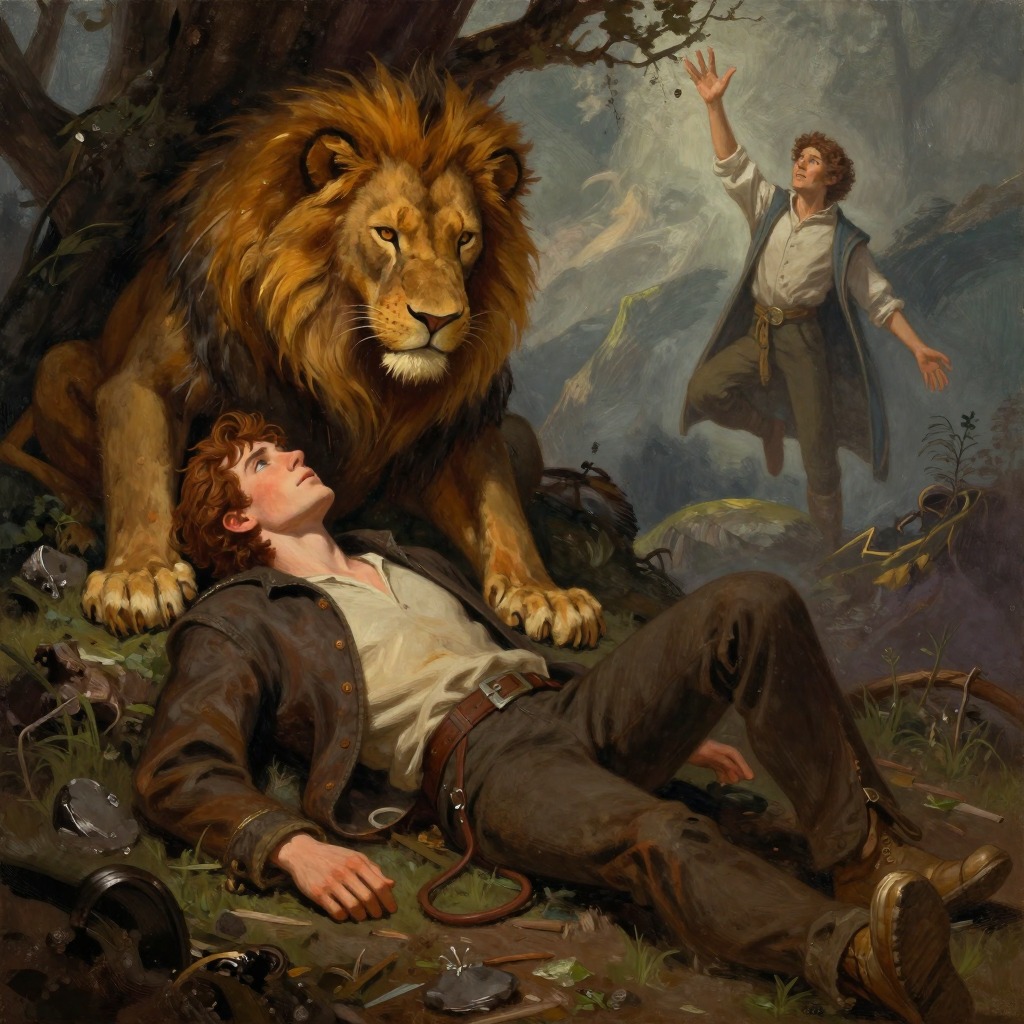
At the very moment the sun's edge appeared, the girls heard from behind them a loud noise—a great cracking, deafening sound as if a giant had broken a giant's plate. They turned, afraid, and saw that the Stone Table was broken into two pieces by a great crack that ran down it from end to end; and there was no Aslan. Then a great voice spoke behind their backs: "Yes! It is more magic." They looked round. There, shining in the sunrise, larger than they had seen him before, shaking his mane (for it had apparently grown again), stood Aslan himself. Lucy cried out, "Aren't you dead then, dear Aslan?" and he answered, "Not now." When Susan asked in a shaky voice if he was a ghost, Aslan stooped his golden head and licked her forehead; the warmth of his breath and a rich sort of smell that seemed to hang about his hair came all over her. "Do I look it?" he said. Both girls flung themselves upon him and covered him with kisses.
The Deeper Magic Explained
Aslan explained the meaning of his resurrection to the astonished girls. The Witch, he said, knew the Deep Magic that the Emperor-Beyond-the-Sea had put into Narnia at the very beginning—the law that every traitor belonged to her as lawful prey and that for every treachery she had a right to a kill. But there was a magic deeper still which she did not know. Her knowledge went back only to the dawn of Time. If she could have looked a little further back, into the stillness and the darkness before Time dawned, she would have read a different incantation. She would have known that when a willing victim who had committed no treachery was killed in a traitor's stead, the Table would crack and Death itself would start working backwards. This Deeper Magic, older than the Witch's law, transformed the meaning of the sacrifice: Aslan had died not for his own treachery—he had committed none—but in place of Edmund, who was a traitor. Because Aslan was innocent and gave himself willingly, death could not hold him, and the Stone Table, the symbol of the old law, was shattered.
The Joyful Romp and the Renewal of Strength
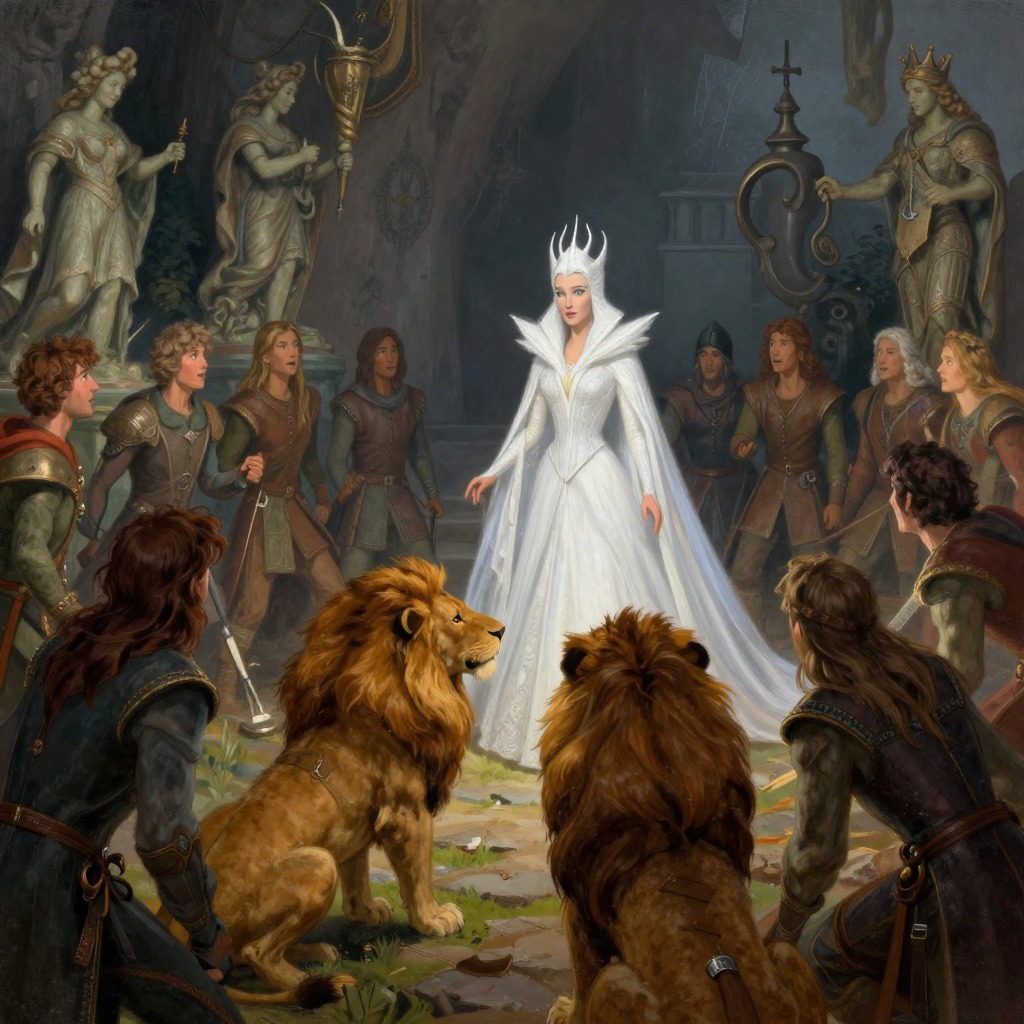
After the explanation, Aslan's mood shifted from solemn revelation to exuberant life. He stood for a second, his eyes very bright, his limbs quivering, lashing himself with his tail. Then he made a leap high over the girls' heads and landed on the other side of the Table. A mad chase began. Round and round the hilltop he led them, now hopelessly out of their reach, now letting them almost catch his tail, now diving between them, now tossing them in the air with his huge and beautifully velveted paws and catching them again, and now stopping unexpectedly so that all three of them rolled over together in a happy laughing heap of fur and arms and legs. Lucy could never decide whether it was more like playing with a thunderstorm or playing with a kitten. When all three finally lay together panting in the sun, the girls no longer felt in the least tired or hungry or thirsty. Aslan then announced that he felt his strength coming back and that he was going to roar. He told the girls to put their fingers in their ears. When he opened his mouth to roar, his face became so terrible that they did not dare to look at it, and all the trees in front of him bent before the blast of his roaring as grass bends in a meadow before the wind. He then told them they had a long journey to go and that they must ride on him. They climbed onto his warm, golden back, and with a great heave he shot off, faster than any horse could go, downhill and into the thick of the forest, heading directly for the White Witch's castle to liberate the stone statues and join the battle.
Narrative and Thematic Significance
The Resurrection of Aslan is the story's central reversal, transforming the apparent defeat of good into an unassailable victory. It is the moment when the narrative's deepest theological and moral logic is revealed: self-sacrificial love, freely given by an innocent, breaks the power of death and the legalistic claim of the Witch. The event also completes the arc of Edmund's redemption, for Aslan's death was accepted in his place, and his resurrection ensures that Edmund's life is not merely spared but fully restored. The breaking of the Stone Table symbolizes the end of the old order of retributive justice and the inauguration of a new order based on grace and deeper magic. For Susan and Lucy, the experience moves from utter despair to bewildered joy, and their witness to both the death and the resurrection makes them the first to understand the full scope of what has happened. The resurrection also empowers Aslan to complete his work: he roars with renewed strength, rides to the Witch's castle, breathes life back into her stone victims, and leads the final charge that destroys her forever. The event thus functions as both the climax of the spiritual drama and the necessary precondition for the military victory that follows.