The White Stag
The Lion, the Witch and the WardrobeThe White Stag is a legendary creature in Narnia, a milk-white stag whose capture is said to grant wishes. It appears at two crucial structural moments in the Pevensies' story: first as a promise of wonder that lures Lucy Pevensie deeper into the magical wood, and finally as the quarry of a royal hunt that leads the now-grown Kings and Queens back through the wardrobe to their childhood. More than a mere animal, the Stag functions as a threshold figure, opening and closing the entire Narnian adventure.
Role in Narnian Lore and the First Journey
The White Stag is introduced early in the narrative as part of the Faun Tumnus's enchanting tales of forest life. Tumnus tells Lucy about "long hunting parties after the milk-white Stag who could give you wishes if you caught him." This description places the Stag within the realm of Narnian myth and desire, a prize that promises to fulfill the deepest longings of whoever captures it. The Stag is thus established as a symbol of ultimate quest and magical reward, a creature that embodies the very possibility of wish-fulfillment in this enchanted land.
The Final Hunt and Return to the Wardrobe
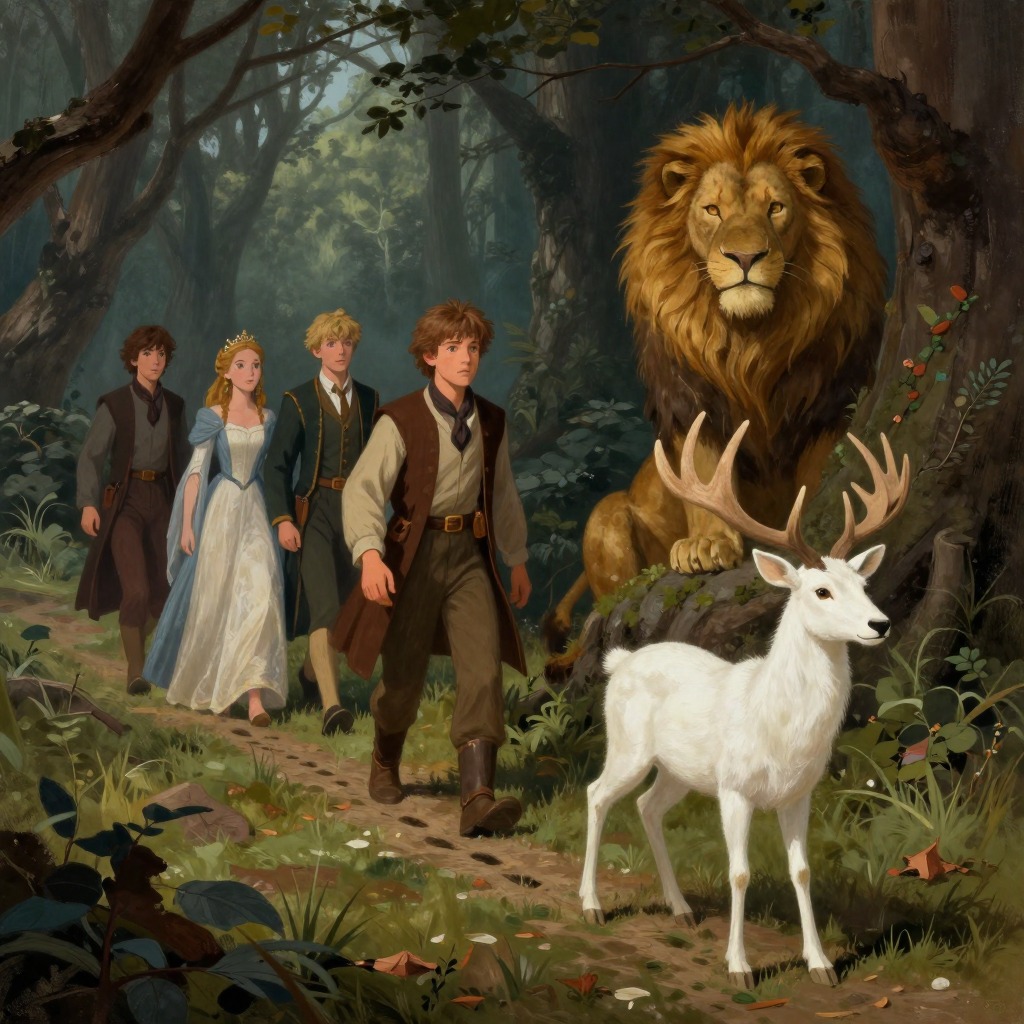
Years later, after the Pevensies have reigned as the four monarchs of Narnia, the now middle-aged Tumnus brings them news that the White Stag has reappeared in the Western Woods. The Kings and Queens, with their court, ride out to hunt it. The Stag leads them on a strenuous chase through rough and smooth terrain until only the four sovereigns remain, their courtiers' horses exhausted. The Stag enters a thicket where the horses cannot follow, prompting King Peter to declare, "Fair Consorts, let us now alight from our horses and follow this beast into the thicket; for in all my days I never hunted a nobler quarry." The others agree, and they proceed on foot.
The Lamp-post and the Threshold
As they push deeper into the thicket, Queen Susan first notices a "tree of iron," which King Edmund corrects as a "pillar of iron with a lantern set on the top thereof." They recognize it as the Lamp-post, the very boundary marker between Narnia and the wardrobe. A strange foreboding falls upon them all. Queen Lucy voices the feeling that passing it will lead either to "strange adventures or else some great change of our fortunes." Queen Susan proposes turning back, but King Peter insists they never abandon a quest, and King Edmund declares he would not turn back "for the richest jewel in all Narnia and all the islands." Queen Susan finally yields, saying, "Then in the name of Aslan, if ye will all have it so, let us go on and take the adventure that shall fall to us." Within a few paces, they find themselves pushing through coats instead of branches, and they tumble out of the wardrobe into the spare room, no longer Kings and Queens but simply Peter, Susan, Edmund, and Lucy in their old clothes, having returned to the exact moment they left.
Thematic Significance: The Wish That Ends a Reign
The White Stag's hunt is the final adventure of the Pevensies' first sojourn in Narnia. It is a quest they undertake as mature rulers, speaking in the formal language of their kingship, and it leads them not to a wish but to the end of their reign. The Stag, a creature of wish-granting, paradoxically brings about the loss of their kingdom. Yet the Professor later assures them that they will return to Narnia, reinforcing Aslan's declaration that "once a king or queen in Narnia, always a king or queen." The Stag thus embodies the bittersweet nature of their adventure: the pursuit of a wish leads to a profound change, but the identity forged in Narnia remains permanent. The creature's role as a threshold figure—first opening the world of wonder and then closing the chapter of their reign—makes it a powerful symbol of the cyclical, quest-driven nature of the Narnian experience.