White Witch's Petrifying Power
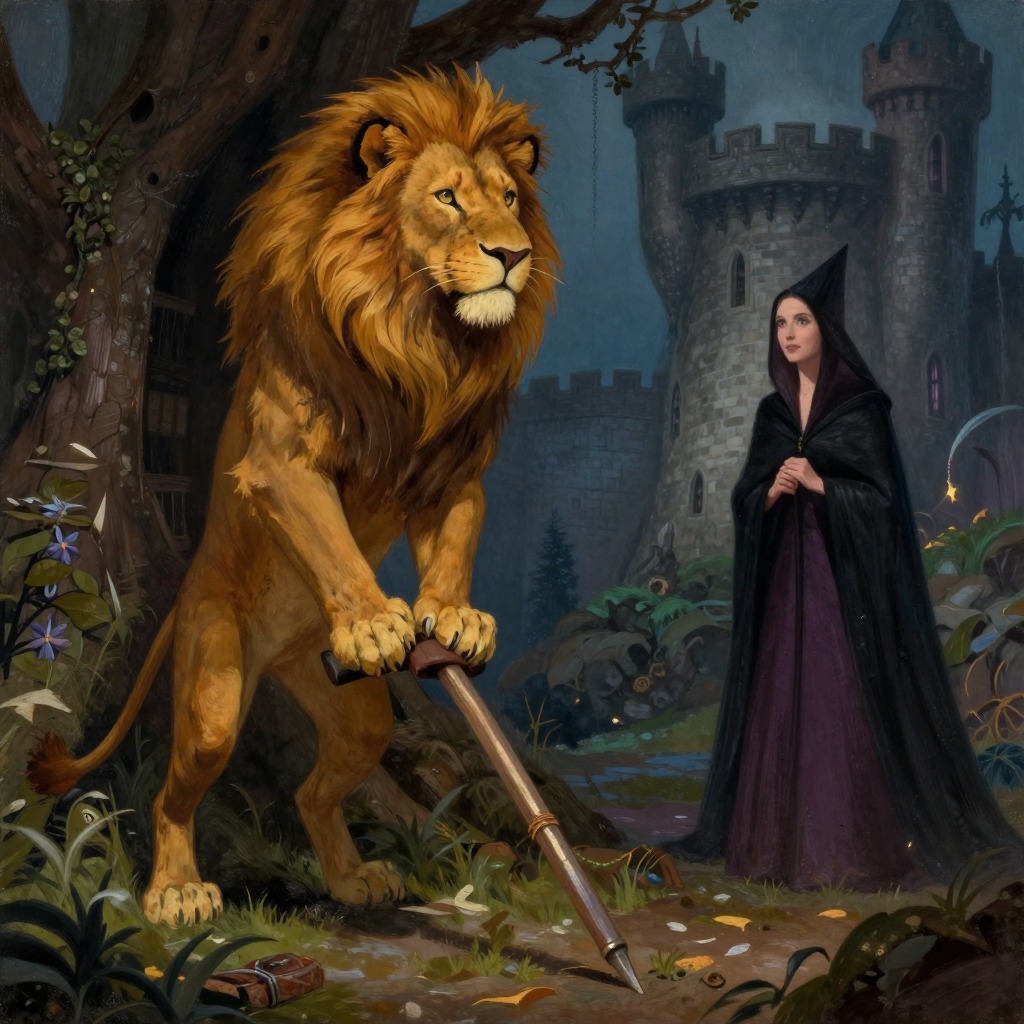
The Lion, the Witch and the WardrobeThe White Witch's Petrifying Power is the defining instrument of her tyranny over Narnia, a magic that transforms living creatures into cold, lifeless stone statues, leaving them as permanent, silent monuments to her cruelty. This power is wielded through her wand, a long, straight golden rod that she carries as both a symbol of authority and a weapon of absolute control. The threat of petrification hangs over every creature in Narnia, enforcing obedience through the fear of being frozen forever in a moment of terror or despair.
Mechanism and Use
The White Witch's petrifying power is activated by a wave of her wand. When she raises it and directs it at a target, the victim is instantly turned to stone, becoming a statue that retains the exact posture and expression of the moment of transformation. This is demonstrated when she encounters a party of woodland creatures celebrating with food given by Father Christmas; in her rage, she waves her wand and instantly turns the entire merry group—a squirrel and his wife with their children, two satyrs, a dwarf, and an old dog-fox—into stone figures seated around a stone table, with a stone fork frozen halfway to a stone mouth and a stone plum pudding on the table. The transformation is instantaneous and irreversible by any means known to the Witch's enemies, leaving the victims as permanent, lifeless statues. The power is not limited to small creatures; the courtyard of the Witch's castle is filled with dozens of statues of all kinds, including satyrs, wolves, bears, foxes, cat-a-mountains, tree spirits, a centaur, a winged horse, a dragon, and a giant, all turned to stone by her wand. The Witch's own house is described as being "all full of statues" in the courtyard, up the stairs, and in the hall, a macabre collection of her victims.
The Threat of Petrification
The fear of being turned to stone is a constant, oppressive force in Narnia. Mr. Tumnus, the Faun, describes the fate that awaits him if he disobeys the Witch: she will "wave her wand over my beautiful cloven hoofs and turn them into horrid solid hoofs like a wretched horse's," and if she is especially angry, she will "turn me into stone and I shall be only a statue of a Faun in her horrible house." This threat is not an idle one; the Witch's castle is a gallery of her victims, a place where the petrified remain as a warning to all who might defy her. The power is so feared that even the mention of the Witch's name causes a shudder among the creatures of Narnia. The petrifying power is also used strategically in battle; during the final battle, the Witch uses her wand to turn Aslan's troops into stone "right and left," a tactic that nearly defeats the army before Edmund Pevensie smashes the wand with his sword, breaking the spell and ending the immediate threat of petrification.
Limitations and Countermeasures
While the petrifying power is devastating, it has limitations. The Witch's wand is the conduit for the magic; when Edmund shatters the wand during the battle, the power to turn creatures to stone is broken, and the Witch is forced to fight with her stone knife instead. Furthermore, the petrification is not permanent if countered by a greater magic. Aslan, after his resurrection, demonstrates the ability to reverse the petrification by breathing on the stone statues, restoring them to life. He breathes on a stone lion, a stone dwarf, a stone Dryad, a stone rabbit, two centaurs, and eventually the stone giant Rumblebuffin, and each is restored to living, breathing form. This reversal is described as a process where a "tiny streak of gold" runs along the marble surface, then spreads like a flame licking over paper, until the stone ripples into living hair and the creature comes back to life. The petrifying power, therefore, is a manifestation of the Witch's magic that can be undone by the deeper, older magic of Aslan, but for those without such power, the threat of being turned to stone is absolute and final.
Narrative Significance
The White Witch's Petrifying Power serves as the primary mechanism of terror and control in Narnia, embodying the cold, lifeless tyranny of her reign. It is a constant reminder of the stakes of the conflict: to oppose the Witch is to risk being frozen forever, a fate that befalls Mr. Tumnus and countless others. The power also creates a visual and thematic contrast between the Witch's static, deathly rule and Aslan's life-giving, restorative presence. The petrified statues in the Witch's courtyard are a museum of her cruelty, and their liberation by Aslan is a triumphant act of renewal that signals the end of her reign. The breaking of the wand by Edmund is a crucial turning point in the battle, demonstrating that the Witch's power, while formidable, is not invincible and can be overcome by courage and decisive action.