Stone Table
The Lion, the Witch and the WardrobeThe Stone Table is the ancient, grim altar at the heart of Narnia's prophecy and sacrifice. It is a great slab of grey stone supported on four upright stones, cut all over with strange lines and figures that might be the letters of an unknown language, and it stands on a green open hilltop from which one can see the forest spreading in every direction and, far to the east, the sea. It is the place where the White Witch demands the blood of traitors according to the Deep Magic from the Dawn of Time, and it is the site where Aslan gives himself in Edmund's place, only to be resurrected when a Deeper Magic from before the dawn of time breaks the Table itself. The Stone Table is thus the fulcrum of the story's moral and magical order: the point where the old law of death is fulfilled and the new law of life begins.
Location and Description
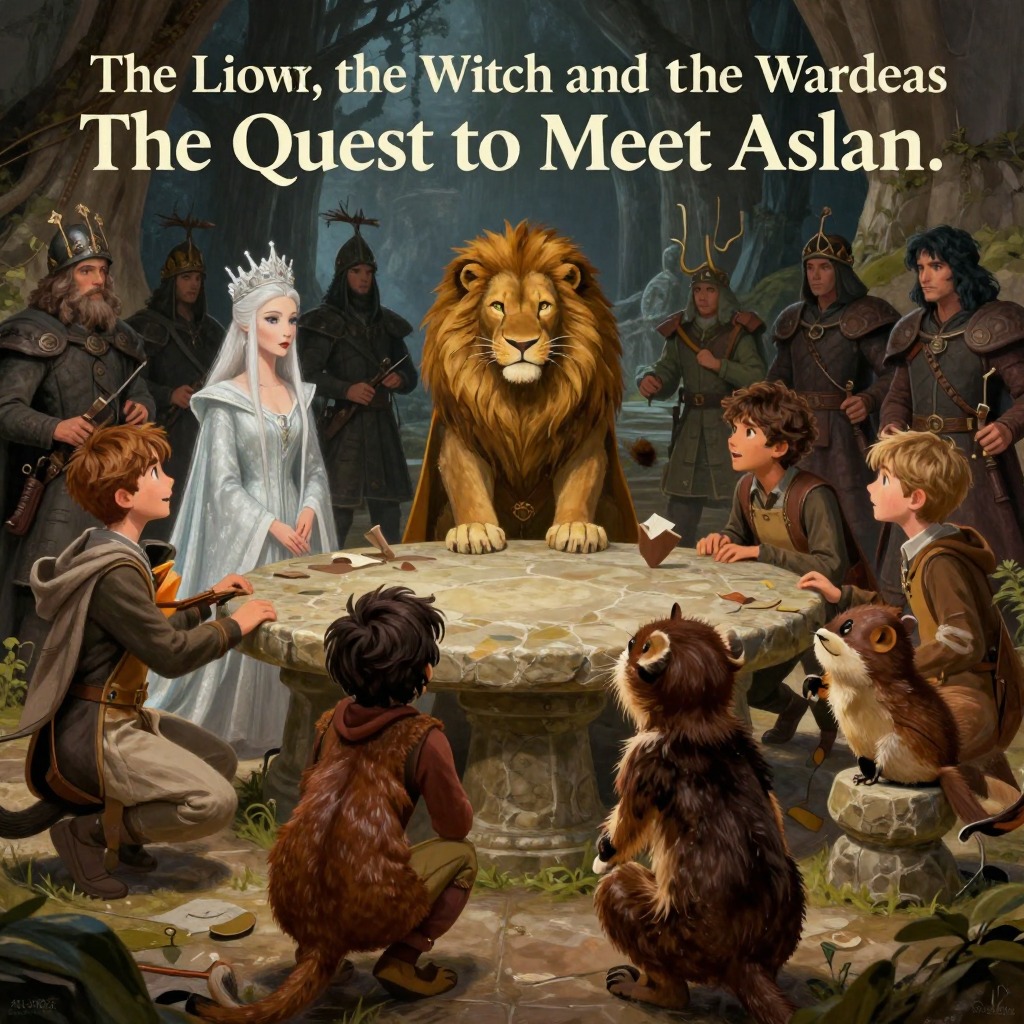
The Stone Table stands on a flat, open hilltop in the heart of Narnia, a place that commands a view of the forest spreading as far as one can see in every direction except ahead, where far to the east the sea is visible. The Table itself is a grim slab of grey stone supported on four upright stones, very old, and covered with strange lines and figures that might be the letters of an unknown language, giving a curious feeling to those who look at them. Beside it, a pavilion of yellow silk with crimson cords and ivory tent-pegs, flying a banner with a red rampant lion, is pitched when Aslan's camp arrives. The hilltop is the meeting place for Aslan and the children, and it is the destination toward which Mr. Beaver leads the party after Edmund's betrayal.
The Meeting with Aslan and the Witch's Claim
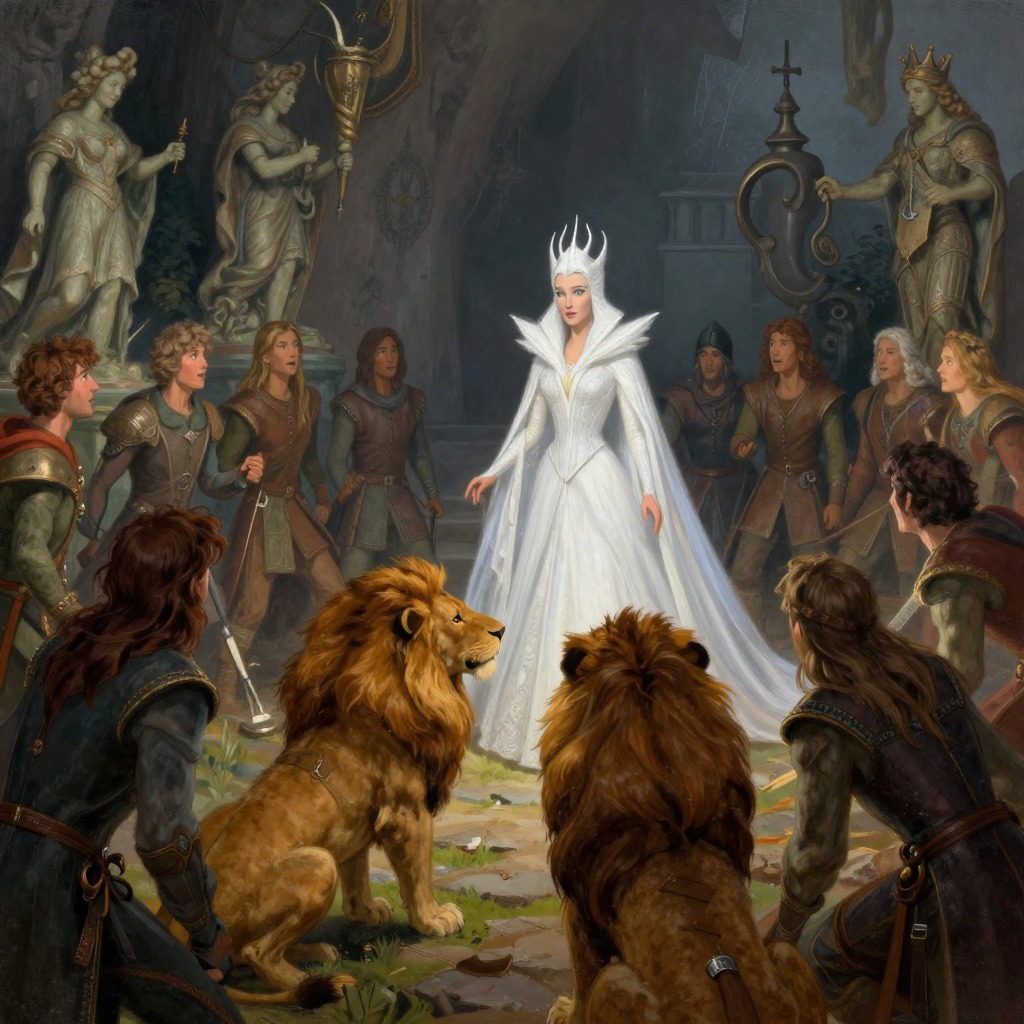
When the children and the Beavers first reach the Stone Table, they find Aslan standing in the centre of a half-moon of creatures, including Tree-Women, Well-Women, centaurs, a unicorn, a bull with the head of a man, a pelican, an eagle, a great dog, and two leopards carrying his crown and standard. It is here that Aslan welcomes Peter, Susan, Lucy, and the Beavers, and asks where the fourth child is. Mr. Beaver reports Edmund's betrayal, and Lucy asks if anything can be done to save him. Aslan replies, "All shall be done. But it may be harder than you think." Later, the White Witch herself comes to the Stone Table to claim Edmund as her lawful prey under the Deep Magic, which states that every traitor belongs to her and that she has a right to a kill. Aslan does not deny the law, and after a private conversation with the Witch, he announces that she has renounced her claim on Edmund's blood. The Witch departs with a look of fierce joy, but the reader soon learns that the renunciation was conditional on Aslan's own death.
The Sacrifice of Aslan
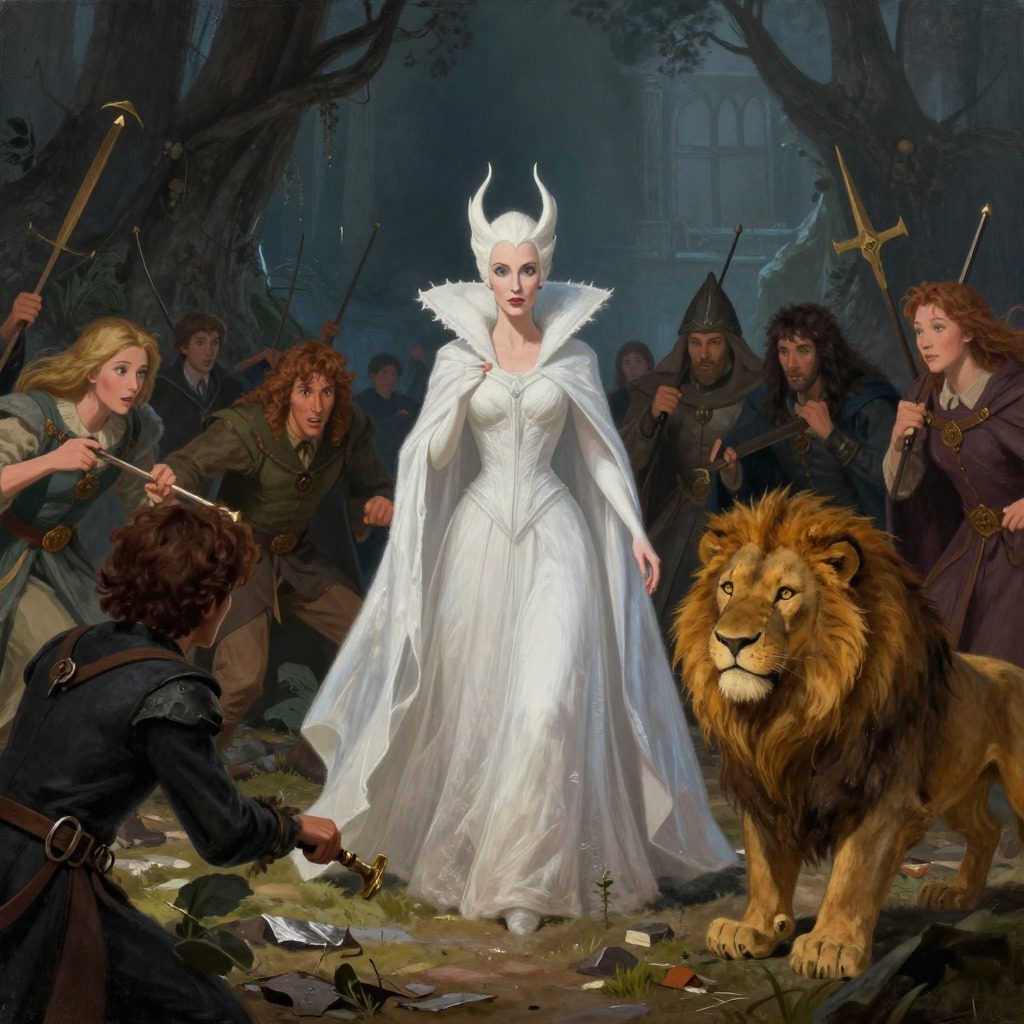
On the night after the meeting, Aslan walks slowly and sadly from the camp to the Stone Table, followed secretly by Susan and Lucy. He tells them they must stop at the last tree and not let themselves be seen. From their hiding place, the girls watch as a crowd of the Witch's followers—ogres, wolves, bull-headed men, spirits of evil trees, Cruels, Hags, Incubuses, Wraiths, Horrors, Efreets, Sprites, Orknies, Wooses, and Ettins—surround the Table. The Witch orders Aslan bound, and the hags, at first afraid, find he makes no resistance. They shave his mane, muzzle him, kick him, spit on him, and jeer at him, then drag him to the Stone Table and tie him with cords so tight they cut into his flesh. The Witch bares her arms, whets her stone knife, and, standing by Aslan's head, declares that she will kill him instead of Edmund, thus appeasing the Deep Magic, and that after his death nothing will prevent her from killing Edmund as well. The children cover their eyes and do not see the actual moment of the killing.
The Resurrection and the Broken Table
After the Witch and her followers leave, Susan and Lucy spend the night beside Aslan's dead body on the Stone Table. They remove his muzzle and try to untie him, but the knots are too tight. At dawn, hundreds of field mice creep onto the Table and gnaw through the ropes. As the sun rises, the girls hear a loud cracking noise, like a giant breaking a giant's plate, and turn to see the Stone Table broken into two pieces by a great crack running from end to end. Aslan is gone. Then they hear a great voice behind them: "Yes! It is more magic." Aslan himself stands before them, larger than before, his mane grown again. He explains that though the Witch knew the Deep Magic, there is a magic deeper still which she did not know: when a willing victim who had committed no treachery was killed in a traitor's stead, the Table would crack and Death itself would start working backwards. The Stone Table, the symbol of the old law of death, is shattered, and its breaking marks the beginning of the new order.
Significance
The Stone Table is the physical and symbolic centre of the story's central act of atonement and resurrection. It is the place where the Deep Magic—the law that every traitor's blood belongs to the Witch—is fulfilled by the death of a willing, innocent victim, and where a Deeper Magic from before the dawn of time overthrows that law, cracking the Table and reversing death. The Table's breaking is the visible sign that the old order of winter and death has been defeated, and it prepares the way for the final battle and the coronation of the four children at Cair Paravel. The Stone Table thus functions as an altar of sacrifice and a monument of transformation, embodying the transition from the reign of the White Witch to the reign of Aslan and the true Kings and Queens of Narnia.