The Little Prince and the Rose
The Little PrinceThe Little Prince and the Rose form the most intimate and consequential relationship in the book, one that survives the prince's absence and haunts the narrator's waking thoughts. The Rose, a flower of singular beauty and fragility, lives on the little prince's planet, where she is sheltered under a glass globe each night and watched over with meticulous care. This bond is not merely sentimental; it is the axis around which the entire story's emotional gravity turns, for the prince's devotion to his Rose is what gives his journey meaning and what leaves the narrator with a question that can never be fully answered.
The Nature of the Bond
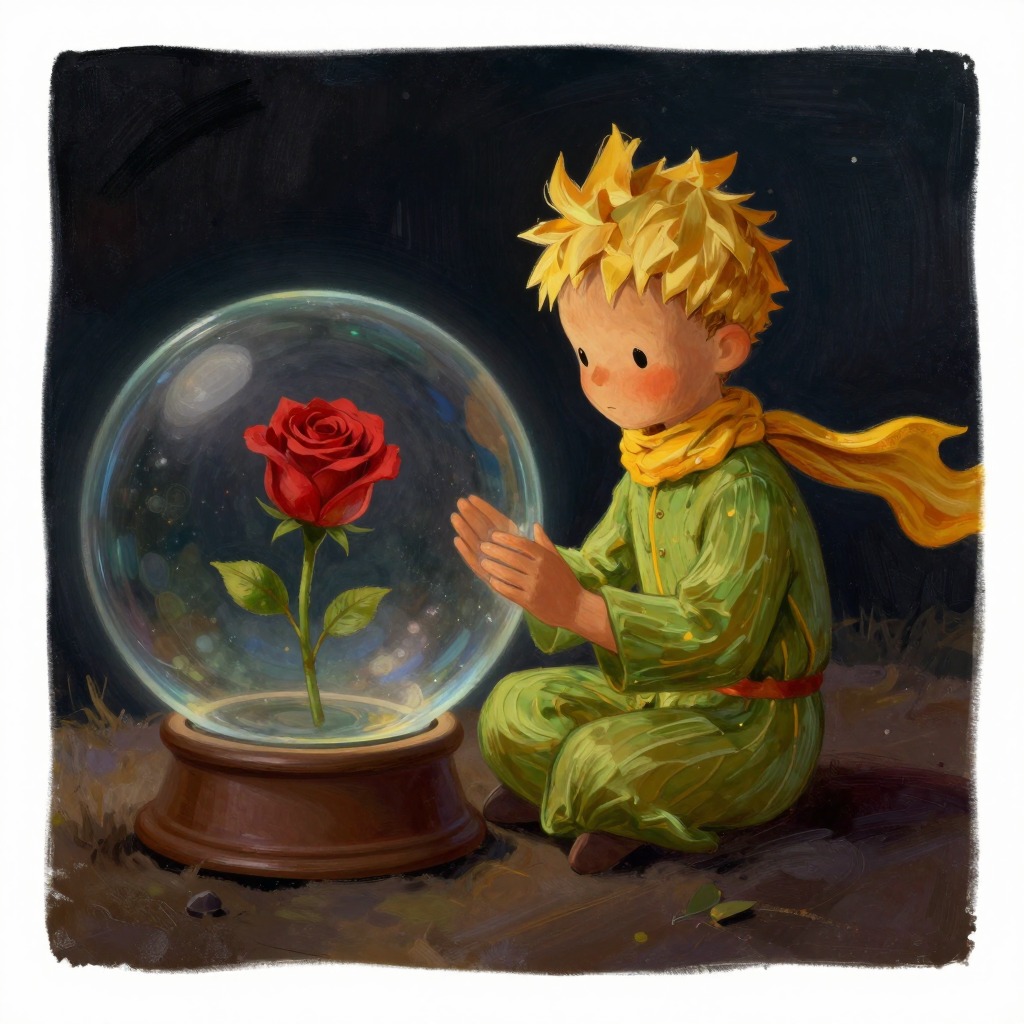
The relationship is defined by protective ritual. Every night, the Little Prince shuts his flower under her glass globe, a gesture of tenderness that also reveals his anxiety about her vulnerability. He watches over his sheep very carefully, knowing that the animal, though beloved, poses a constant threat to the Rose. This nightly routine is the prince's act of love—a small, repeated ceremony that keeps the Rose safe from the world's dangers. The narrator, recalling this, imagines the prince's diligence: "The little prince shuts his flower under her glass globe every night, and he watches over his sheep very carefully." This image of vigilance is the foundation of their relationship, a quiet contract between the prince, the Rose, and the sheep that holds the cosmos in balance.
The Threat of the Sheep
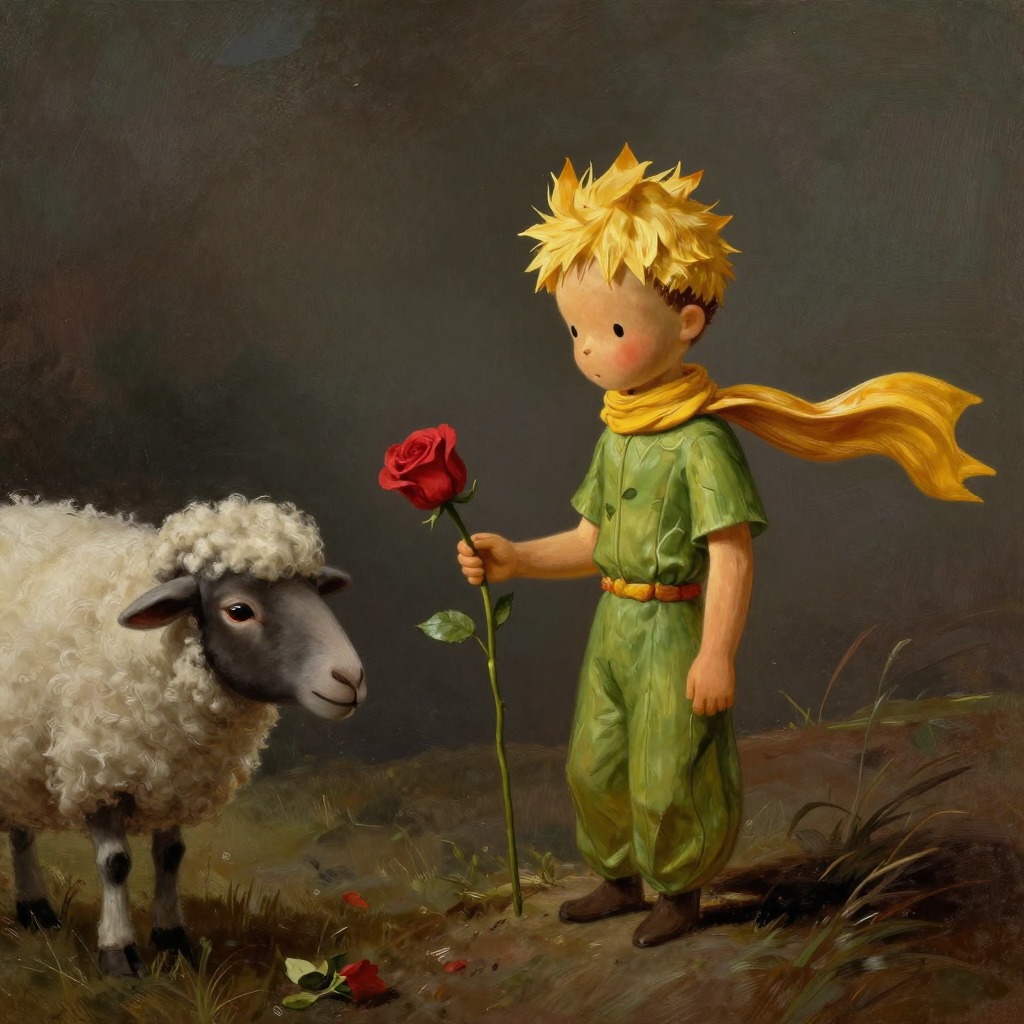
The sheep is the shadow that falls across this bond. The narrator, in drawing the muzzle for the little prince, forgot to add the leather strap to it, a lapse that means the prince will never have been able to fasten it on his sheep. This small omission transforms the sheep from a companion into a potential destroyer. The narrator's mind oscillates between two possibilities: either the prince's care is sufficient, and the Rose remains safe, or a moment of absent-mindedness—forgetting the glass globe, or the sheep slipping out silently in the night—could undo everything. The sheep, once a gift and a friend, becomes the agent of a possible catastrophe, and the Rose's fate hangs on the prince's unbroken attention.
The Cosmic Question
The narrator's uncertainty about the Rose's fate becomes a "great mystery" that alters the universe itself. He poses the question directly: "Has the sheep eaten the flower?" This is not a trivial query; it is a matter of such importance that no grown-up will ever understand it. The narrator insists that if the sheep has eaten the Rose, then "nothing in the universe can be the same" for those who love the little prince. The fate of a single flower on a distant planet becomes the fulcrum on which the meaning of all existence turns. The narrator invites the reader to look up at the sky and ask the same question, warning that the answer will change how everything is perceived. This cosmicization of a domestic concern elevates the relationship between the prince and the Rose to a metaphysical level, where love and loss are written into the stars themselves.
The Narrator's Vigil and the Promise of Return
The narrator's grief is tempered by a fragile hope. He knows the prince did go back to his planet, because he did not find his body at daybreak. The prince's disappearance is not death but a return, and this knowledge allows the narrator to find comfort in the stars, which now sound like "five hundred million little bells." Yet the comfort is unstable: when the narrator imagines the prince's carelessness, "the little bells are changed to tears." The relationship between the prince and the Rose thus becomes a source of both joy and sorrow for the narrator, who is left to wait and wonder. He describes the landscape where the prince appeared on Earth and disappeared as "the loveliest and saddest landscape in the world," and he draws it again to impress it on the reader's memory. He asks that anyone who comes upon that spot in the African desert wait under the star, and if a little man appears who laughs, has golden hair, and refuses to answer questions, they should send word that he has come back. This plea is the narrator's final act of devotion to the prince, and through him, to the Rose—a hope that the bond, though tested by distance and doubt, will endure.
The Significance of the Relationship
The relationship between the Little Prince and the Rose is the emotional and philosophical core of the book. It embodies the paradox of love: the need for protection and the impossibility of absolute safety. The prince's care for the Rose is a model of responsibility, but the narrator's forgotten strap reveals the fragility of all such efforts. The question of whether the sheep has eaten the flower is unanswerable, and this uncertainty is the price of love. The narrator's final words—"Send me word that he has come back"—are a testament to the enduring power of this bond, which transcends the boundaries of planets and the limits of human understanding. For those who love the little prince, the fate of the Rose is not a minor detail but the very measure of the universe's meaning.