Augusta
The Long WalkAugusta is the state capital and one of the decisive thresholds of the Long Walk. For the Walkers, it is not merely another town on the route but the place where the event becomes unmistakably national: television coverage, enormous crowds, official signs, lights, noise, and drunken revelry turn their exhaustion and possible deaths into a shared public spectacle. Its approach also marks a psychological change, as the Walkers realize that the ordeal will be watched on a scale far beyond the roadside audiences encountered earlier.
A Landmark on the Route
Augusta enters the Walkers’ conversation as a significant destination rather than an abstract point on the map. When Ray Garraty mentions that the Walk has rarely gone beyond the state line into New Hampshire and only once into Massachusetts, he places Augusta within a record-conscious geography of endurance and death. The city therefore represents both progress and danger: reaching it would mean surviving farther than most participants in the event’s history, but the comparison with exceptional athletic records also makes the Walk’s human cost seem like a statistic destined to be broken only rarely.
The city is also contrasted with other Maine locations. Peter McVries asks about Augusta after dismissing Oldtown, and Abraham identifies it as a regional center. Stebbins later explains that the atmosphere will change around Oldtown and Augusta because continuous television coverage will make the Long Walk a national pastime. Augusta thus occupies an intermediate position in the route’s structure: it is geographically local to Maine, yet culturally large enough to convert the Walk into a countrywide performance.
The City Before Arrival
The Walkers perceive Augusta long before they enter it. They hear the crowd from roughly five miles away, and the lights stain the sky with a soft, bubblelike glow. The sound resembles waves striking a distant shore, while the illumination evokes the frightening atmosphere of wartime air raids. These comparisons make the city appear less like a place of refuge than an approaching force. Its presence expands across darkness, sound, and sky before the Walkers can see its streets.
As the noise grows, the Walkers bunch closer together like frightened children in a storm or animals caught in a blizzard. The Crowd is imagined as a vast, hungry power capable of clawing its way out of the Augusta basin and consuming them. This image gives the city an almost physical agency in the narrative. Augusta does not simply contain spectators; it concentrates a collective appetite that threatens to overwhelm the distinction between watching suffering and participating in it.
The Augusta Spectacle
The Walkers pass beneath a large sign announcing that Augusta is only ten miles away. The sign congratulates those who have reached the hundred-mile mark and names them members of the Century Club, turning exhaustion into an official milestone and a public celebration. The congratulatory language is deliberately at odds with the condition of the participants. Their bodies are being steadily damaged, yet the city’s approach frames that damage as an achievement suitable for banners, applause, and commercial recognition.
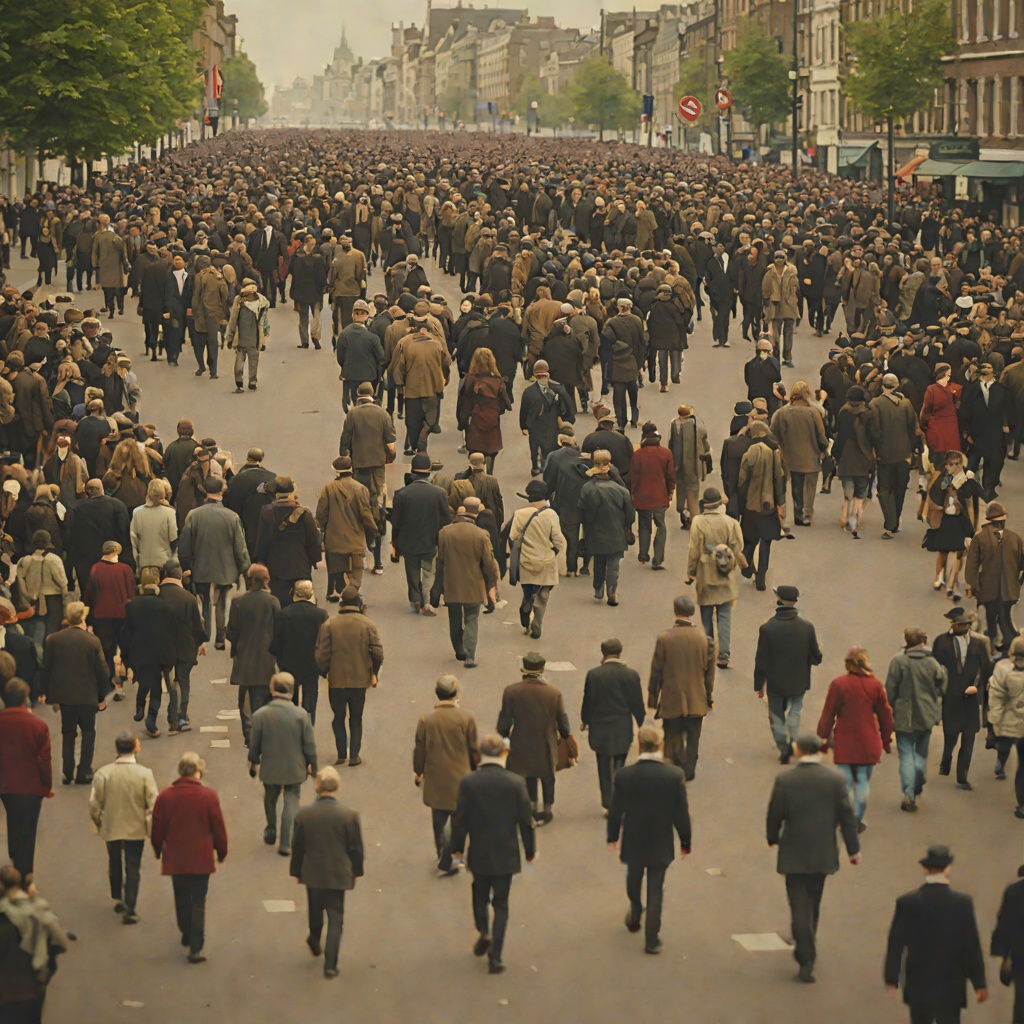
The Augusta crowd is described as unlike the crowd at Oldtown. Oldtown had seemed like a false, provincial version of New York, whereas Augusta appears as a once-a-year city of revelers, drunken celebrants, eccentric spectators, and uncontrolled excitement. The difference is not simply one of size. Augusta produces a more extreme social atmosphere in which the Walkers’ arrival becomes an occasion for mass intoxication and collective release. The city’s identity is temporarily reorganized around the event.
The Walkers hear and see the city before reaching it because the spectacle exceeds the immediate road. Its glow fills the sky, its crowd carries for miles, and its reputation is reinforced by continuous television coverage from the capital. Augusta therefore joins physical place and media image: it is both a real city on the route and a national screen onto which the Long Walk is projected.
Exposure, Control, and Significance
Augusta’s importance is sharpened by what happens elsewhere along the route. At Caribou, a network news crew surrounds the Walkers with lights, a reporter’s microphone, and technicians unrolling electric cable. At the hundred-mile crowd, state police hold spectators behind orange nylon ropes while flashbulbs burst and a policeman struggles with a screaming child. These details establish the public order that Augusta magnifies: the Walkers are displayed, the crowd is restrained, and soldiers remain ready to enforce the rules when exhaustion threatens to become escape.
The same public gaze turns bodily collapse into spectacle. Curley is shot on the road after slowing beyond what the rules permit, while Travin is killed after diarrhea and repeated warnings leave him unable to maintain the required pace. Hank Olson later staggers onward with his intestines slipping through his hands, and even this grotesque survival is observed by soldiers, spectators, and the Walkers. Near the end, an exhausted Garraty is pointed out to others while flashbulbs go off, and soldiers keep their guns trained on him as he drifts toward the crowd. Augusta’s spectacle is therefore prepared by a route-wide system in which suffering is simultaneously private agony and public entertainment.
The city’s decisive narrative function lies in this contradiction. It promises recognition, applause, and the prestige of reaching a historic distance, but it offers no protection from the system that makes the Walkers visible. The banners and cameras celebrate endurance while the soldiers preserve the conditions under which endurance ends in execution. Augusta is consequently the Long Walk’s great intensifying threshold: the place where local spectatorship becomes national pastime, where the crowd’s excitement approaches collective hunger, and where the Walkers’ individual bodies are most clearly converted into a public event.