Boston
The Long WalkBoston is the Long Walk’s mythic destination and its most powerful measure of distance. It begins as a place the Walkers can imagine only vaguely, then becomes a sign, a number of miles, and finally an announced point that still lies beyond the exhausted survivors. The city’s importance is therefore less geographical than structural: Boston turns the road into a promise of completion while the Walk steadily transforms that promise into another form of pressure.
Boston as a Distant Horizon
Boston first appears in the Walkers’ conversation as the next great threshold after the smaller settlements and state-capital references along the route. When Peter McVries tells Ray Garraty to wait until they reach Boston, the response is a collective groan rather than enthusiasm. The name carries the burden of the miles still ahead. It is large enough to seem almost beyond the scale of the Walk, and its mention briefly replaces immediate fatigue with an image of a future endpoint.
That future remains measurable. Garraty estimates that the Walkers have covered about eighty miles and that twenty-seven boys have already been eliminated, calling the distance a quarter of the way home. Boston thus exists inside a double accounting system: it is a destination imagined as homeward progress, but it is also approached through the body count. The closer the Walkers come, the more starkly the city’s promise is set against the deaths that make the measurement possible.
The Sign and the Spectacle
Near the end, a roadside sign announces that Boston is forty-nine miles away and urges the Walkers onward. By then, the message no longer functions as ordinary encouragement. The sign gathers the surrounding screaming, laughter, and insanity into a single public emblem: the city is close enough to name, yet still so unbelievable that Garraty experiences its very sound as mythic. Boston becomes less a civic destination than a word inflated by exhaustion, repetition, and the crowd’s demand that the Walkers continue.
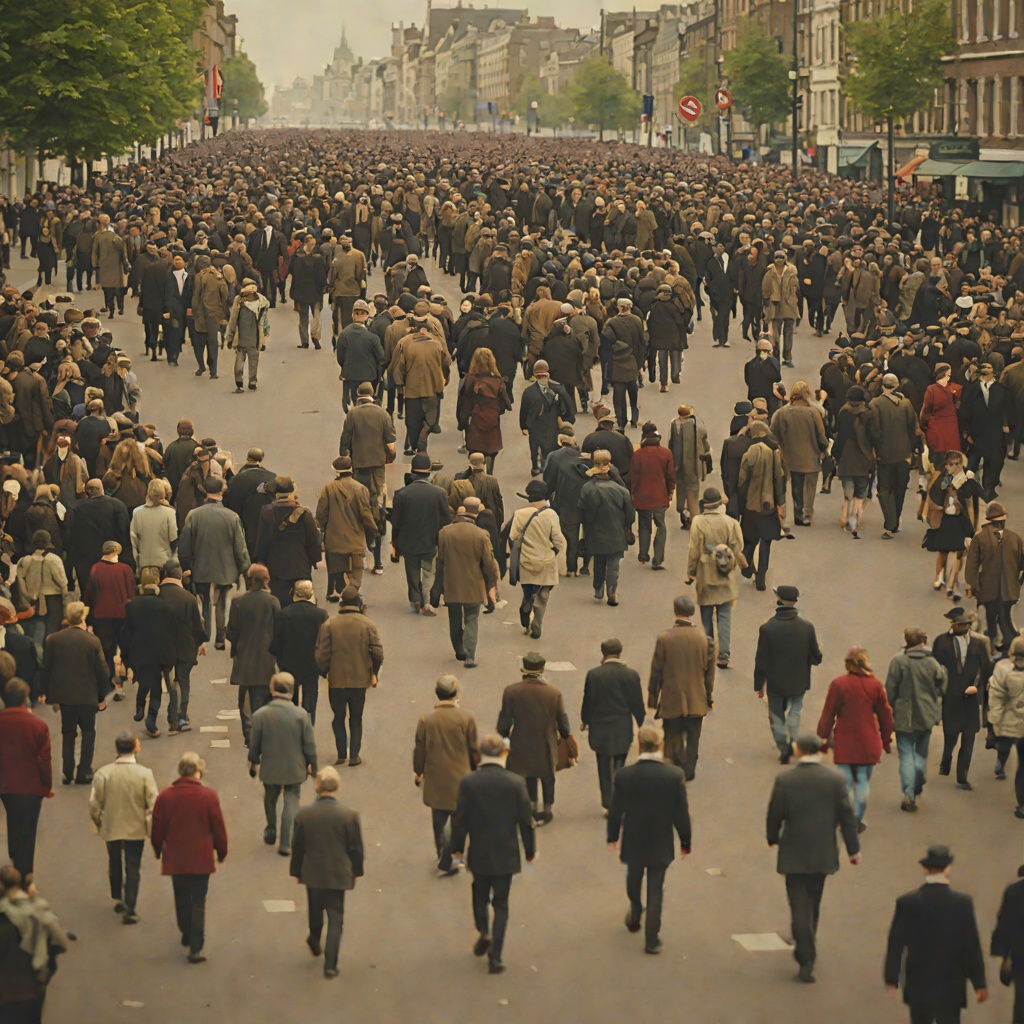
The sign also reveals how the route is staged as a public spectacle. The Walkers do not approach Boston privately or silently; they pass through an environment of cheers, shouts, catcalls, lights, signs, and spectators. Distance is displayed for the crowd, and the crowd’s optimism converts an ordeal into an apparently achievable challenge. The imperative that the Walkers can make it is radically detached from the visible evidence of their condition. Boston is advertised as attainable at the very moment when the bodies on the road make attainment increasingly doubtful.
Boston and the Arithmetic of Survival
The city’s meaning is inseparable from the Long Walk’s recurring arithmetic. Garraty hears or witnesses deaths that are immediately absorbed into numerical calculation: after Curley is shot, he thinks of the remaining ninety-nine; after two more boys disappear, the odds are described as infinitesimally improved for those still walking. Later, Olson’s living body is reduced by Peter McVries to number fifty-three, merely part of the body count. Boston stands at the far end of this process, as though the survivors’ identities could be carried there only after being stripped down to distance and statistics.
Garraty recognizes the threat of this reduction when he imagines the official record that would follow his own elimination: his name, number, and mile of death, followed by a brief human-interest newspaper story identifying him as Maine’s Own. Boston consequently promises not only arrival but public classification. The endpoint belongs to an institutional record as much as to the Walkers themselves. The city becomes the place toward which individual stories are driven and the place where those stories risk being flattened into an outcome.
The Unreached Destination
The Long Walk is proclaimed finished while the remaining Walkers are still forty miles from Boston. This reversal makes the city’s role especially severe. Boston has governed their expectations for hundreds of miles, but the official ending arrives before the destination can be entered or even reached. The announcement separates the event’s formal conclusion from the geography that has organized it. The winner is declared on the road, not in Boston; the city remains outside the ceremony that has been moving toward it.
The final survivors are too depleted to receive Boston as a conventional reward. When Stebbins and McVries ask Garraty for a story to take their minds off their troubles, both have aged visibly, and the request belongs to a moment of exhaustion rather than triumph. McVries then sits down and refuses to continue, while Garraty tries to pull him up and the soldiers intervene, placing guns to McVries’s head before giving Garraty another warning. Boston’s proximity therefore intensifies the cruelty of the ending: the destination is nearer than ever, but the Walkers’ bodies and the rules of the event have already made ordinary arrival irrelevant.
Narrative Significance
Boston operates as a paradoxical endpoint. It supplies the Long Walk with direction, scale, and a shared vocabulary of hope, yet every new reference to it exposes the distance between public encouragement and private suffering. The city is invoked as home, rendered as a roadside statistic, transformed by Garraty’s exhaustion into a mythic word, and finally left forty miles away when the event ends. Its decisive narrative function is to make completion imaginable without allowing completion to redeem the ordeal. Boston is the horizon that keeps the Walk moving, but it is also proof that the system can define victory before the promised place is reached.