Collie Parker
The Long WalkCollie Parker is defined by aggression, physical courage, and refusal to soften his language or conduct. Within the Long Walk, where exhausted boys are steadily reduced to numbers and a body count, Parker remains conspicuously present as a hostile individual: he threatens anyone who intrudes on him, curses the conditions around him, and finally attacks the military apparatus that makes the race possible. His trajectory moves from interpersonal intimidation to open revolt, ending in a futile but unmistakable act of resistance.
Identity and Introduction
Parker first enters the narrative through a small collision that reveals more than a formal introduction could. While Harkness is trying to record every walker’s name and number in a notebook, he runs into Parker, who immediately tells him to watch where he is going. The incident is brief, but it establishes Parker as someone whose boundaries are enforced through menace rather than negotiation. His reputation among the walkers is even more explicit: he is described as a very mean person, a judgment supported by the ease with which he turns irritation into a threat.
That reputation distinguishes Parker from the quieter forms of fear spreading through the group. The walkers are all subject to the same rules, warnings, fatigue, and eventual possibility of being shot, but Parker expresses the pressure as outward hostility. His anger gives him a recognizable social identity at a time when the Event is designed to erase identity. Against the official language of numbers and elimination, he presents himself as a body that will still answer insult with force.
Conduct Among the Walkers
Parker’s most direct early conflict comes during Gary Barkovitch’s movement up the line, when Barkovitch is provoking other walkers. After Peter McVries dismisses him, Barkovitch grabs Parker and begins another challenge. Parker answers with a threat to tear off Barkovitch’s nose and make him eat it, causing Barkovitch to move on quickly. The exchange is not merely comic aggression. It shows Parker policing the immediate social space of the walkers through fear, while Barkovitch’s provocations expose how easily the group’s desperation can become mutual cruelty.
Parker also participates in the walkers’ rough conversational world, but his responses tend to cut through its temporary camaraderie. When he looks around a developed stretch of road and asks where the ocean is, comparing the surroundings to Illinois, Ray Garraty tells him to keep walking and points out that the ocean lies about a hundred and eight miles south, near Freeport. Parker replies by condemning the state. His complaint is deliberately crude, yet it captures his impatience with every landscape that fails to offer escape. The road promises distance but not freedom; Parker’s disgust makes that contradiction audible.
The broader contest continually turns such behavior into spectacle. The crowd watches the walkers, cheers them, and collects souvenirs from their exhaustion, while the soldiers remain ready to enforce the rules. Parker’s hostility therefore operates under constant observation. He is not simply an angry boy among other angry boys; he is a participant whose anger is being displayed, contained, and gradually directed toward the machinery surrounding him.
The Assault on the Halftrack
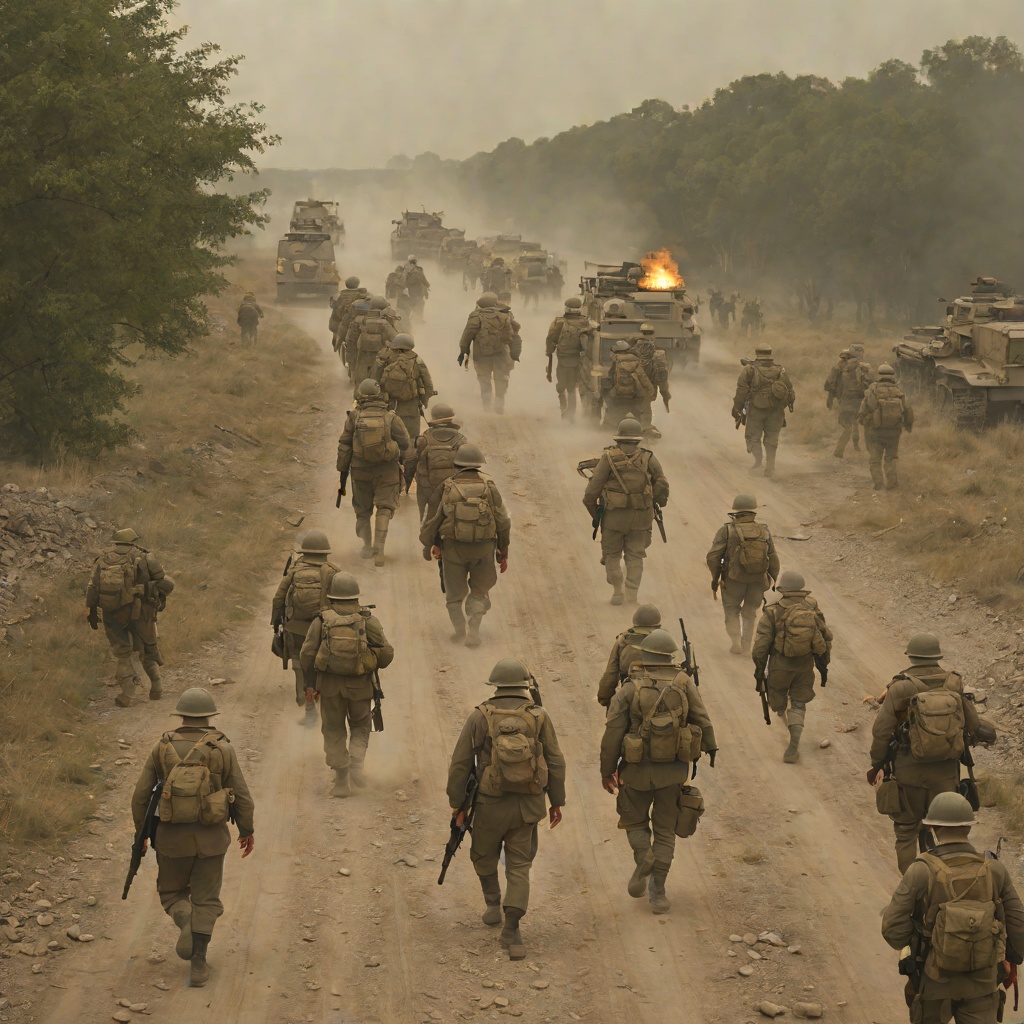
Parker’s decisive action occurs when he suddenly climbs onto the halftrack and takes a rifle. The attack erupts amid irregular gunfire and hoarse screams from the crowd. One soldier has already fallen, a neat blue hole in the center of his forehead surrounded by powder burns, while the other soldiers jump from the vehicle. Parker then turns toward the stunned walkers and urges them to join him, suggesting that his objective is larger than personal escape. He tries to transform his own attack into collective action against the soldiers and the system they represent.
The moment reverses the normal direction of violence. Throughout the Long Walk, the armed authorities watch the boys, issue warnings, and shoot those who fail to maintain the required pace. Parker instead stands above the road with a military rifle in his hands, making the enforcers vulnerable before the crowd. His revolt exposes the contest’s hidden political structure: what appears to be a voluntary endurance spectacle is also a tightly managed zone in which armed personnel decide who may continue living. Parker’s response is not an argument against the rules but an attempt to break the arrangement by force.
His action remains uncontrolled and incomplete. After firing two more rounds into the road, he loses the rifle and falls, mortally wounded. One bullet comes close to Garraty’s face, and someone in the crowd is hurt, so Parker’s rebellion carries danger for the spectators and walkers as well as for the soldiers. The attack briefly opens the possibility of solidarity, but it does not create organized resistance. It ends as suddenly as it began, leaving the walkers to continue past him.
Death and Aftermath
Parker dies on the road, breathing rapidly, his eyes still blazing. He tries to force out a final condemnation, but the words break apart into fragments before he dies staring viciously at the passing walkers. The broken speech is significant because it preserves his anger while denying him a complete final statement. Even at the moment of death, the Event does not grant him a dignified public explanation; it grants only a spectacle of a wounded body and an unfinished voice.
Garraty immediately asks what happened to Parker. McVries explains that Parker must have known he could not make it and had therefore crept up on the soldiers when they were inattentive. McVries also believes Parker wanted all the walkers to join him and that, together, they might have succeeded. This interpretation gives the assault a collective dimension that Parker himself could not complete. His failure is not proof that resistance was meaningless; it shows how quickly a possible uprising can be isolated when exhaustion, fear, and the rules of the Long Walk keep the others moving.
Parker’s death also intensifies the book’s pattern of depersonalization. Earlier, the walkers calculate how many remain, and deaths become adjustments to the odds; later, even a living boy can be imagined as an official name, number, and elimination point. Parker resists that statistical reduction for a final moment by attacking the agents of the system, yet the structure absorbs his death almost immediately. The walkers pass on, and his rebellion becomes another event within the body count.
Narrative Role and Significance
Parker functions as both a threatening companion and a failed insurgent. His early confrontation with Harkness and his threat against Barkovitch make him a source of danger inside the walkers’ group, but the halftrack assault redirects that danger toward the true mechanism of enforcement. The contrast complicates any simple distinction between personal violence and political resistance: the same temper that makes Parker cruel or frightening in conversation also gives him the impulse to strike at the soldiers.
His story further exposes the masculine performance demanded by the Long Walk. Strength is displayed through endurance, insults, fearlessness, and willingness to answer violence with violence. Parker embodies that code in its most explosive form. Yet the Event’s power is stronger than individual bravado. A rifle can reverse the hierarchy for seconds, but it cannot overcome the surrounding system, the walkers’ exhaustion, or the soldiers’ superior control. Parker’s end therefore turns his aggression into a tragic measure of the contest’s limits: he can refuse submission, but he cannot survive outside the rules he attacks.