Curley
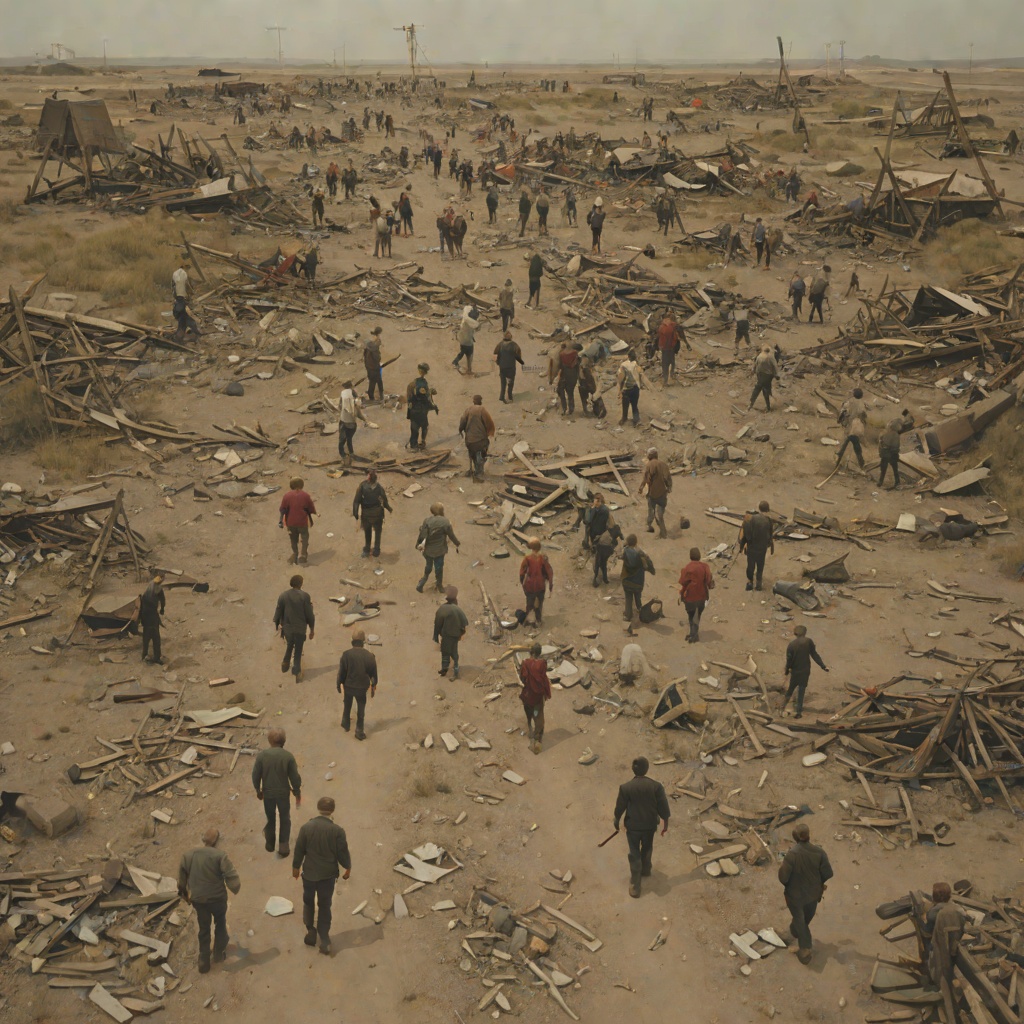
The Long WalkCurley, Walker number 7, is the first death the walking group fully witnesses during the Long Walk. Introduced as a skinny, gangling boy in blue jeans who has tried unsuccessfully to cultivate sideburns, he is defined at first by ordinary youth and visible effort. His collapse transforms the race from a difficult endurance contest into an openly lethal system, and his death becomes the first concrete demonstration that the State’s warnings end not in punishment or removal but in a firing squad.
Identity and Introduction
Curley appears among the Walkers near Limestone, where the group has already crossed a wooden-slatted bridge and passed a sign announcing that Limestone is seven miles away. He is trying to maintain the required pace while staring at and favoring his right leg. The failed sideburns and earnest, concentrated face give him a specific, awkward individuality: he is not initially presented as a statistic, but as a boy whose body is beginning to betray him.
His immediate problem is a charley horse, a painful muscular cramp that slows him in full view of the others. The Walkers begin adjusting unconsciously to his reduced speed, and that apparent solidarity becomes dangerous because their pace is also the mechanism by which the State measures survival. Curley’s suffering therefore affects the entire group even before his death: their fascination draws them toward his crisis, while their need to keep moving prevents them from truly stopping to help.
The Warning System and the Last Struggle
Curley has already received his first warning when Ray Garraty hears that he is in trouble and moves forward to find him. As Curley loses ground, the warnings recur until the announcement identifies his third warning. Curley protests that he has a charley horse and insists that it is unfair to be judged under such conditions. His appeal is significant because it asks the rules to recognize a distinction between unwilling failure and deliberate surrender, but the system recognizes only speed and compliance.
For a brief moment, Curley appears to recover. While massaging his leg frantically, he feels the cramp begin to loosen and thanks God in relief. The recovery cannot undo the accumulated warnings, however. When he suddenly doubles over again, he continues walking, but far too slowly. The scene’s value shifts with brutal speed: physical pain becomes panic, panic becomes helpless exposure, and the promise of recovery becomes an illusion produced by the warning system’s irreversible procedure.
The soldiers on the rear of the slow-moving halftrack raise their guns as Curley struggles along the sunlit road. The crowd gasps, as though it has not understood until that instant what the Walk means, while the Walkers react with the same shock despite already knowing the rule. The others scatter from around Curley like quail, leaving him alone. Their retreat makes the execution possible, but it also reveals how the event disciplines everyone who witnesses it: proximity to the condemned body threatens to interfere with the organized process of elimination.
Execution and Immediate Consequences
Curley tries to deny what is about to happen, but four carbines fire. The bullets destroy his head, and the rest of his body falls forward on the white line. The violence is not concealed or softened; the execution is a public, procedural act carried out in the open road, before the crowd and the remaining Walkers. His death confirms that a warning is not merely a temporary penalty. It is a countdown whose final stage is legally authorized killing.
Ray Garraty immediately translates the death into arithmetic, thinking that there are now ninety-nine Walkers left. The counting is a psychological defense against the blood and bodily horror, but it is also the language the event imposes on him. Curley’s individuality disappears almost at once into the reduced field of competitors. Stebbins steps over the remains without changing expression, leaving a bloody track from one foot, while Garraty looks away to avoid becoming sick. The contrast between Stebbins’s apparent composure and Garraty’s nausea emphasizes that no response can restore Curley’s personhood once the machinery has completed its work.
Narrative Role and Significance
Curley’s death establishes the Long Walk’s governing contradiction: participation may have begun through an apparently formal process of identification and consent, yet the event converts boys into administratively controlled lives. At the gate, Ray Garraty’s blue plastic identification card is transferred from his mother to a guard and consumed by a computer terminal, which displays his official name and address. In Curley’s case, that bureaucratic logic reaches its endpoint on the road. A boy with a face, clothing, pain, and a desperate claim of unfairness becomes a warning record, a corpse, and one fewer competitor.
The execution also foreshadows later deaths and attacks. Ewing is similarly dragged aside and shot after falling below speed, while Hank Olson’s later assault on the halftrack exposes the violence from the opposite direction: the soldiers ordinarily control the guns, but Olson seizes one as he attempts to climb aboard. After Ewing’s death, Peter McVries observes that the dead boy bleeds the same color as anyone else, yet the official odds have changed only infinitesimally. Curley’s earlier death initiates this recurring pattern in which human suffering is immediately converted into numbers, probabilities, and distance.
Curley is not given an extended personal history or a later return. That narrowness is part of his function rather than evidence that he lacks significance. His unsuccessful sideburns, injured leg, shouted protest, moment of hope, and final isolation make him recognizable just long enough for the State to erase him. The first witnessed execution teaches Garraty and the reader that the Long Walk does not merely threaten death in the abstract; it stages death as routine administration, with the crowd watching, the soldiers performing, and the survivors continuing forward.