Curley’s death
The Long WalkCurley’s death is the first killing that fully reveals the Long Walk’s governing reality to Ray Garraty and the other Walkers: the contest is not merely an ordeal governed by rules, but a state-supervised system in which a failing body can be legally converted into a target. Curley’s charley horse makes him lose speed; warnings mark his shrinking margin of survival; and four carbines finally erase him from the road. His death leaves ninety-nine boys, but it also leaves the survivors psychologically altered, forced to continue walking past a human body while the event is absorbed into the arithmetic of the race.
Causes and Immediate Conditions
Curley is identified as boy number 7, a skinny, gangling boy in blue jeans who has tried unsuccessfully to cultivate sideburns. His immediate crisis is physical rather than deliberate: he develops a charley horse, receives his first warning, and begins favoring his right leg. His concentration becomes fixed on that leg, while the others gradually adjust their pace to his slowing movement. Their fascination inadvertently draws them toward the same danger, because the group’s attention changes the collective speed instead of allowing Curley to remain safely within it.
The warning system turns the injury into a formal countdown. As Curley loses ground, the soldiers announce, "Warning! Warning 7!" Later, when he is still unable to recover, the announcement becomes "Warning! Warning 7! Third warning, 7!" Curley protests that he has a charley horse and that it is unfair to be punished for it. His appeal exposes the narrowness of the contest’s rules: the system recognizes neither accident nor incapacity as an exception. A body that cannot maintain the prescribed pace is treated as having violated the same condition as any intentional defector.
The Execution on the Road
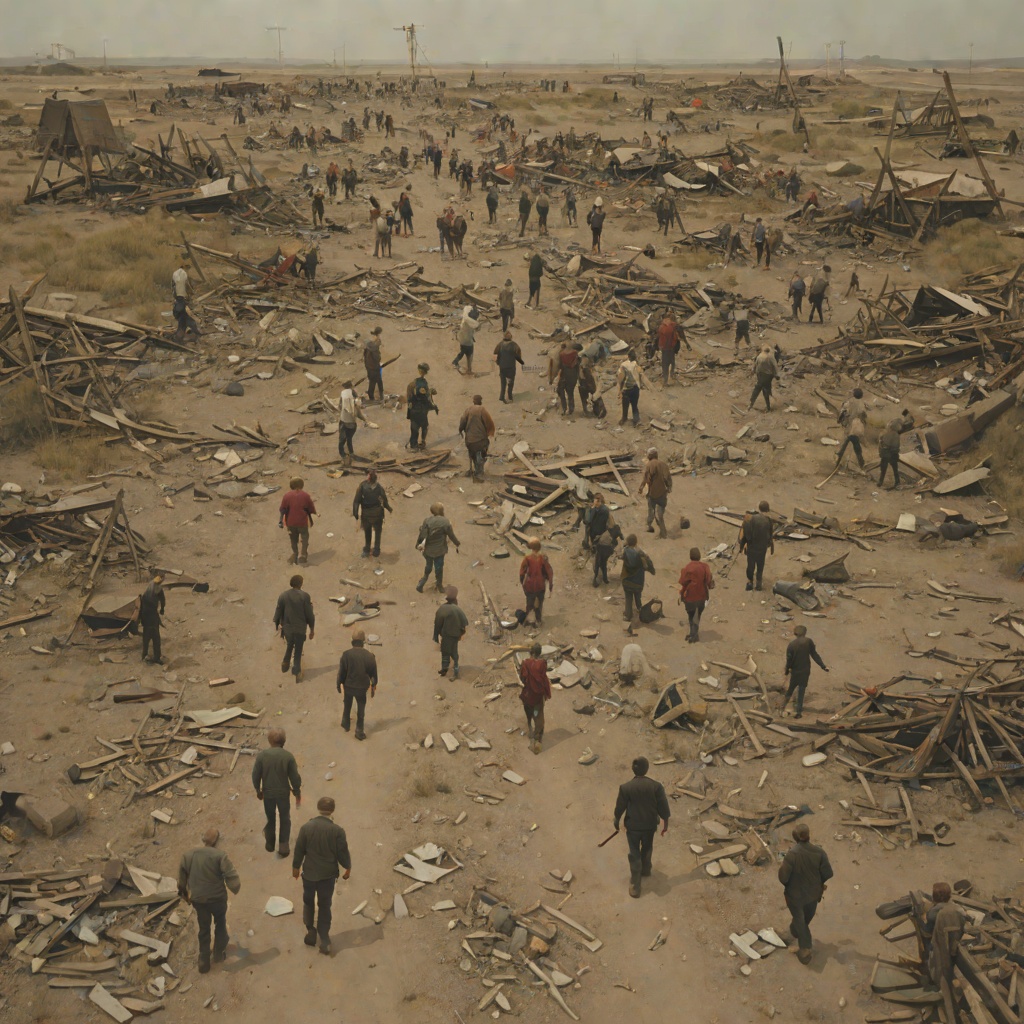
Curley continues walking even while doubled over and screaming, but his movement is far too slow. The scene then seems to decelerate around him. The soldiers on the rear of the halftrack raise their guns; the crowd gasps; and the Walkers scatter from Curley as though physical proximity might transfer his danger to them. The road, briefly crowded with spectators and fellow contestants, becomes a cleared killing ground. Curley is left alone in the sunlight, visibly exposed beneath the rifles.
Four carbines fire. The shots are described as extraordinarily loud, carrying away toward the hills and returning from them. Curley’s head is destroyed in a violent burst of blood, brains, and skull fragments, while the rest of his body falls forward across the white line like a sack of mail. The execution is therefore both mechanically efficient and publicly staged: the soldiers perform the prescribed act, the crowd witnesses it, and the Walkers are compelled to see what the warnings have always meant.
Witnesses and Immediate Aftermath
Garraty cannot look away. The spectators fall silent, and he watches because the reality of the rules has become impossible to evade. His immediate thought is numerical: there are now ninety-nine Walkers. The number evokes the childish rhythm of bottles falling from a wall, but the joke collapses into nausea and repeated disbelief. The contrast between the playful counting rhyme and the shattered body shows how quickly death is translated into a manageable statistic, even as Garraty experiences it as terror.
Stebbins steps over what remains of Curley. His foot slips slightly in the blood, leaving a bloody track, yet his expression does not change and he does not look down. Garraty interprets this composure as a kind of betrayal, because Stebbins seems to have accepted the death without the shock Garraty still feels. The survivors do not stop, mourn, or gather around the body. Their required forward motion makes the corpse an obstacle on the route and a warning embodied in flesh.
Curley’s death is also the first clear instance of the race’s statistical logic. Later deaths are described in terms of the odds shifting for those who remain, and the walkers wonder what happens to the bodies after removal from the road. The death thus initiates a recurring pattern in which a named person disappears while the competition becomes numerically easier for everyone else. The system’s efficiency depends on precisely this double movement: intimate horror at the instant of execution, followed by depersonalized accounting.
Political and Narrative Significance
The event exposes the Long Walk as an exception to ordinary protections. Curley has entered through an official process: an old blue Ford arrives at a guarded lot, his blue plastic identity card is passed from his mother to a guard, and a computer terminal verifies the participant’s registration. The procedure gives the contest an administrative appearance, while the rules authorize soldiers to kill a registered boy once the warning sequence is exhausted. Curley’s death reveals how identity verification and bureaucratic order can coexist with immediate lethal violence.
The execution also clarifies the relationship between consent and coercion. Garraty’s mother regards his participation as madness and feels guilty that she did not stop it before the machinery of the State took control. At the starting point, the Major raises his hand, delays the beginning, and finally gives the command, "Luck to all," after which the boys cross the marker in disciplined formation. The ceremonial language suggests fairness and sporting fellowship, but Curley’s death supplies the ceremony’s hidden consequence: once the walk begins, the participant’s continued existence depends on satisfying an impersonal pace under armed surveillance.
The event establishes a pattern that continues through the race. Ewing is later dragged aside and shot after falling below speed, while Olson attacks the halftrack and seizes a rifle before being shot in the stomach. Garraty’s response to Olson emphasizes that he was still alive when the soldiers fired, whereas McVries reduces him to number fifty-three in the body count. This contrast had already been prepared by Curley’s death: one witness clings to the fact of a living person, while the contest’s language presses toward numbers, warnings, and eliminated entries.
The broader course of the Long Walk intensifies the same logic. After roughly eighty miles and twenty-seven deaths, Garraty and McVries describe themselves as a quarter of the way home; after ninety-nine miles, thirty-six boys are gone. Such milestones make survival resemble progress, but each measurement is built from vanished bodies. By the time Garraty imagines an official record naming him as eliminated at a particular mile, Curley’s death has become the template for that imagined notice: a person’s name, number, and final location compressed into an administrative report.
At the end, the Major’s salute and promise of the Prize echo the beginning’s formal authority. Garraty sees the Major standing in a jeep, ready to grant the winner a first wish, while Stebbins has already been shot and Garraty walks alone toward the stopped vehicle. The ending does not undo Curley’s execution; it completes the structure that Curley’s death first made visible. A state ceremony frames the killing, a crowd turns it into spectacle, and the survivor is offered reward only after every other body has been removed. Curley’s death is therefore the Long Walk’s foundational revelation: the rules do not merely measure endurance, but organize the legal, public, and statistical disposal of human life.