Event
The Long WalkThe Event is the central public institution of the novel: a regulated endurance contest whose apparent voluntariness conceals a system of state power, bodily exhaustion, and legalized killing. It begins with identity verification and ends with the Prize, but its deeper structure is a continuous conversion of individual lives into spectacle. Walkers enter as named boys with families and private histories; along the road they become monitored competitors, public images, dwindling numbers, and finally expendable bodies.## Definition and Institutional Machinery The Event is organized through an unmistakably bureaucratic apparatus. At the guarded entrance, an old blue Ford arrives in a rural parking lot, where a khaki-clad guard demands a blue plastic identification card. The card is passed to a computer terminal that appears strangely out of place in the countryside; the machine consumes it and flashes Ray Garraty’s identifying information on its screen. This procedure makes participation legible to the state before the walking has even begun. The boy is not merely admitted as a person but entered as a record.
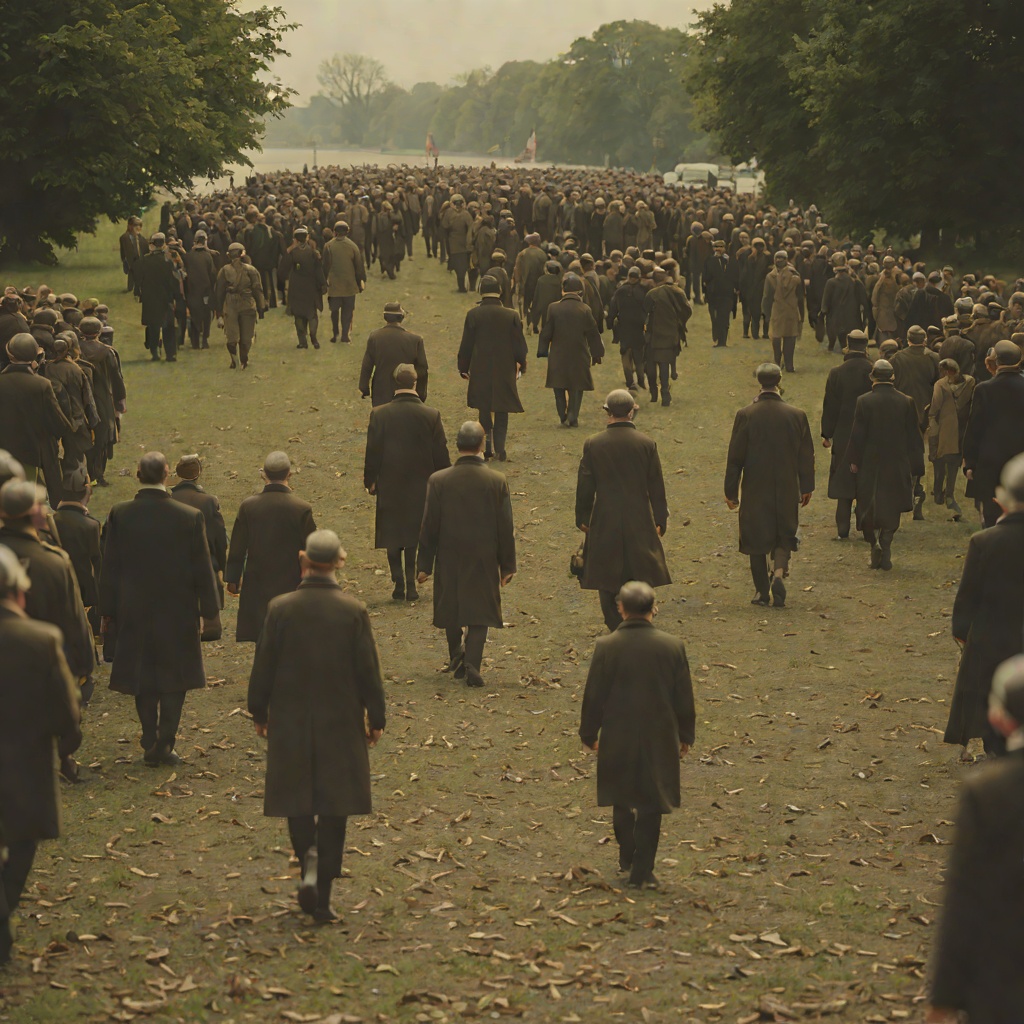
The machinery combines impersonal administration with direct military authority. The Major’s command is the decisive signal: his fingers drop, he wishes the entrants luck, and the boys pass the stone marker in parade-step while the sound of their feet becomes unnaturally loud. The formal gesture gives the beginning a ceremonial surface, but the ceremony inaugurates an order in which movement is compulsory. Ray Garraty realizes that nobody freezes; everyone crosses the marker and begins. The Event therefore transforms choice into momentum, binding the participants to a procedure that has already taken possession of them.
Its official language also disguises coercion as personal responsibility. Garraty’s mother recognizes that guilt has allowed the state’s machinery to advance from anxiety to irreversible control, while Garraty insists that entering was his own idea and that the decision is best one way or the other. The scene establishes the Event’s most important ideological effect: the participant can describe submission as self-determination even as guards, computers, weapons, and rules make withdrawal increasingly impossible.## Public Spectacle and Media Event The Event does not remain a private contest between walkers and officials. At Caribou, a large crowd and a network news crew surround the route. Battery lights bathe the road in warm white glare, and a heavy newspaperman in a three-piece suit trots beside the walkers, directing a long-reach microphone toward them while technicians unreel electric cable. The contest is thus made into a simultaneous physical ordeal and media production. The walkers supply living images, brief responses, and bodily drama; the equipment supplies the means by which distant viewers can consume them.
When the reporter runs out of cable and retreats toward the mobile unit, the crowd cheers as enthusiastically as it had during the interview. Posters of the Major rise and fall on sticks still bleeding sap, and the spectators cheer more frantically when the cameras turn toward them, waving to Aunt Betty and Uncle Fred. The Event offers the crowd a chance to perform its own spectatorship. Its participants are not only watching death but displaying themselves as an audience within the broadcast, converting collective approval into part of the program’s content.
The spectacle expands beyond television. At the hundred-mile point, a huge red-and-white banner congratulates the walkers and announces the Century Club. In another town, State Police hold back deep ranks of spectators with bright orange nylon ropes while flashbulbs erupt; a screaming child waves a toy glider and an autograph book. Such details place commercial celebration, family entertainment, official security, and lethal competition in the same frame. The Event’s violence is not hidden from the public. It is made attractive through signs, photographs, slogans, access control, and the promise of proximity to famous contestants.
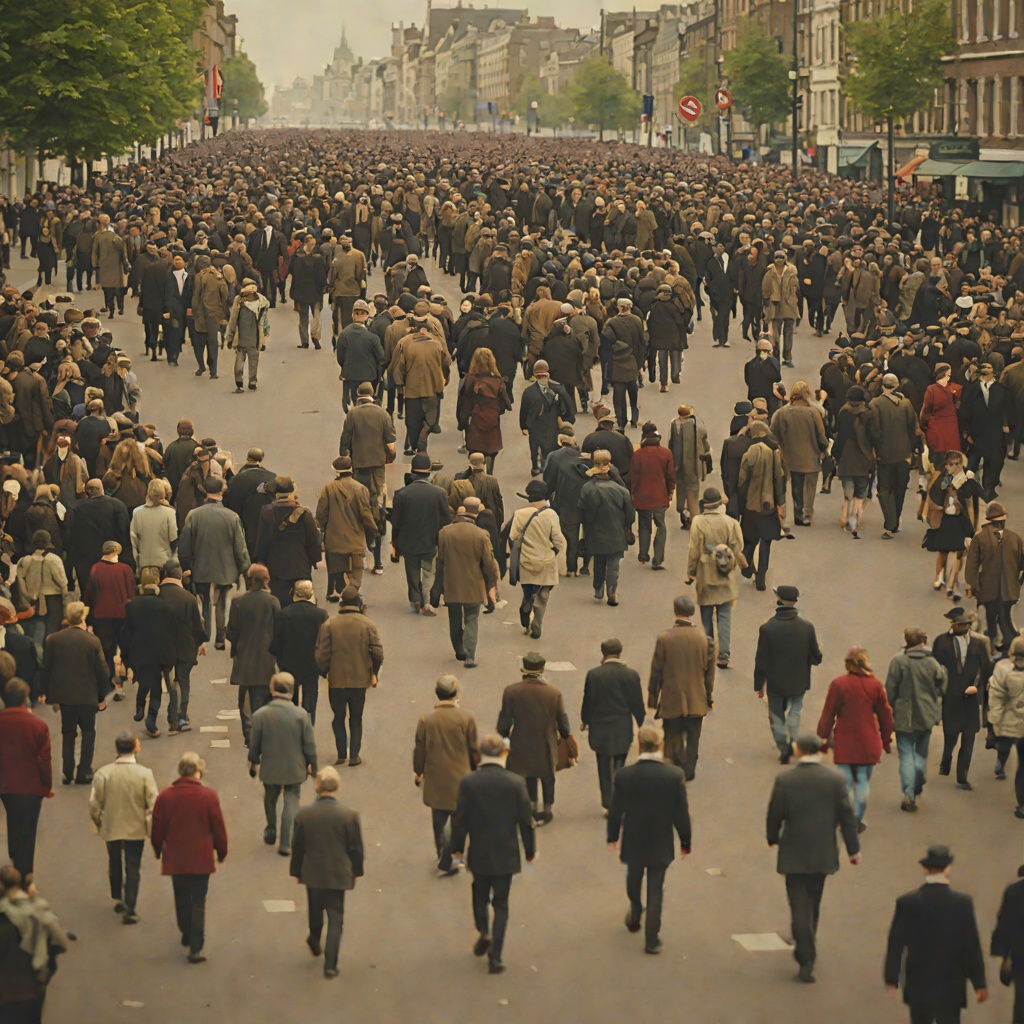
The crowd eventually becomes less a collection of individuals than a repeated social mask. It fills doorsteps, lawns, driveways, picnic areas, gas-station tarmacs, and supermarket lots. It mugs, gibbers, and cheers, watching even the most humiliating bodily acts, yet remains essentially the same from mile to mile. This recurring Crowd Face gives the Event a mass identity that overwhelms the walkers’ distinct personalities. Its appetite is stable even when particular spectators change, suggesting that the contest is sustained by a social mechanism of looking rather than by any single person’s decision.## The Event’s Geography and Ritual Scale The route repeatedly enlarges the Event from local occurrence into shared civic ritual. In Oldtown, the passage becomes a nightmare of cheering, arc-sodium lamps, confetti, newspapers, shredded telephone books, and toilet paper falling from upper-story windows. Night is turned into glaring, shadowless day, and the town is recast as a ticker-tape parade. The imagery is deliberately celebratory, but the celebration is attached to exhaustion and death; public festivity makes the walkers’ danger resemble an honored procession.
Augusta intensifies this transformation. The city is experienced before it is reached, first as sound and then as an immense field of light. The crowd can be heard miles away, while the glow fills the sky with a pastel bubble that recalls images of wartime destruction. Once the walkers enter, the ordinary town seems to disappear beneath the mass gathering. There are no longer separate ladies, children, or men, but Crowd: a bodiless Voice and Eye that behaves as both God and Mammon. The Event therefore produces a secular religious structure in which spectators worship, fear, and economically sustain the same power.
At the height of Augusta’s excitement, two purple-white spotlights reveal the Major in his jeep, saluting rigidly as he draws away from the walkers. His pose is a state icon placed inside a delirious public landscape. The remaining walkers cheer despite their hoarseness and physical danger, and the crowd responds with increasingly violent enthusiasm. Their emotions, described as out of tune rather than broken, do not disappear under pressure; they become distorted and redirected by the spectacle. Milligan’s collapse finally interrupts the contagious cheering, showing how close public excitement has brought the participants to their own destruction.## Enforcement, Death, and the Logic of Elimination The Event’s celebratory surface depends on a lethal enforcement system. When Ewing falls below the required speed for the last time, he is surrounded by other boys who may appear to offer protection, but the soldiers push them aside and drag him to the road’s shoulder. One soldier pins his arms behind him; another places a carbine against his head and shoots. The killing is efficient, practiced, and procedural. A single leg kicks convulsively afterward, an involuntary remnant of the person whom the Event has just reduced to a failed performance.
McVries’s observation that Ewing bleeds the same color as anyone else exposes the gap between the Event’s statistical logic and the body’s sameness. The death adjusts the odds infinitesimally in favor of those remaining, making mortality into arithmetic. The walkers also wonder what happens to the bodies, but the system offers no corresponding ritual of mourning or visible account of disposal. The Event records survival and failure while leaving the dead outside its public narrative except as evidence that the rules work.
The soldiers’ authority is most starkly displayed during Hank Olson’s attack on the halftrack. Olson climbs painfully toward the vehicle, grabs the barrel of a gun, and yanks it away as if it were an ice-cream stick. The soldiers bring their weapons around in perfect coordination, and one shoots Olson through the belly. He nevertheless reaches the top, seizes the barrel of the gun that wounded him, and forces it upward as it fires again. His resistance briefly reverses the expected relation between armed executors and helpless contestant, but the scene also confirms the Event’s underlying asymmetry: the state possesses disciplined weapons, vehicles, and collective force, while the walker has only his damaged body.
At the end, the Event’s promise is condensed into the Major’s salute and the Prize. With the road empty of competitors, the Major stands in the jeep, ready to grant the winner’s first wish, any wish, even a death wish. Behind him, soldiers finish shooting the already-dead Stebbins. The ceremonial reward and the final act of violence occupy the same instant, revealing that victory does not escape the Event’s death-centered logic. The Prize is not a clean alternative to execution; it is the official name given to what remains after elimination has produced a solitary survivor.## Narrative and Political Significance The Event makes death simultaneously exceptional and routine. Each shooting can appear as a discrete punishment triggered by failure, yet the repeated pattern normalizes killing as the ordinary operating condition of the contest. The state’s identity checks, military commands, armed escorts, and public ceremonies give the violence a legal and institutional frame. Because the boys have entered through a formal process, their continued exposure to lethal force can be presented as the consequence of rules rather than as an act of domination.
Its spectators complete the system by translating suffering into communal entertainment. News microphones, television cameras, flashbulbs, banners, spotlights, posters, and cheering crowds do not merely surround the Event; they organize how it is seen. The walkers’ private sensations—cold, hunger, chest pain, fear, and exhaustion—are repeatedly placed against public images of congratulations and celebration. The resulting contrast is the Event’s central irony: the more intensely the outside world celebrates the contest, the less visible the individual reality of the boys becomes.
The Event also dissolves distinctions between ritual, administration, commerce, and warfare. The opening computer terminal assigns identity; the Major supplies ceremonial authority; soldiers enforce the pace with carbines; State Police manage spectators; journalists package the experience; crowds supply emotional and economic energy; and the Prize promises a final reward. These functions appear separate, but together they create one continuous structure. The Event’s decisive achievement is to make organized killing feel like a shared holiday, so that the public can experience state violence not as an atrocity outside ordinary life but as a spectacle woven into ordinary civic culture.