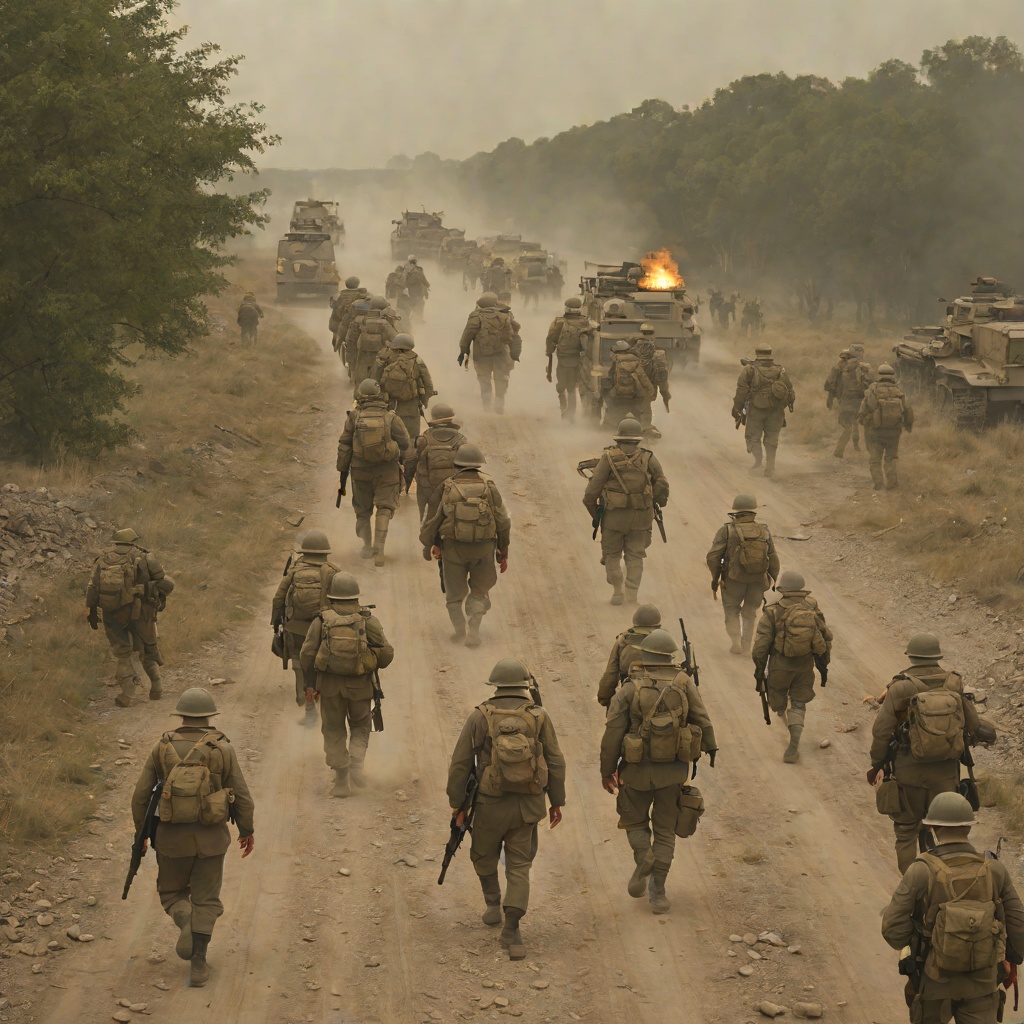
McVries’s assault on the halftrack
The Long WalkMcVries’s assault on the halftrack is one of the clearest moments in which resistance to the Long Walk becomes both physically immediate and structurally futile. Peter McVries turns public anger into an attack on the soldiers, but the encounter ends without liberation: Ray Garraty pulls him back from being shot, and the warning system records the intervention as another violation. The scene changes the value at stake from crude amusement and collective bravado to life, dignity, and the possibility of refusing the Event, while confirming how completely the State’s machinery governs both movement and punishment.
Provocation and the Soldiers’ Authority
The assault begins in an atmosphere of joking familiarity that collapses as soon as McVries notices the soldiers watching him. The walkers have been laughing at increasingly obscene jokes about The Major, including jokes about the Major having sex with his mother, grandmother, and even Sheila, the Bedlington terrier repeatedly shown in his press releases. McVries is still laughing when his attention shifts to the soldiers on the halftrack. Their wooden faces and fixed attention make the laughter suddenly dangerous rather than communal. The soldiers do not need to threaten him verbally; their silent observation restores the real hierarchy of the road.
McVries answers that gaze with direct insult. His face flushes, and the scar on his cheek becomes a stark mark against the blood in his skin as he shouts that The Major bugs himself and accuses the soldiers of doing the same to one another. Other walkers stare uneasily and move away. The retreat isolates McVries at the precise moment when his protest might otherwise have become collective. His anger is public, but the crowd does not become a crowd of resisters; it becomes a field of witnesses protecting themselves by creating distance.
The Charge at the Halftrack
McVries suddenly runs toward the halftrack. Two of the three soldiers raise their rifles to high port, prepared to fire, but McVries stops abruptly and lifts both fists above his head, making the gesture resemble the exaggerated conducting of a mad conductor. He challenges the soldiers to come down and fight him, offering to face them one at a time or all together. The demand is important because it tries to replace the Event’s controlled, one-sided execution with an ordinary physical contest in which the soldiers would have to meet him as men rather than as instruments of the rules.
The halftrack does not accept that transformation. A soldier answers in a neutral voice with a warning, identifying the violation as warning 61 and marking it as McVries’s second warning. McVries then runs again, catches up with the vehicle, stops, and spits on its side. The spittle cuts a clean streak through the dust, a small but visible alteration of the machine’s surface. He continues screaming for the soldiers to come down, insisting that he does not care whether they face him singly or together. His action therefore combines assault, insult, and theatrical exposure: he wants the soldiers to descend from their protected platform and make their violence answerable.
The response is procedural rather than emotional. The next announcement gives warning 61 as the third and final warning. McVries rejects the warning itself with another obscenity, but the machinery has already converted his rebellion into a numbered administrative fact. His courage does not cancel the rule; it advances him toward the punishment the rule authorizes.
Garraty’s Intervention
Ray Garraty reacts before he fully understands that he has decided to act. He turns and runs back toward McVries, receiving a warning of his own, while the soldiers lower their weapons toward McVries. Garraty grabs McVries’s arm and urges him to come away. McVries insists that he is going to fight the soldiers, but Garraty shoves him hard and flatly, telling him that he is going to get shot.
The intervention is not a rejection of McVries’s anger. Garraty has witnessed enough executions to understand what the soldiers’ readiness means, and his movement back toward McVries risks his own position under the same rules. He acts because friendship and immediate bodily responsibility briefly interrupt the Event’s demand that each walker preserve himself alone. Yet the rescue is compromised from the beginning: Garraty saves McVries from the rifles, but he cannot save either of them from the warning system. The result is a narrowed form of survival, not freedom.
McVries returns to walking in a dead, washed-out mood. He calls Garraty the musketeer, acknowledging that Garraty has prevented the immediate shooting, but then touches the scar on his cheek and insists that all of them are going to die. Garraty answers that somebody will win and that the winner might be one of them. McVries counters that the Prize is a fake and that the last walker will simply be taken behind a barn and shot. The assault thus exposes the distrust beneath the Event’s promise of reward: even when a walker is spared, the system’s ultimate claim remains suspect.
Consequences and Political Significance
The halftrack embodies a compact version of the Event’s governing structure. It carries the armed soldiers, moves alongside the walkers, observes their bodies, and enforces speed through warnings that culminate in execution. The same system that can identify a participant through a blue plastic card and a computer terminal, and that can announce official luck through The Major’s ceremony, also turns a human outburst into a countable offense. McVries’s assault is therefore not merely a quarrel with individual soldiers. It is an attempt to attack the visible mechanism that makes the Long Walk possible.
The episode also clarifies the difference between voluntary participation and coercive control. The walkers may have entered the Event through an official process, but once the Walk begins, the State defines every permitted gesture: walking too slowly, stopping, running backward, or confronting the soldiers can all be translated into warnings. The soldiers’ authority is absolute because the rules place the walkers outside ordinary protection while keeping them entirely within administrative capture. A warning sounds like due process, yet its practical meaning is permission to kill.
This logic appears elsewhere in the Walk. Curley is shot after falling below speed, and the crowd and the walkers react with the shock of people who know the rule intellectually but experience its physical reality only when the rifles fire. Ewing is dragged from a group, restrained, and shot at close range after his final failure to maintain the required pace. Travin is watched while diarrhea repeatedly forces him to squat; when he finally half-falls, the soldiers shoot him with his pants down. In each case, the body becomes evidence against its owner. McVries’s difference is that his body moves toward the enforcers instead of failing passively, but the same warning architecture absorbs his defiance.
The later fate of the walkers makes the assault’s limits even clearer. Hank Olson climbs onto the halftrack, seizes a rifle barrel, and continues walking after being shot through the belly, his exposed intestines slipping through his hands. At the end, when McVries finally sits cross-legged on the pavement and refuses to continue, Garraty tries to lift him but cannot; soldiers wrench McVries away and place guns against his head. Garraty begs them to shoot him instead, yet the soldiers give Garraty his third warning rather than granting the substitution. The earlier rescue has no lasting power against the system’s divisions between individual bodies, individual warnings, and individually assigned deaths.
McVries’s assault consequently occupies a crucial middle position between laughter and death. It begins with a joke, becomes an accusation, turns into a charge, and ends as a warning in the official record. Its immediate outcome is survival, but its deeper consequence is the exposure of a structure in which even resistance must occur under the supervision of the power it opposes. The halftrack remains intact, the soldiers remain above the road, and the walkers continue forward; only the claim that the Event is a contest rather than organized state violence has been irreversibly damaged.