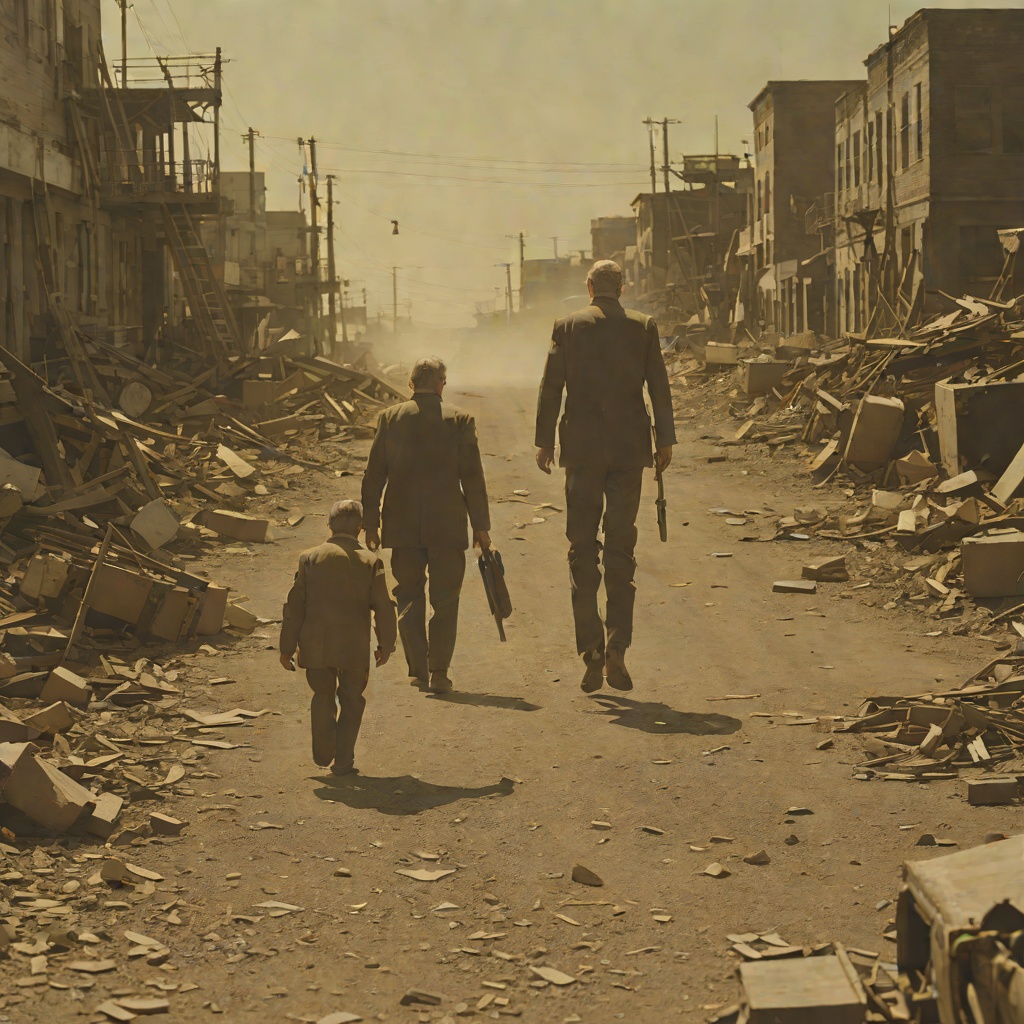
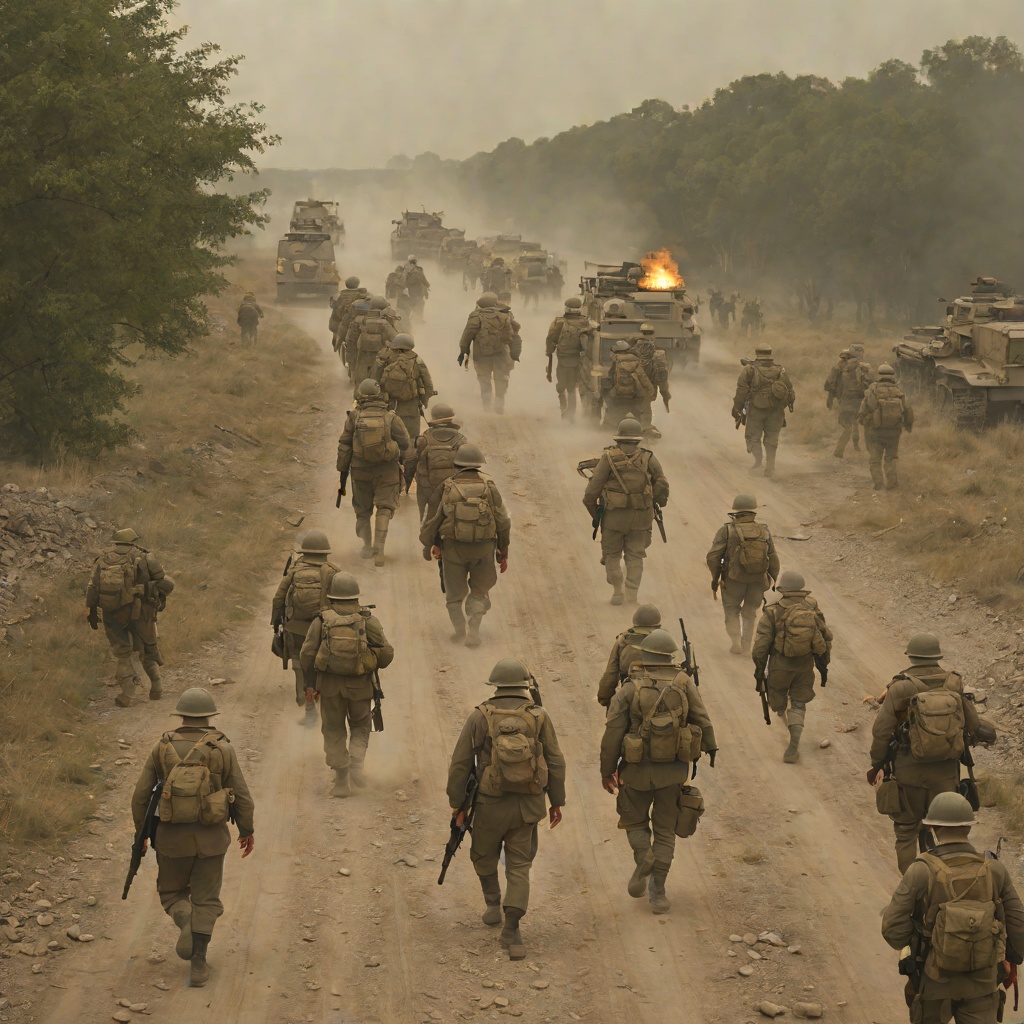
Olson’s attack on the halftrack
The Long WalkOlson’s attack on the halftrack is one of the Long Walk’s clearest confrontations between a Walker and the state apparatus that regulates him. Hank Olson abandons the prescribed line, climbs onto the military vehicle, seizes a rifle, and continues moving after being shot repeatedly. His final cry, “I DID IT WRONG!”, makes the episode both an attempted assault and a desperate recognition that even rebellion has been shaped by the system’s rules.
Causes and Background
The attack grows out of the Walk’s governing contradiction: the boys are formally participants, yet their movement is continuously enforced by soldiers, weapons, warnings, and surveillance. At the outset, the halftrack’s radar dishes monitor every Walker’s speed while an onboard computer enforces the four-mile-per-hour cutoff. A warning is not merely advice; repeated failures lead to a Ticket, and a Walker who accumulates the required warnings becomes legally killable within the event’s procedure. The same regime extends beyond visible soldiers. Hank Olson explains that infrared scopes, microphones, and other equipment can detect the Walkers even in darkness, making escape from the road practically impossible and turning every spoken plan into monitored conduct.
This machinery teaches the Walkers to regulate themselves. They calculate when an old warning will expire, test the boundary of permissible speed, adjust clothing and footwear, and continue despite injuries or bodily emergencies. The halftrack therefore represents more than transport or supervision. It is the mobile center of the event’s coercive order: a platform from which the soldiers measure, warn, and shoot. Olson’s later attack reverses that arrangement by making the vehicle itself the object of action and by forcing the soldiers to respond to a Walker rather than merely judge him.
The episode also follows a pattern already established by the Walk. Curley’s death shows the crowd and the Walkers watching a wounded participant become an exposed target before four carbines reduce his head to blood, brains, and skull fragments. Travin’s death shows the same authority waiting for a bodily failure and shooting him while his pants are down. These scenes establish that vulnerability is not accidental but central to the event’s spectacle: the body is displayed, assessed, and destroyed under an orderly procedure. Olson’s assault emerges against this background of repeated humiliation and execution.
Course of the Assault
Before the attack, Olson speaks quietly to Garraty about Jesus saving him. He then turns toward the halftrack and begins walking off the road. A warning is called, but Olson does not slow. The crowd’s noisy attention falls away into stunned silence as he reaches the soft shoulder and begins painfully climbing the side of the vehicle. The movement is deliberate rather than sudden: he crosses the boundary that the Walkers are forbidden to cross and enters the soldiers’ elevated space.
Once on the halftrack, Olson grabs the barrel of the nearest gun and yanks it from the soldier’s hands. The weapon clatters into the crowd, whose members recoil and scream as though it were a living danger. For a brief instant, the relation of power changes. The soldiers’ rifles, which have defined the Walkers as helpless targets, are no longer fully under military control; Olson has converted one of them into evidence that the armed apparatus can be physically challenged.
The soldiers immediately restore their dominance through coordinated gunfire. One bullet enters Olson’s belly and exits through his back, yet he continues climbing and seizes the barrel of the gun that has just fired. He forces it upward as it discharges again. Peter McVries urges him to kill the soldiers, but the attack cannot become an organized uprising. The remaining guns fire together, and the impact throws Olson from the halftrack. He lands spread-eagled on his back, his abdomen described as a black, shredded ruin. The disarmed guard effortlessly produces another carbine, underscoring how little the system depends on any single weapon or soldier.
Defiance After Injury
The attack does not end when Olson is thrown down. Although several bullets have torn through him, he sits up with his hands against his belly and calmly faces the soldiers. They keep their guns trained on him but hesitate, watching him with what appears almost like curiosity. That pause creates the episode’s most disturbing reversal: the soldiers have already demonstrated overwhelming force, yet Olson’s continued movement makes the expected sequence of warning, shooting, and removal briefly unstable.
Olson slowly regains his feet. He crosses his hands over his abdomen, sniffs the air as if searching for direction, turns toward the route of the Walk, and staggers onward. His intestines slip through his fingers and hang against his groin; he vomits blood and bile, bends over, and nevertheless begins walking again. The grotesque physical exposure is inseparable from the event’s institutional logic. The Walk demands visible forward motion, and Olson’s body becomes the extreme image of a participant reduced to motion alone: catastrophically wounded, stripped of privacy, and still trying to satisfy the rule that movement must continue.
The soldiers and spectators interpret this persistence as intolerable. A shocked voice calls for Olson to be put out of his misery, but the scene does not immediately resolve into mercy. Olson remains a moving target and a public spectacle, while the Walkers watch him from the road. His apparent dignity is not freedom; it is a final struggle inside a system that recognizes only speed, warnings, and termination.
Final Recognition and Consequences
Garraty and McVries walk backward while watching Olson on his knees. Olson rises once more, stands astride the white line, and raises both hands toward the sky. The gesture combines surrender, prayer, and an attempt to reclaim control over the meaning of his death. He then cries, “I DID IT WRONG!” and falls flat and dead. The soldiers fire two additional bullets into him before dragging him from the road.
The final words change the meaning of the entire assault without making its facts less concrete. Olson has resisted the soldiers, seized a rifle, endured repeated gunfire, and continued along the route, but he concludes that he has failed in some fundamental way. The statement does not clarify whether he means the attack, his attempt to live, his prayer, or the Walk itself. Its force comes from that compression: the event offers no successful outside to the rules. Even Olson’s last judgment is expressed from within the logic of having done the contest incorrectly.
The aftermath confirms the asymmetry between human defiance and institutional power. The soldiers remove the body while the Walk continues, just as Curley’s body is stepped over and Travin’s death is absorbed into the forward movement. The armed authority does not need to explain itself, and no appeal interrupts the procedure. Olson’s attack therefore produces no change in the event’s structure, but it does reveal the structure with unusual clarity: surveillance becomes direct violence, warning becomes execution, and the crowd’s astonishment becomes part of the machinery that turns a death into public spectacle.
Narrative Significance
As a scene, the attack is driven by a sharp value shift. Olson’s ordinary status as a monitored Walker becomes, for a moment, the active position of an attacker; the possibility of dignity and agency rises when he takes the rifle, then collapses into overwhelming bodily destruction when the soldiers fire in unison. The gap between what the crowd expects and what Olson does sustains the scene: a wounded Walker should slow, receive his Ticket, and die, whereas Olson repeatedly refuses the expected pause.
The episode also exposes the Long Walk as an exception-like order in which ordinary moral distinctions are displaced by procedure. The soldiers can shoot a participant because the event has converted speed into a legal measure of life, while the spectators can recoil from a weapon and then remain present for the destruction of the person who seized it. Olson is simultaneously outside ordinary protection and completely captured by the system’s instruments. His body is not permitted to leave, rest, or die privately; even after catastrophic injury, it remains subject to the road, the warning system, the guns, and the watching crowd.
Olson’s attack thus functions less as a conventional military challenge than as a revelation enacted through the body. The halftrack’s surveillance, weaponry, and elevated position make visible the state’s organized control, while Olson’s climb briefly makes that control vulnerable to contact. His failure restores the hierarchy, but his persistence prevents the hierarchy from appearing natural or uncontested. The event’s final image is not simply a defeated boy; it is a system continuing smoothly after absorbing an act that momentarily forced its violence into the open.