Percy
The Long WalkPercy is a young Walker identified in the event by the number 31 and repeatedly referred to as “Percy What's-His-Name.” His significance lies less in a developed personal biography than in the way the narrative preserves his name, his mother’s desperate recognition of him, and the exact mechanics of his elimination before reducing him to part of the body count. Through Percy, the Long Walk appears simultaneously as a family crisis, a public entertainment, and a controlled system in which leaving the road makes a participant legally killable.
Identity and Introduction
Percy first becomes distinct from the mass of Walkers when a woman calls his name from the roadside: “Percy! Percy!” He blushes, waves, and hurries forward with his head slightly bent, while the woman tries to run into the road. A policeman restrains her gently before she can reach him, and the guarded procession continues. The scene establishes the split between Percy as a recognizable son and Percy as Walker 31, one participant among the numbered bodies moving through the event. The same woman later reappears in Caribou, still searching for him. She breaks through the police cordon and moves directly into the procession, pawing through the boys and unintentionally tripping one of them while calling for her son to come home. The soldiers reach for their guns, and for a moment her interference threatens to earn her an interference ticket, but a policeman finally locks her arm and drags her to a police cruiser. A small boy watches from a KEEP MAINE TIDY barrel while eating a hotdog. The grotesque ordinariness of that spectatorship makes Percy’s family emergency part of the route’s entertainment, while his mother’s repeated attempts to interrupt the event reveal that the state’s boundaries are stronger than personal recognition.
Percy Within the Long Walk
Percy’s appearances are framed by the event’s accumulating statistics. At the start, the Major’s raised hand suspends a hundred boys in terrible silence; when the hand falls, the Walkers move forward under the formal wish of “Luck to all.” Later, after another Walker has been shot, the remaining field is described as having shifted infinitesimally in favor of those still alive. The language of odds already places Percy inside a system that measures survival collectively rather than honoring individual lives. The numerical logic becomes more explicit as the Walk proceeds. At roughly eighty miles, with twenty-seven Walkers gone, the group can describe itself as a quarter of the way home. After ninety-nine miles, only thirty-six of the original field have fallen, a calculation that produces both pride and resentment: the distance is treated as an achievement even as each reduction in the death count means another human being has disappeared. Percy’s mother resists precisely this conversion. She does not see a percentage, a distance, or a remaining total; she sees Percy and demands that he come home.
Flight and Execution
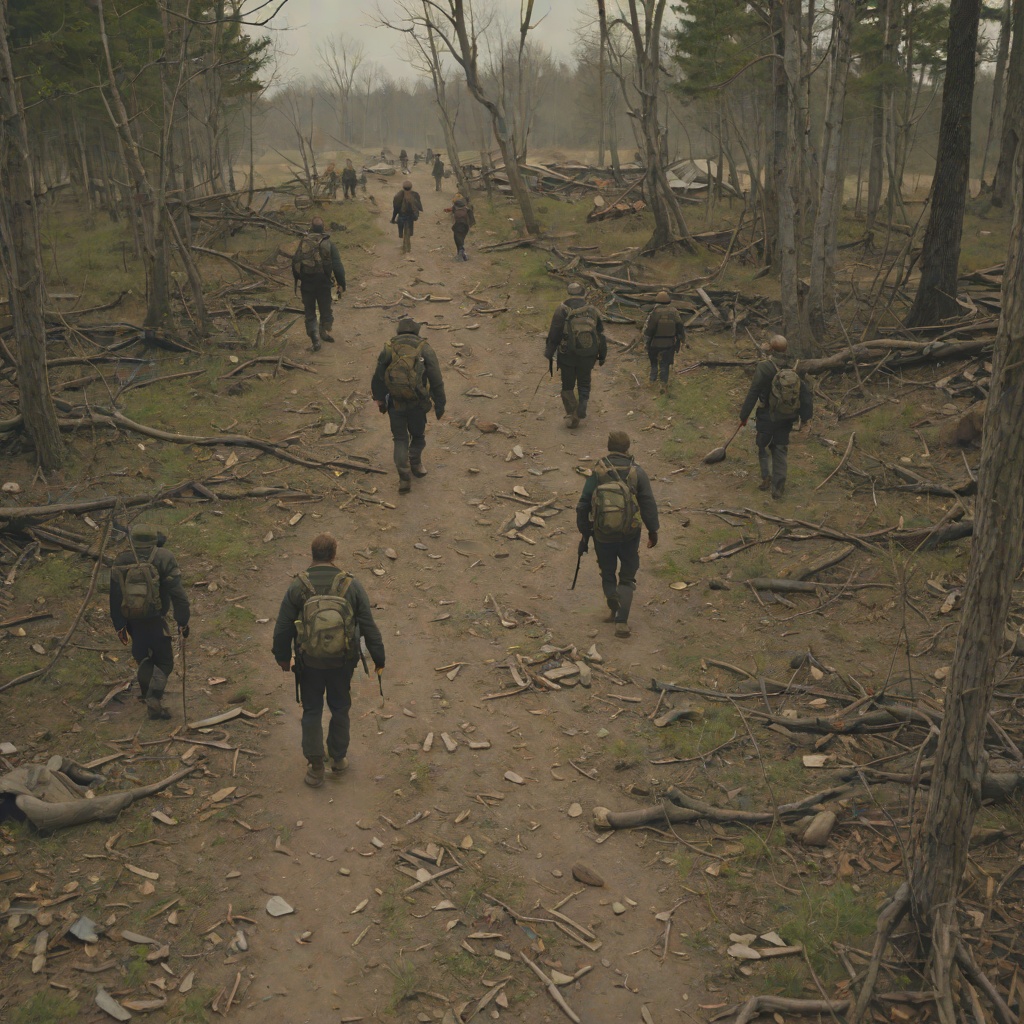
Percy gradually edges toward the side of the road while watching the soldiers on the halftrack and measuring the thick woods less than seven feet away. The other Walkers observe him, imitate ordinary conversation, and speculate about whether he has the courage to run. His movement toward the trees is slow and unhurried, almost deceptively calm: he takes several steps toward the woods, his blond hair stirred by a light breeze, resembling an Explorer Scout on a bird-watching outing rather than a fugitive under armed surveillance. There are no warnings once Percy’s right foot crosses the verge. The rules treat leaving the road as an immediate forfeiture of the right to warning, and the soldiers appear to have anticipated the attempt. One clean rifle report strikes him before he can escape. Percy reaches the weedy border of the pine forest and stands motionless, one hand pressed to his chest, while blood shines through his fingers. The visual symmetry between Percy and the angular soldier who shot him makes the execution resemble a frozen tableau, but the symmetry is false: one figure has the weapon and legal authority, while the other has only the brief illusion of choice.
Family, Witnesses, and Aftermath
Percy’s mother appears twice because the narrative refuses to let his death be detached from ordinary kinship. At the first roadside encounter, the police prevent her from reaching him; in Caribou, they remove her from the road and place her in a cruiser. Her repeated failure turns maternal love into a visible conflict with the event’s administration. She can identify her son, call him by name, and demand his return, but none of those acts can suspend the schedule or override the soldiers’ authority. Percy’s death also affects the Walkers as a spectacle witnessed at close range. Before the shooting, Garraty recognizes that Percy is preparing to break for the woods and understands that the soldiers will shoot him. After the shot, attention shifts between the armed man and Percy’s wounded body, with Percy becoming “the real show.” The road, the trees, the crowd, and the halftrack form a public stage on which a private attempt at escape is converted into an official execution. Later, Garraty imagines the dead as names and numbers in state records, with the eliminated Walker reduced to a headline and a mile marker. Percy is therefore both remembered as a son and absorbed into the statistical language that governs the Walk.
Narrative and Thematic Significance
Percy’s arc is a compact demonstration of the Long Walk’s political structure. Identity is admitted at the gate through a plastic card and a computer terminal, then increasingly governed by numbering, warnings, distance, and elimination. The same apparatus that records a participant’s official identity also makes his body available to armed enforcement. Percy’s mother’s interference is treated as a ticketable violation, Percy’s departure from the road as grounds for immediate shooting, and his death as one increment in the field’s changing total. His story also exposes the difference between apparent voluntariness and actual coercion. Percy does not merely vanish from the Walk; he tests the narrow boundary between continuing and escaping. The woods are physically close, yet the rules make them inaccessible: the instant he crosses the verge, the state’s response is automatic. His death shows how the event’s promise of choice is bounded by surveillance and lethal enforcement, while the crowd’s presence turns that enforcement into a shared public image. Finally, Percy remains a counterweight to the recurring language of endurance. The Walkers speak in miles, percentages, remaining bodies, food, and fatigue, but Percy’s mother keeps restoring a human scale through the repeated call of his name. The contrast does not save him. It makes the loss more legible: Percy is not only Walker 31, not only another eliminated participant, but also the boy his mother tries twice to retrieve from a machine designed to prevent retrieval. In that tension between person and statistic, his brief narrative presence becomes one of the clearest images of the event’s dehumanizing order.