The Century Club hysterical episode
The Long WalkThe Century Club hysterical episode is the Long Walk’s most visibly public crisis of bodily and psychological control. When the walkers reach one hundred miles, a celebratory roadside spectacle turns Ray Garraty’s exhaustion into hysterical laughter, nearly causing his elimination. Peter McVries saves him by physically forcing him onward, converting a moment of apparent humiliation into a decisive exchange of life for obligation.
Causes and Background
The episode occurs after the walkers have completed the first hundred miles, a distance marked by a huge red-and-white banner congratulating the Century Club Long Walkers. The announcement presents survival as an achievement worthy of civic pride, but the congratulations arrive within a system in which warnings, falling below speed, and execution make every mile a test of continued biological usefulness. The milestone therefore carries a double charge: it celebrates endurance while exposing how little separates public honor from death.
Garraty is already depleted by the road and by the spectacle surrounding it. Earlier, he had estimated that the walkers were about eighty miles out with twenty-seven already gone, and after ninety-nine miles thirty-six had disappeared. The numbers make progress visible only through attrition. Even food becomes part of the pressure. Other walkers are eating concentrate while Garraty tries to postpone his own meal, his stomach gnawing and growling as he watches McVries finish chicken spread. His resentment toward the others’ continued survival is not simple cruelty; it is the involuntary response of a body being forced to compete against every other body.
What Happens at One Hundred Miles
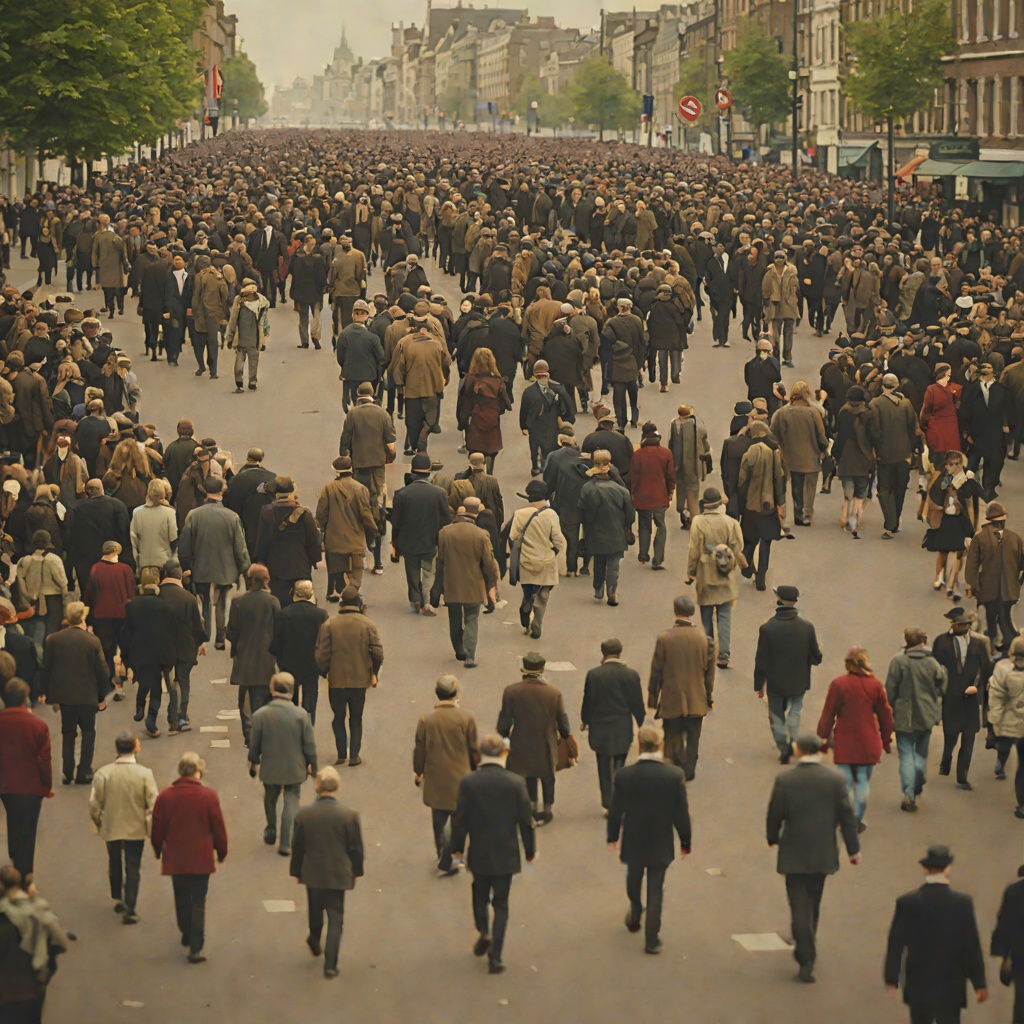
The Century Club crowd is the largest the walkers have yet encountered. State police hold people behind orange nylon ropes while flashbulbs pop, spectators cheer repeatedly, and a boy waves a toy glider and an autograph book. The scene makes the Long Walk a public performance rather than a private ordeal. Collie Parker responds by waving, smiling, and cursing the spectators and newsmen, a defiant performance that Garraty finds increasingly funny.
Garraty’s laughter begins when he notices the crowd’s absurd details: a man holding a badly lettered sign for Scramm has popped his fly, while a heavy woman in a yellow sunsuit is being crushed among beer-drinking college students. His perception turns the celebratory crowd into a grotesque tableau. The laughter intensifies because Collie Parker continues smiling and waving while insulting the people who have gathered to watch them. Garraty’s amusement is therefore inseparable from the spectacle’s moral ugliness: the crowd treats exhausted young men as entertainers, and his mind answers by exposing the ridiculousness underneath the ceremony.
The reaction quickly becomes physically dangerous. Garraty covers his mouth, laughs until his stomach knots, walks bent-legged, and hears warnings clearly despite the surrounding noise. He falls to his knees and receives another warning, then continues in short barking bursts that his laboring lungs can barely produce. He even thinks that dying from laughter would be an extraordinary joke, a thought that shows how completely the distinction between comedy and death has collapsed for him.
McVries tries to keep him moving by putting an arm around his back and hooking a hand into his armpit. Garraty repeatedly collapses, gasping that he cannot continue because his breath is gone. McVries then slaps him twice, once across each cheek, and walks away without looking back. The action is harsh but functional: tenderness cannot interrupt the race, while shock may restore the bodily rhythm on which Garraty’s life depends. The laughter stops, leaving Garraty with jelly-like legs, empty lungs, black spots before his eyes, and the immediate understanding that falling would mean death.
The Rescue and Its Cost
The episode does not end when Garraty stops laughing. His breathing returns only slowly, and he remains certain for a long time that a stitch is forming in his side. The crisis has shifted from comic excess to the sober mechanics of survival. McVries’s intervention has bought Garraty time, but it has not restored comfort or safety; it has merely returned him to the narrow path between walking and execution.
That rescue is confirmed moments later by the sound of the guns. Garraty initially believes the death may be his own, but a small stone shifts beneath one of his feet and reveals that another walker, Frank Morgan, has been eliminated. Morgan is dragged from the road with his glasses still hooked over one ear, the left lens shattered. The concrete details of the body and the broken glasses puncture Garraty’s hysterical unreality. He is alive, but another person has paid the price of the delay and danger surrounding him.
Hank Olson reacts with furious condemnation, declaring that McVries will be punished and that divine judgment will strike him down. McVries answers calmly that he pays his debts. His intervention is not presented as pure generosity: he regards Garraty as someone to whom he owed protection, and he treats the rescue as the settlement of an account. Nevertheless, the practical result is unmistakable. McVries prevented Garraty from going down, and Garraty recognizes that the two men are now bound by a debt that the race itself cannot acknowledge.
Consequences and Significance
The episode changes the meaning of companionship within the Long Walk. The rules reduce each fallen walker to an adjustment in the odds, and the narrative repeatedly records the dead as a body count. Yet McVries refuses, for one crucial moment, to let Garraty become merely another number. He risks his own pace and physically intervenes, preserving the individual life that the official structure is designed to discard.
At the same time, the rescue cannot escape the race’s logic of exchange. McVries’s help is framed as repayment, and Garraty’s renewed motion is purchased through pain, fear, and obligation. The scene thus produces a value reversal: the Century Club’s public celebration turns endurance into humiliation and near death, while the violent slap that appears degrading becomes the act that restores life. The crowd’s cheers make suffering into a spectacle; McVries’s private action momentarily makes it a relation between two human beings.
The event also foreshadows the Long Walk’s broader pattern of social death. The crowd sees colored shirts, souvenirs, signs, and entertainment, while the organizers preserve names and numbers for official records. Garraty’s laughter exposes the instability of that public image, but the gunfire reasserts the governing order. The walkers may be celebrated at one hundred miles, yet the celebration contains the threat of elimination at every step. By surviving the hysterical episode, Garraty does not escape the system; he becomes more conscious of its power and more deeply indebted to the person who briefly opposed its reduction of him to a statistic.
Narrative Role
As a main-narration event, the episode compresses the Long Walk’s central contradictions into one roadside sequence. It joins physical exhaustion to mass entertainment, comedy to execution, and friendship to coercive bodily force. Garraty’s breakdown is both an individual failure of control and a lucid response to the absurdity of the spectacle around him. McVries’s intervention supplies the reversal: the man who is laughing himself toward elimination is pulled back into the race, while the surrounding celebration is followed by the unmistakable sound of another walker’s death. The Century Club milestone consequently becomes less a triumph than a threshold at which survival, performance, debt, and mortality are exposed as parts of the same mechanism.