The Change
The Long WalkThe Change is the decisive historical rupture behind the political order of The Long Walk. It is not presented as a single narrated episode with a fully explained chronology, but as a remembered dividing line between an earlier society and the world in which the Walkers are processed, monitored, and killed under state authority. Its importance lies in the way it makes extraordinary violence appear administrative: the machinery of the state turns boys into verified identities, selected contestants, warnings, numbers, and finally casualties.
Historical Threshold
The clearest account of The Change comes from Stebbins, who places it in opposition to an earlier age “before the Change and the Squads,” when millionaires still existed and public philanthropy took the form of foundations and libraries. His comparison is deliberately casual but historically revealing. The old society was unequal and imperfect, yet it possessed institutions through which people could imagine leaving something behind; the new order has replaced those forms of continuity with the state’s direct management of life and death. Stebbins connects the earlier world not only to wealth but also to the possibility of descendants, inheritance, and durable social memory, then contrasts it with Walkers who will not leave children or “bastards.”
The Change therefore functions less as background decoration than as a historical explanation for the novel’s emotional climate. It separates a remembered civil society from a present defined by the Squads, the Long Walk, and the Major’s authority. The evidence does not specify the exact causes or date of the rupture, and the silence is significant: the characters live inside its consequences more fully than they understand its origins. History has become an operating system rather than a subject of public debate.
Administrative Power
The post-Change state reaches into the smallest acts of participation. When Ray Garraty arrives at the guarded parking lot, an old blue Ford is subjected to a formal gate ritual. A guard in khaki asks for the blue plastic identity card, and the card is passed to a computer terminal that seems strangely out of place in the rural landscape. The machine consumes the card and displays Garraty’s official identity, “GARRATY RAYMOND DAVIS,” followed by his address, “RD 1 POWNAL MAINE.” The scene joins bureaucratic precision to physical intimidation: the state does not merely know who he is; it requires him to become legible before it permits him to proceed.
That process is reinforced by the language of selection. The Long Walk is represented as a public drawing in which the Major draws two hundred names during a televised spectacle, while the announced names do not tell viewers whether a boy is an actual Walker or only a backup. McVries explains that participants are not informed of their status until the final backout date itself, a design that lets the authorities “stack the deck their way.” The apparently voluntary contest is thus surrounded by withheld information, deadlines, and procedural control. The Change has produced a system in which consent is formally preserved while meaningful choice is narrowed by secrecy and state-managed timing.
Violence as Procedure
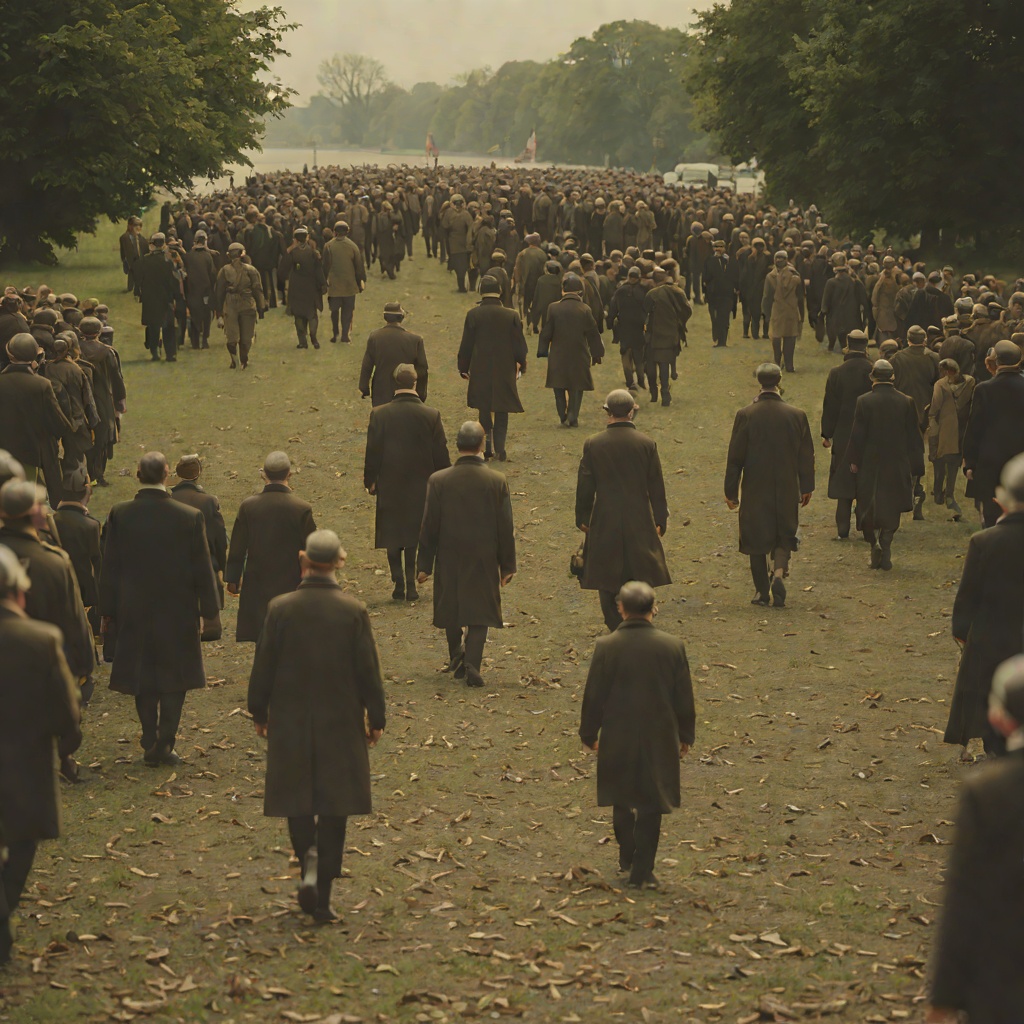
The Walk’s opening converts command into ritual. The Major raises his fingers over the assembled boys, suspending them in an immense silence while Garraty waits for the appointed signal. His hand finally drops, he offers “Luck to all,” and the boys begin walking smoothly, without jostling. The ceremony gives lethal coercion the surface of sportsmanship and military order. A gesture, a clock, and a brief benediction are enough to activate the mechanism.
The same system governs elimination. When Ewing falls below the required speed for the last time, soldiers push the other boys aside, drag him to the shoulder, pin his arms behind him, and shoot him in the head with a carbine. The killing is not an eruption outside the rules; it is the competent execution of the rules. The soldiers are described as experts who perform their job well, making technical efficiency itself part of the horror.
Later, Hank Olson’s attack on the halftrack exposes the physical foundation beneath the ceremony. As Olson climbs toward the vehicle, the soldiers bring their guns around in “perfect four-part harmony.” He seizes one weapon by its barrel and tears it from the soldier holding it, but another gun fires into his belly and through his back. Even after being shot, Olson reaches the top and grabs the weapon that wounded him, forcing its barrel upward as it fires again. The confrontation briefly reverses the expected relation between armed state and unarmed subject, yet the reversal cannot free Olson from the system’s lethal perimeter. Resistance becomes another scene contained by the Squads’ weapons.
At the end, the Major arrives in a jeep, standing upright and saluting. He is presented as ready to grant the winner a first wish, any wish, even a death wish: the Prize. Behind him, the already-dead Stebbins is shot again, while Garraty is left alone on the road. The state’s final representative therefore combines reward, spectacle, and execution. The same authority that promises unlimited personal fulfillment has just overseen the destruction of every rival.
From Persons to Statistics
The Change also alters how death is understood. After Ewing’s execution, McVries observes that Ewing bleeds the same color as anyone else, a bodily fact that momentarily resists the state’s abstraction. Yet the narration immediately registers the official logic: two boys are gone, the odds have shifted infinitesimally, and the remaining field has been reduced by a calculable amount. The dead body is absorbed into probability.
This statistical language recurs as the Walk advances. Around the eightieth mile, Garraty and McVries note that twenty-seven boys have already fallen, but the count is also framed as progress: they are a quarter of the way home. After ninety-nine miles, thirty-six are gone, and the endurance of the survivors is described through the simultaneous wonder that they have come so far and the cruel wish that everyone might drop dead. At this point, achievement and attrition are inseparable; the race advances only because bodies disappear.
Olson’s death produces the sharpest challenge to that conversion. Garraty insists that Olson was alive when he spoke to him and repeats the word “Alive.” McVries answers that Olson is only a number, part of the body count, number fifty-three. Garraty rejects that reduction, but his resistance is already framed against the official vocabulary of the event. The Change has made personal death and public arithmetic coexist, with the arithmetic steadily threatening to overwrite the person.
The same fate awaits Garraty in his imagination when he nearly buys his ticket. He pictures the official record as “GARRATY, RAYMOND, #47, ELIMINATED 218th MILE,” followed by a brief human-interest story in state newspapers identifying him as “MAINE’S OWN” and the sixty-first boy to fall. The imagined notice preserves his name only within a standardized entry, a mileage, and a rank in the death sequence. Even the phrase that promises human interest turns grief into consumable publicity.
The Change and the Prize
The Prize gives The Change its final contradiction. The system claims to offer the winner freedom through the fulfillment of any wish, but the offer is made only after the state has arranged a contest in which participation is bureaucratically controlled and elimination is enforced by gunfire. The Prize is therefore not outside the machinery; it is the machinery’s culminating promise. Death is distributed to almost everyone, while the survivor is invited to request whatever remains imaginable.
The Change’s historical significance rests in this fusion of legitimacy and violence. Guards, computers, clocks, televised drawings, official records, soldiers, and the Major’s salute all belong to one continuous order. None is merely a separate feature of the setting. Together they show a society that has learned to present coercion as procedure and annihilation as entertainment, while preserving enough ceremony, choice, and reward to make the arrangement appear voluntary. The boys walk through a world in which the past has been compressed into one ominous name, but every step demonstrates what that name has made possible.