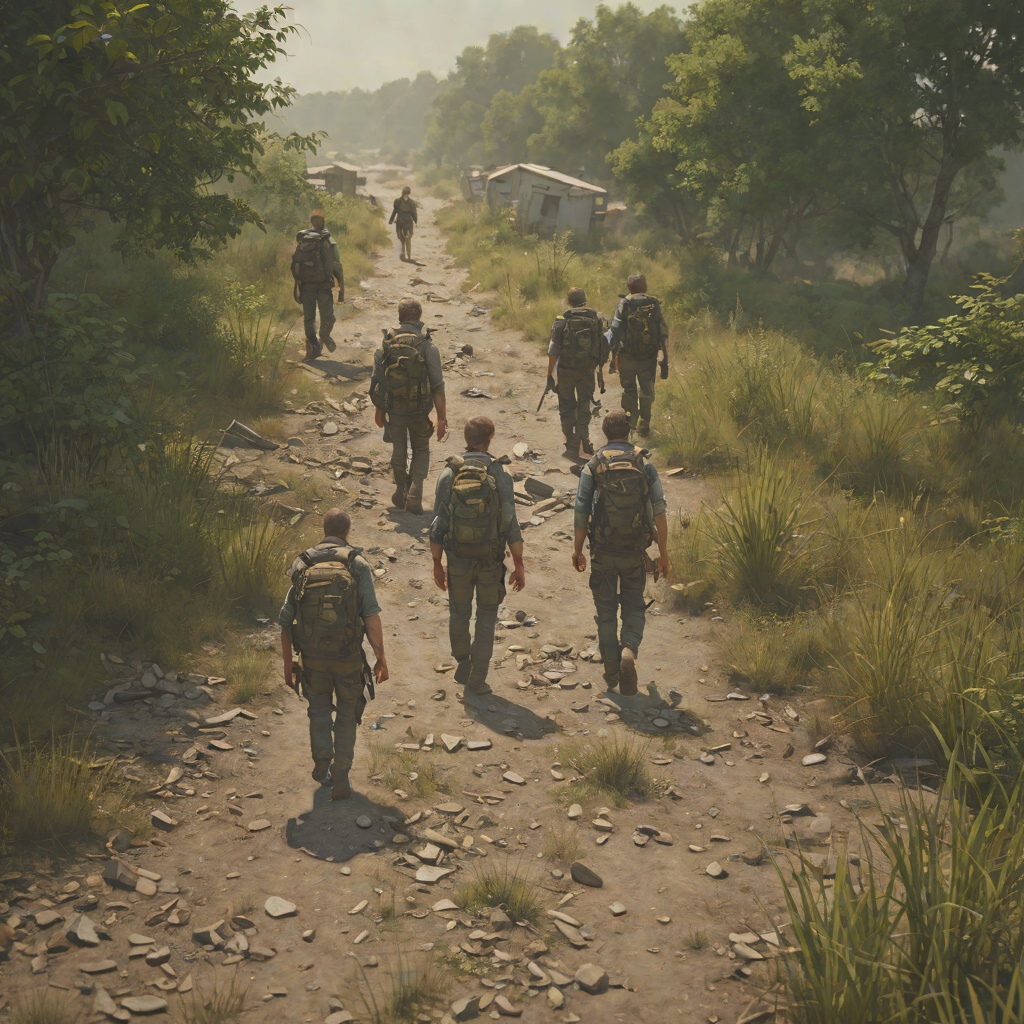
The Dom L’Antio watermelon incident
The Long WalkThe Dom L’Antio watermelon incident is a roadside confrontation in which Dom L’Antio tries to give free watermelon to the Long Walkers, only to be restrained by State Troopers. Its decisive significance lies in the collision between ordinary human generosity and the Event’s absolute control over movement: even food may become an offense when receiving it requires turning, stopping, or leaving the prescribed road.
Causes and Setting
The incident occurs after Garraty has begun to recover his spirits while the Walkers approach Oldtown and the turnpike. He has been thinking that the smoother road may make the remaining distance bearable and has even decided to wave to the next pretty girl he sees. Instead, he encounters a small Italian man beside an old station wagon with its rear hatch open. Dom L’Antio wears a battered felt hat and a black mustache curled at the ends, and he greets the Walkers with an exaggerated grin and strikingly white, square teeth.
The station wagon has been prepared as a mobile gift stand. An insulating mat covers the cargo compartment, crushed ice fills it, and wedges of watermelon show through the ice like broad pink grins. Above the vehicle, a sign announces: “DOM L'ANTIO LOVES ALL LONG WALKERS-FREE WATERMELON!!!” The abundance is made especially powerful by its timing. The Walkers are exhausted, hungry, and bound to a regime in which even a small deviation from the required pace can bring a warning or a bullet. The watermelon therefore represents more than refreshment: it is an unsanctioned alternative to the Event’s controlled distribution of bodily needs.
The Confrontation
Several Walkers, including Abraham and Collie Parker, break toward the shoulder at a dogtrot. They are moving faster than the required pace, but in the wrong direction, and the soldiers warn them. Dom L’Antio responds with delighted laughter, claps his hands, and lifts double handfuls of watermelon from the ice. The Walkers gather outside the restraining ropes as the roadside crowd becomes increasingly excited. Their desire is immediate and physical; Garraty feels his mouth shrivel with want while recognizing that the soldiers may prevent him from accepting the food.
Three State Troopers appear to restrain Dom L’Antio. Unlike the handpicked Long Walk soldiers, they are embarrassed and visibly red-faced, but they still force him away from the roadside. Dom L’Antio protests that the watermelon belongs to him and that he intends to give it away. When one Trooper reaches for the pieces in his hands, another circles behind him and slams the station wagon’s cargo door shut, sealing away the remaining supply.
The crowd turns against the Troopers. People boo, and a woman in a floppy straw sunhat throws a transistor radio at one officer, knocking off his cap. Garraty feels sympathy for the struck Trooper but continues shouting abuse, swept into the crowd’s shared resistance. The scene briefly reverses the normal arrangement of spectatorship: the crowd is no longer merely watching the Walkers submit to the rules, but openly challenging the officials who enforce them.
The Watermelon Throw
Just as Dom L’Antio seems to be disappearing from view, he slips free and runs back toward the Walkers. The crowd parts for him and then closes, or tries to close, against the police. A Trooper tackles him around the knees, sending him forward into the dirt. At the last instant, Dom L’Antio throws the watermelon slices in a wide arc and cries, “DOM L'ANTIO LOVES YOU ALL!”
The throw transforms restraint into spectacle. Dom lands headfirst and is quickly handcuffed, but the watermelon slices rise and pinwheel through the bright air. Garraty laughs aloud, raises both fists, and watches Abraham catch a piece with nonchalant deftness. The image contrasts sharply with the routine executions along the road: instead of bodies falling under rifle fire, pink slices pass through the air toward waiting hands.
The victory remains precarious. Several Walkers receive third warnings for stopping to collect pieces, yet no one is shot. Five, and then six, of the boys manage to obtain watermelon. The others cheer those who succeed or curse the wooden-faced soldiers, whose expressions now seem to reveal chagrin. The Event’s rules have not disappeared, but their enforcement momentarily bends under the pressure of collective action and public embarrassment.
Feast and Solidarity
Abraham eats with his face streaked by pink juice, then declares, “I love everybody!” and spits three brown seeds into the air. Collie Parker drives his face into his piece, devours it hungrily, breaks it in two, and throws half to Garraty while insulting him as “hicksville” and a “goddam rube.” Garraty answers, “Go fuck yourself,” but the exchange is affectionate in its antagonism: the food produces a temporary social ease that the Walk’s deadly competition normally suppresses.
Garraty catches the piece in surprise and experiences its coldness and sweetness as an almost overwhelming bodily relief. Some juice runs up his nose and down his chin; he eats only half, then calls to Peter McVries and throws the remainder to him. The gesture extends the incident’s chain of generosity. Dom L’Antio gives to the Walkers, Collie Parker gives to Garraty, and Garraty gives to Peter McVries. Against the Event’s logic of elimination, the watermelon creates a small economy of sharing.
Consequences and Significance
The incident does not alter the Long Walk’s rules or halt the soldiers’ authority. Warnings are still issued, the Troopers still remove Dom L’Antio, and the remaining Walkers must continue forward. Its consequence is instead emotional and symbolic. For a brief interval, the competitors are not reduced to pace, warnings, and survival statistics. They are hungry boys receiving cold fruit from a roadside stranger, laughing, shouting, sharing, and taking pleasure in one another’s good fortune.
The watermelon also exposes the Event’s governing contradiction. The Walk is presented as a public spectacle surrounded by cheering crowds, yet the authorities tolerate participation only when it remains controlled. A vendor may love the Walkers, and spectators may cheer them, but no one may materially assist them outside the approved system. The same public that is invited to celebrate the Event is punished or dispersed when its generosity threatens the discipline that makes the spectacle possible.
Placed beside the executions of Curley, Ewing, and Travin, the incident offers a vivid counter-image to state violence. Curley’s body is shattered by four carbines; Ewing is dragged aside and shot after falling below speed; Travin is killed while suffering a humiliating stomach illness. Against those scenes, Dom L’Antio’s watermelon is a transient image of color, appetite, and touch. Yet even this bright interruption remains surrounded by rifles and warnings. The incident’s hope is therefore real but limited: it cannot redeem the Walk, only reveal what the Walk’s system continually denies.