US-Canada border
The Long WalkThe America-Canada border is the northern starting threshold of the Long Walk, marked by a simple stone post and controlled by guards, identity technology, and the state’s armed apparatus. It is where Ray Garraty’s private decision becomes a public, enforceable ordeal: after crossing it, he is no longer merely a sixteen-year-old from Pownal, Maine, but a numbered walker subject to the event’s rules, surveillance, and lethal penalties.
Setting and Threshold
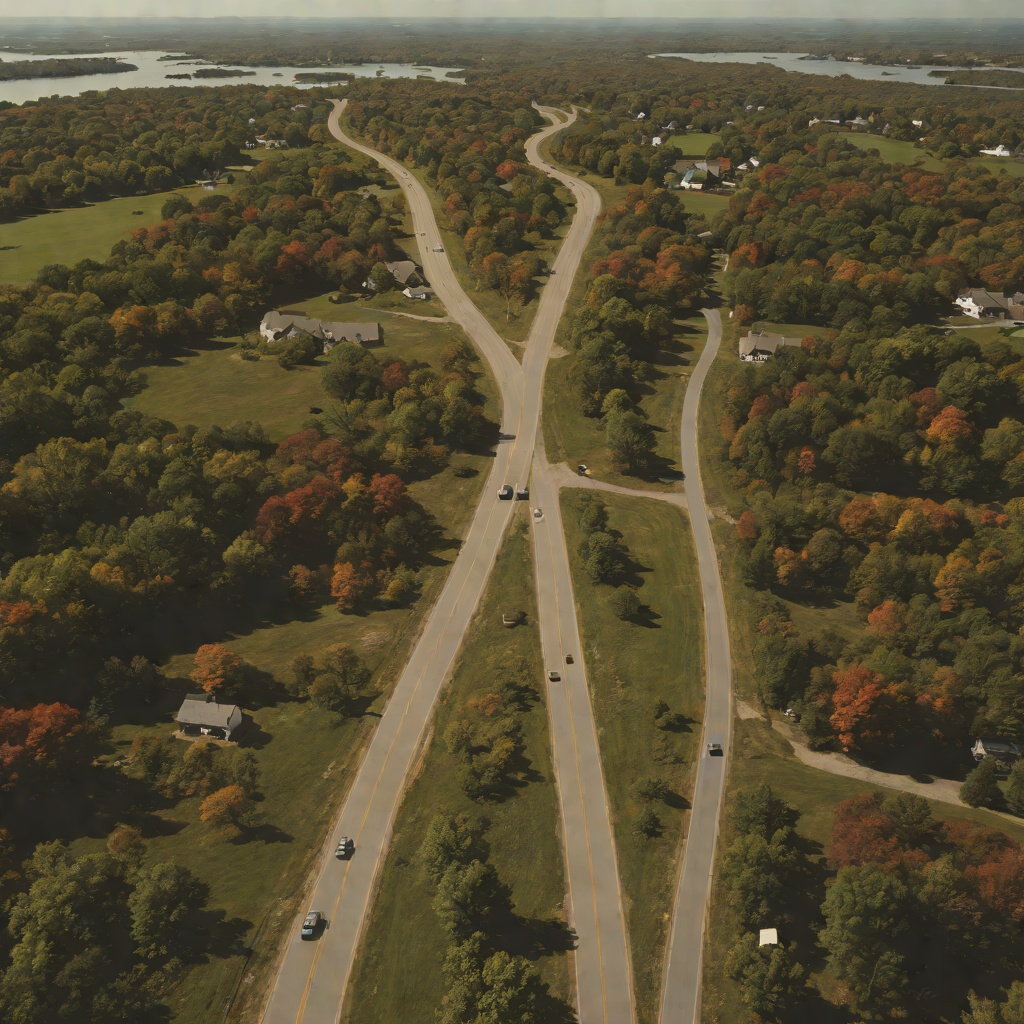
The border appears as a rural landscape of pines, pure blue sky, a broad black road, and a stone marker separating America from Canada. Its apparent simplicity contrasts with the elaborate machinery stationed nearby. An old blue Ford enters a guarded parking lot, where a khaki-clad guard demands a blue plastic identification card and feeds it into a computer terminal. The terminal produces Ray Garraty’s official identity, including his full name and address in Pownal, Maine. A domestic and familiar world is therefore processed through an impersonal administrative system before the road even begins.
The marker also gives the departure a ritual shape. Ray Garraty’s mother has brought him foil-wrapped cookies, embraces him awkwardly, and struggles to accept that the choice has become irreversible. Her anxiety is linked to guilt: she believes she should have stopped his participation before the state’s machinery took control. At the border, family feeling and bureaucratic authority occupy the same space, but they do not possess equal power. Her trembling chin and belated acceptance show that the crossing is not simply travel; it is a separation that has become too late to prevent.
Departure into the Long Walk
After the walkers leave the parking area, a woman’s sudden scream breaks the uneasy quiet. Ray Garraty and Peter McVries move closer together without looking back, while ahead of them the road waits, wide and black. Peter McVries notices that the composition surface will become hot by noon and intends to remain on the shoulder, an early reminder that the apparently open road is already a field of tactical choices governed by heat, speed, and bodily endurance.
The Major then converts the assembled boys into an organized body. Soldiers distribute belts containing snap pockets and tubes of high-energy concentrate paste, along with canteens. Hank Olson wears his belt low on his hips like a gunslinger and eats a Waifa chocolate bar, while Ray Garraty wonders whether the display is bravado or evidence of knowledge he lacks. The equipment is practical, but it also makes the participants legible as managed units: bodies are supplied, arranged, timed, and prepared for a contest whose material conditions have been set by authority.
When The Major drops his fingers and wishes everyone luck, the walkers begin moving smoothly, without jostling. Ray Garraty passes beyond the stone marker with Peter McVries on his left and Hank Olson on his right. The sound of their feet becomes unusually loud, and the repeated sense that this is truly happening gives the crossing its irreversible force. The border is the point at which anticipation overtakes fear and the event’s abstract rules become bodily motion.
The Border as State-Controlled Space
The checkpoint demonstrates how the Long Walk’s violence is concealed within routine administration. Identity is verified by a computer terminal; participants are assembled by number and line; soldiers distribute supplies; and The Major’s gesture authorizes movement. The system does not need to present the crossing as an open act of coercion. It surrounds a supposedly voluntary decision with procedures that make withdrawal, family intervention, and ordinary legal protections increasingly irrelevant.
That structure remains visible throughout the route. Soldiers push aside the other walkers when Ewing falls below speed, drag him to the shoulder, and shoot him with a carbine. Later, Hank Olson climbs onto a halftrack and seizes a soldier’s gun barrel before being shot in the belly. At the Long Walk’s end, The Major arrives in a jeep, salutes, and stands ready to grant the winner’s wish, even as the already-dead Stebbins is shot behind him. These later scenes retrospectively darken the border crossing: the same organized authority that supplied belts and canteens also possesses the weapons and procedures that determine who may continue living.
Route, Infrastructure, and Expansion of the Spectacle
Once the walkers leave the border, the road becomes a succession of controlled and improvised thresholds. At roughly sixty miles, they reach a makeshift plank bridge over a fast-running rill, illuminated by truck beams. A washed-out support and missing butt planks have been replaced with a sawed-off telephone pole and a convoy-truck tailgate. The repair keeps the route functioning, but its roughness reveals that the landscape itself is being altered to sustain the event.
The route later parallels a turnpike, with a steep embankment and bone-white arc-sodium lights visible above it, before the entrance ramp rises ahead. In Porterville, the walkers pass a traffic island, the Porterville Rec Center, and a Government Sales building before reaching the Androscoggin River and a textile mill. The road therefore moves through civic, industrial, and transportation spaces without releasing the walkers from the event’s logic. Ordinary infrastructure becomes scenery, boundary, obstacle, and viewing platform for the same continuous ordeal.
Near Freeport, the walkers cross an overpass and enter town, then turn onto U.S. 1. Woolman’s, a place associated with Ray Garraty’s memories of stopping there with Jan after movies, comes into view behind a false front. The crowd swells, a fire siren joins Klingerman’s cries, and ticker tape falls into the rain. The familiar town is transformed into a spectacle space in which Ray Garraty searches for his mother and Jan while soldiers keep their guns trained on him, ready to shoot if he attempts to vanish into the crowd.
Northern Boundary and Narrative Significance
The border remains a structural reference point even after the walkers have traveled far beyond it. A large banner later announces that only fifteen miles remain before the Massachusetts border, emphasizing how the Long Walk measures progress through successive territorial limits. The narrow neck of New Hampshire between Maine and Massachusetts makes the state line seem close, but the walkers’ exhaustion turns that geographic distance into another test of survival.
As a location, the America-Canada border joins intimate departure to institutional violence. Ray Garraty arrives with a mother, cookies, an address, and a recognizable home identity; he leaves under military supervision, carrying standardized food and water, his movement fixed by a public rule system. The stone marker is therefore less a neutral national boundary than the first visible line in a sequence of enforced thresholds. Beyond it, roads, bridges, turnpikes, towns, crowds, state lines, and the final jeep all belong to an expanding machinery that converts motion into obedience and death into spectacle.