Bilbo Baggins
The Lord of the RingsBilbo Baggins of Bag End is the hobbit whose unexpected journey to the Lonely Mountain and whose discovery of a seemingly insignificant golden ring set in motion the vast events of the War of the Ring. He is the first hobbit to become famous in the wide world, the author of the initial chapters of the Red Book of Westmarch, and the figure whose act of pity toward a wretched creature named Gollum ultimately determined the fate of Middle-earth. His life spans the quiet prosperity of the Shire, the perils of high adventure, and a final, blessed departure across the Sea into the Uttermost West.
Identity and Background
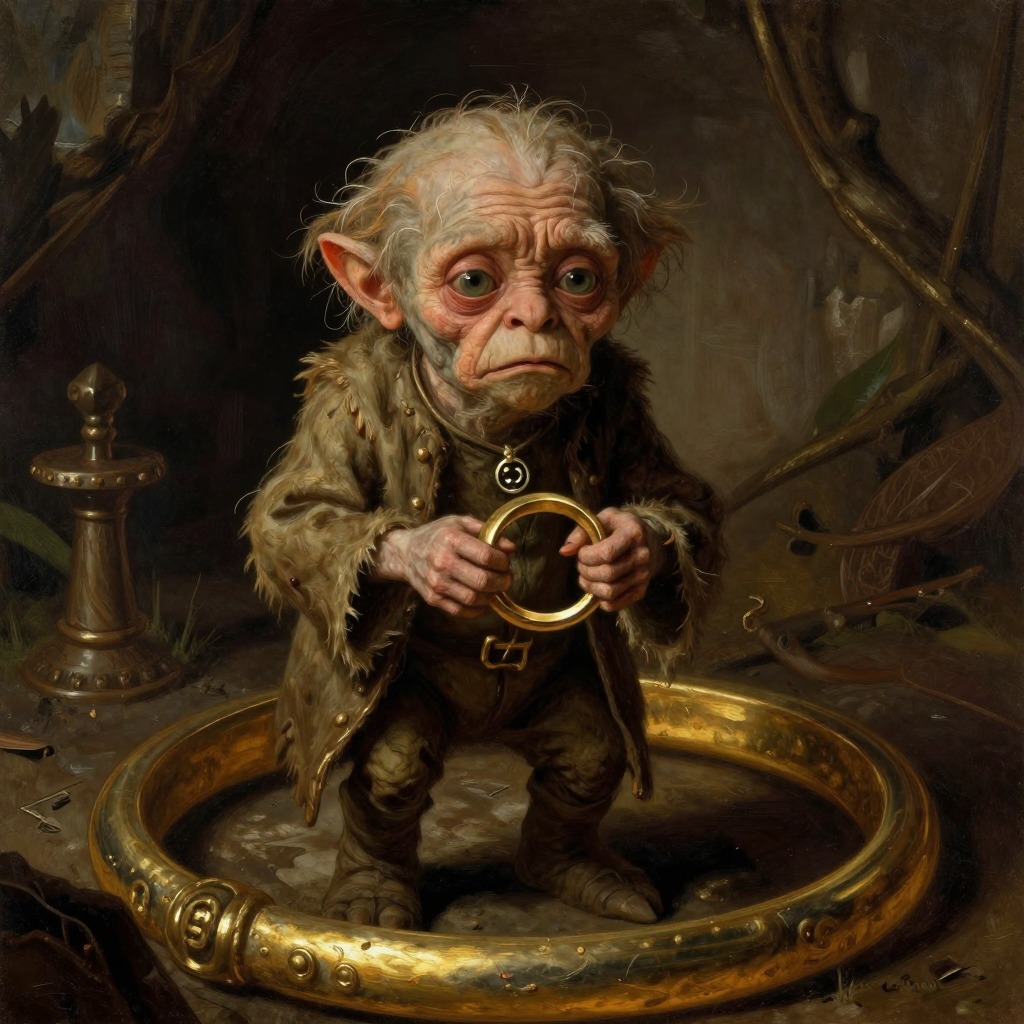
Bilbo was the son of Bungo Baggins and Belladonna Took, a union that blended the respectable, conventional Baggins nature with the adventurous, unpredictable Tookish streak. He lived a comfortable, solitary life at Bag End in Hobbiton, a hole renowned for its comfort and its well-stocked pantry, until the Wizard Gandalf and a company of thirteen Dwarves arrived on his doorstep. This visit launched him on the Quest of Erebor, during which he stumbled upon the One Ring in the dark tunnels of the Misty Mountains. There, he encountered Gollum, a creature twisted by the Ring's power, and engaged him in a Riddle-game for his life. Winning by chance—asking "What have I got in my pocket?"—Bilbo escaped, but he kept the Ring, a secret he guarded for sixty years. His account of this meeting was initially a lie, claiming Gollum had promised him a "present," a falsehood that deeply troubled Gandalf and hinted at the Ring's corrupting influence.
The Long-Expected Party and Departure
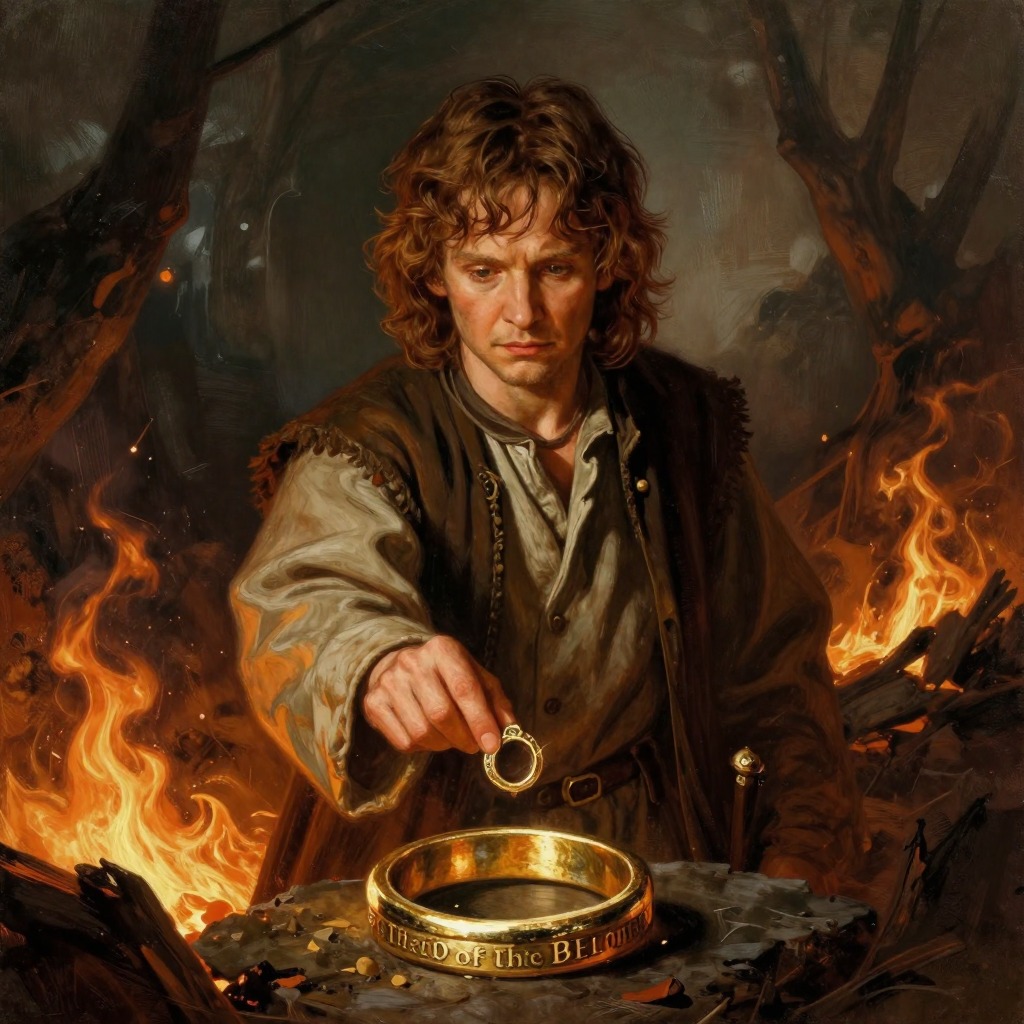
For decades after his return, Bilbo lived quietly in the Shire, his wealth and prolonged vigour making him a local legend. He was called "well-preserved" at ninety-nine, and many whispered that his fortune was ill-gotten. On his eleventy-first birthday, he threw a party of spectacular magnificence, complete with fireworks designed by Gandalf, a grand pavilion, and gifts for all. During his after-dinner speech, he announced his immediate departure, slipped on the Ring, and vanished in a blinding flash, leaving his guests flabbergasted. This was no mere prank; it was the culmination of a long-planned escape. He had already sold Bag End to his relatives, the Sackville-Bagginses, and had made all arrangements to leave. In the privacy of his home, he prepared to leave, donning an old cloak and a worn leather belt with a short sword, and packing a heavy bag. He struggled intensely with Gandalf over the Ring, momentarily calling it "my Precious" and reaching for his sword, before finally surrendering it. He then departed into the night with three Dwarves, singing of the Road, leaving behind his home and his life in the Shire for good.
Life in Rivendell and the Final Years
After his departure, Bilbo wandered to Rivendell, where he settled into a peaceful, scholarly life. He wrote poetry, including the lay of Eärendil, and continued his book, the Red Book of Westmarch. He grew very old, reaching the age of one hundred and thirty-one, surpassing the Old Took. When Frodo arrived in Rivendell after his own perilous journey, Bilbo was overjoyed to see him, though he had grown sleepy and frail. He gave Frodo his mithril-coat and his sword Sting, and he asked to see the Ring one last time, but when Frodo showed it, a shadow fell between them, and Bilbo's face seemed to become hungry and gnarled. He quickly understood and told Frodo to put it away, apologizing for the burden. He spent his final days in Rivendell, content to sit by the fire, listen to tales, and sleep. On the day of the final departure, he joined the Ring-bearers and the Keepers of the Three Rings, riding a small grey pony to the Grey Havens, where he sailed into the West, his story complete.
The Ring and the Riddle-game
The central event of Bilbo's life was his finding of the Ring. In the caves of the Misty Mountains, he put his hand on it in the dark, a moment of "mere luck" that was in fact the turning point of the age. The Ring had abandoned Gollum, seeking its master, and was picked up by the most unlikely person imaginable. Bilbo's encounter with Gollum was a Riddle-game, a contest of wits where the stakes were his life. He won by asking a question that was not a riddle, but Gollum, bound by his promise, was forced to show him the way out. Bilbo's decision not to kill Gollum when he had the chance, an act of pity and mercy, was later revealed by Gandalf to be of immense importance, for Gollum was bound up with the fate of the Ring. Bilbo's long possession of the Ring, for sixty years, left its mark. He felt "thin, sort of stretched, like butter that has been scraped over too much bread," a sign that the Ring was gaining control. Yet he gave it up of his own accord, an act that Gandalf considered crucial, proving that hobbits could resist the Ring's power longer than the Wise believed.
Relationships and Legacy
Bilbo's most significant relationship was with his adopted heir, Frodo Baggins. He took Frodo in as a child after his parents drowned, and the two shared a deep bond, celebrating their birthdays together. Bilbo taught Frodo his letters and told him tales of Elves and Dragons, and he entrusted him with the Ring and the secret of his journey. He also maintained a long friendship with Gandalf, though it was strained by the wizard's persistent questioning about the Ring. His legacy is twofold: he is the author of the Red Book, the primary source for the history of the War of the Ring, and he is the Ring-finder, the hobbit whose discovery of the One Ring set the stage for its eventual destruction. His story, from a comfortable hobbit-hole to the shores of the Sea, is a testament to the idea that even the smallest person can change the course of the world.