Edoras
The Lord of the RingsEdoras, the chief city of Rohan, stands as the seat of the Kings of the Mark, a realm of horsemen renowned for their valor and independence. Nestled in a sheltered valley at the feet of the White Mountains, the city is dominated by Meduseld, the Golden Hall, a great thatched hall whose roof glimmers like gold in the sunlight. The approach to Edoras is marked by the Barrowfield, where seven mounds on the left and nine on the right commemorate the sires of the House of Eorl, their slopes covered with the white flowers of simbelmynë, the evermind that blooms in all seasons. The city itself is a place of wooden houses and a single great hall, built upon a green hill and encircled by a dike and a thorny fence, with a stream flowing from a spring carved in the likeness of a horse's head.
History and Significance
Edoras was founded by Brego, son of Eorl the Young, who completed the Golden Hall in the year 2569 of the Third Age. It became the capital of Rohan after the Rohirrim were granted the land of Calenardhon by Cirion, Steward of Gondor, following the Battle of the Field of Celebrant. For centuries, the city stood as a symbol of the alliance between Rohan and Gondor, a bastion of free Men against the encroaching darkness. However, by the time of the War of the Ring, Edoras had fallen into a state of decay under the influence of Gríma Wormtongue, a servant of Saruman who whispered poison into the ears of the aging King Théoden. The king, once a proud warrior, had become bent and feeble, his will sapped by Wormtongue's counsels, and the city's martial spirit had waned.
The Arrival of Gandalf and the Restoration
The turning point for Edoras came with the arrival of Gandalf the White, Aragorn, Legolas, and Gimli. Gandalf confronted Wormtongue and, casting aside his grey cloak, revealed his true power. He commanded Théoden to come forth from his hall, and the king, casting aside his staff, stood tall and straight once more. The wizard's intervention broke the spell of despair that had held the city, and Théoden, reclaiming his sword Herugrim, declared war on Saruman. The city was roused from its lethargy, and the Riders of Rohan mustered for the ride to Helm's Deep and, later, to the Battle of the Pelennor Fields. The Lady Éowyn, who had been left to govern the people in Théoden's absence, stood alone before the doors of the silent house as the host rode west, a figure of both sorrow and resolve.
The City's Role in the War
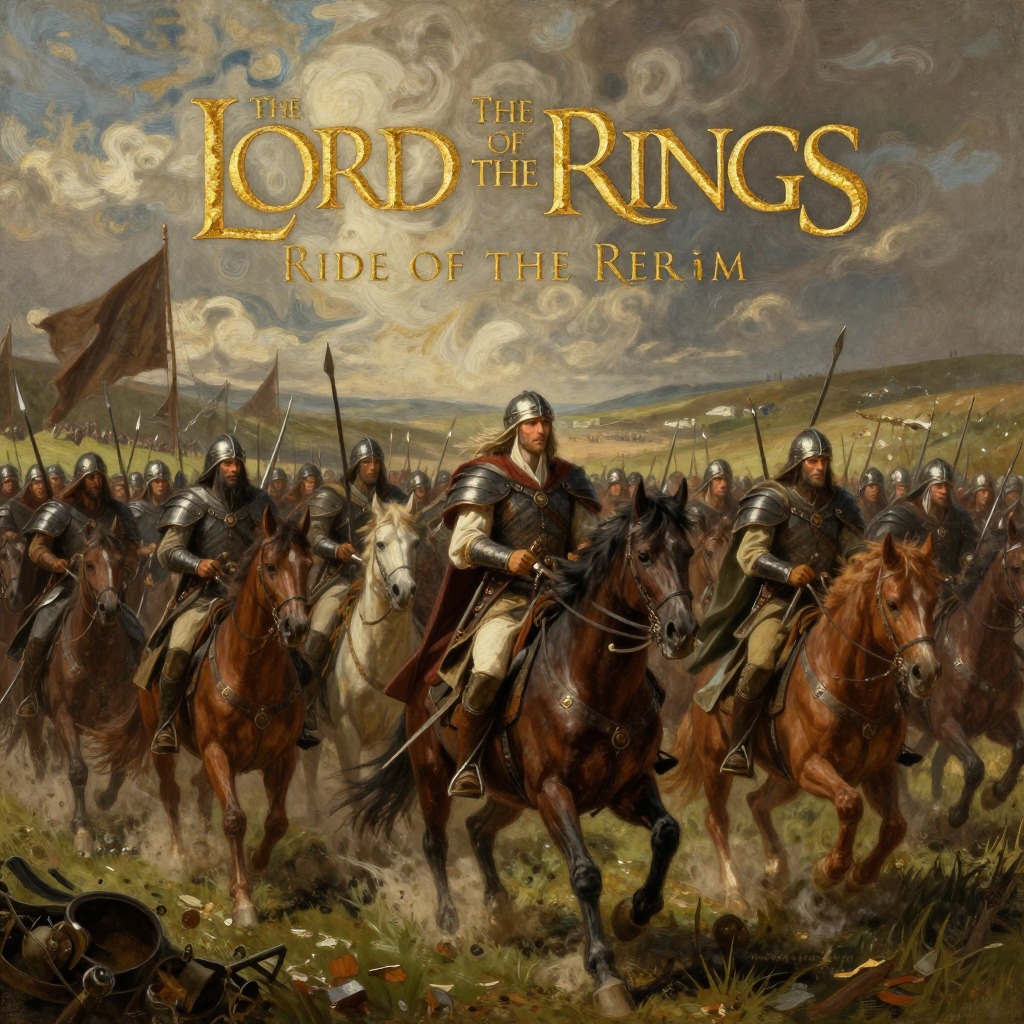
Edoras served as the staging ground for the Muster of Rohan, where Théoden gathered his forces before riding to the aid of Gondor. The city itself was not directly attacked during the war, but its fate was tied to the battles fought far away. After the victory at the Pelennor Fields, Théoden's body was brought back to Edoras and laid to rest in a great mound, the eighth of the east-side barrows, where the white simbelmynë grew thickest. The city then passed to Éomer, who became a great king, and in the years of peace that followed, Edoras was restored to its former glory, a place of feasting and song, where the memory of the fallen was honored.
Architecture and Description
Edoras is described as a city of wooden buildings, with the Golden Hall at its heart. The hall is long and wide, filled with shadows and half-lights, its mighty pillars carved and gleaming with gold. The floor is paved with stones of many hues, and woven cloths depicting ancient legends hang upon the walls. The city is approached by a winding road that passes through the Barrowfield, where the mounds of the kings are covered with the white flowers of simbelmynë. The stream that flows from the horse's head fountain provides water for the city, and the surrounding plains of Rohan stretch away to the east and west, a land of grass and wind.