Frodo Baggins
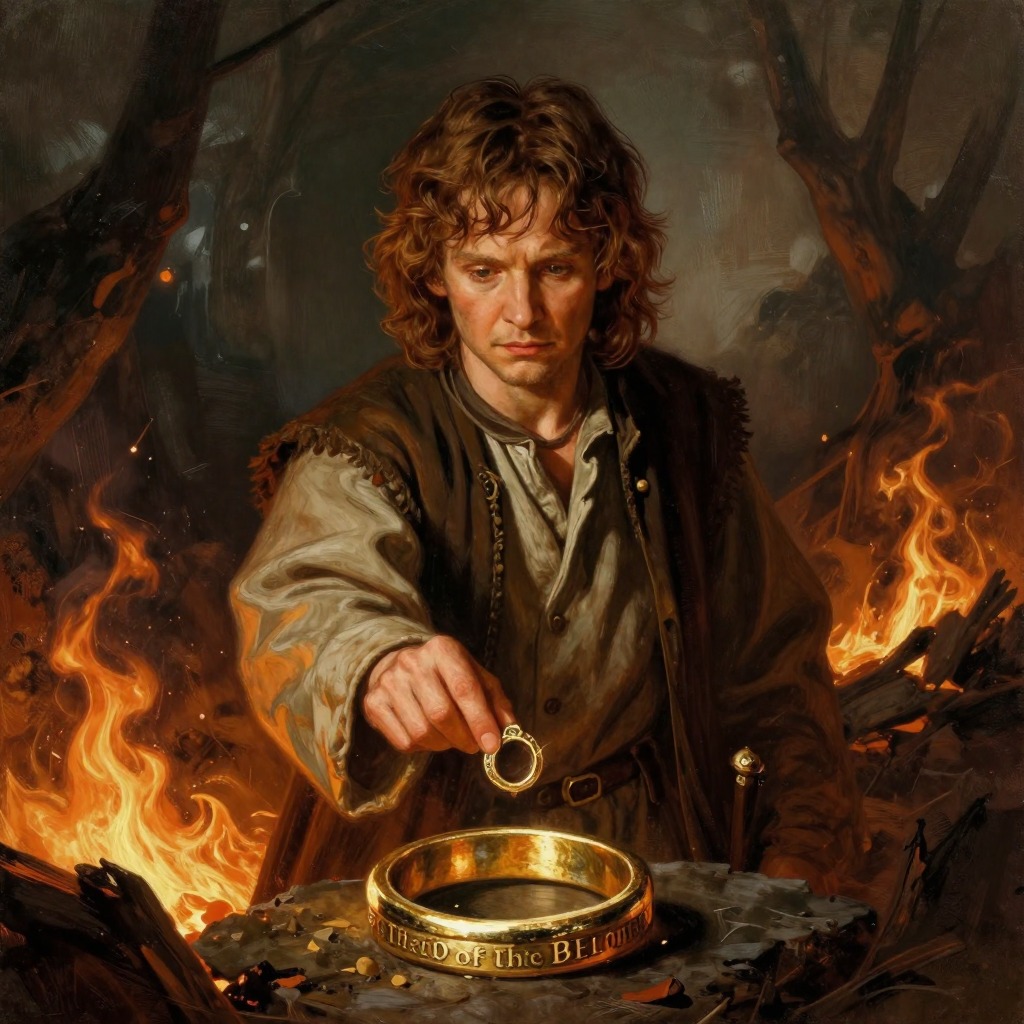
The Lord of the RingsFrodo Baggins, a hobbit of the Shire, is the central protagonist of The Lord of the Rings, the Ring-bearer upon whom the fate of Middle-earth rests. He is introduced as the adopted heir of his eccentric uncle, Bilbo Baggins, living quietly at Bag End in Hobbiton. Frodo is described as a fair, bright-eyed hobbit, taller than some and with a cleft in his chin, who inherits not only Bilbo's estate but also a mysterious golden ring that proves to be the One Ring, the master-weapon of the Dark Lord Sauron. His journey from a peaceful, provincial life to the heart of darkness in Mordor forms the spine of the entire narrative, transforming him from a reluctant adventurer into a figure of immense, tragic endurance.
Identity and Background
Frodo was born to Drogo Baggins and Primula Brandybuck, who died in a boating accident on the Brandywine River when he was a child. Orphaned, he was raised by the Brandybucks in Buckland, a region of the Shire known for its more adventurous and peculiar folk. At the age of thirty-three, he was adopted by his cousin Bilbo, who brought him to live at Bag End. Frodo shared Bilbo's birthday, September 22nd, and the two became inseparable companions. He was known for his friendship with the Elves, often wandering alone in the hills and woods under starlight, a habit that marked him as slightly odd to his more insular neighbors. He was also a close friend of Merry Brandybuck, Pippin Took, and his gardener, Samwise Gamgee, who would become his most loyal companion.
The Burden of the Ring
Frodo's life is irrevocably changed when Gandalf the Grey reveals the true nature of Bilbo's ring: it is the One Ring, the Ruling Ring of Sauron. The wizard explains that the Ring is a malevolent entity that seeks to return to its master, and that it must be destroyed in the fires of Mount Doom, where it was forged. Frodo, feeling the weight of this terrible knowledge, volunteers to take the Ring to Rivendell, and later, at the Council of Elrond, he accepts the monumental task of carrying it to Mordor itself. "I will take the Ring," he says, "though I do not know the way." This decision sets him on a path of immense physical and spiritual trial. The Ring's influence grows as he journeys, becoming a heavy weight on his body and a corrosive force on his mind, tempting him with power and isolating him from his friends. He feels the constant, searching presence of the Eye of Sauron, a hostile will that strives to pierce all shadows and see him.
Key Actions and Relationships
Throughout the quest, Frodo demonstrates remarkable resilience and a deep, often unspoken, capacity for pity. He spares the life of Gollum, a wretched creature also enslaved by the Ring's desire, a decision that Gandalf later says may rule the fate of many. This mercy proves crucial, as Gollum ultimately destroys the Ring by falling into the Cracks of Doom while wrestling it from Frodo. Frodo's relationship with Samwise Gamgee is the emotional core of the journey. Sam's unwavering loyalty, practical sense, and love provide Frodo with the strength to continue when his own will falters. In the dark of Mordor, Sam carries Frodo when he can no longer walk, and it is Sam who rescues him from the Tower of Cirith Ungol after he is stung by Shelob. Frodo's bond with Sam is tested by the Ring's power, most painfully when Frodo, under its influence, momentarily sees Sam as a thief and an orc, but their friendship ultimately endures.
Change and Ending
Frodo is irrevocably changed by his ordeal. He is wounded by a Morgul-knife on Weathertop, stung by Shelob, and loses a finger when Gollum bites off the Ring. The physical and spiritual scars of bearing the Ring never fully heal. He experiences recurring pain on the anniversaries of his wounds, particularly on October 6th, the day he was stabbed at Weathertop. After the Ring's destruction, he returns to the Shire, but finds he is no longer the same hobbit. He feels a deep sense of loss and displacement, telling Sam, "I have been too deeply hurt, Sam. I tried to save the Shire, and it has been saved, but not for me." He finds no lasting peace in the simple life he once loved. His true home has become the memory of his journey and the burden he carried. He is granted the grace to sail into the West from the Grey Havens, a passage to the Undying Lands reserved for the Ring-bearers, where he may find healing for his wounds and weariness. This departure is a bittersweet ending, a final farewell to his friends and the world he saved, but a necessary journey for his own peace.
Narrative Role and Evaluation
Frodo is the quintessential reluctant hero, a figure of immense courage not because he is a warrior, but because he endures a spiritual and psychological torment that would break most beings. His story is one of sacrifice and the heavy cost of doing what is right. He is not a triumphant conqueror but a survivor, deeply scarred by his ordeal. His failure at the very end, when he claims the Ring for himself on the edge of the Cracks of Doom, is a crucial narrative point, highlighting the Ring's overwhelming power and the impossibility of its being mastered by any mortal will. His salvation comes not from his own strength, but from the earlier act of pity that set Gollum on the path to destroy the Ring. Frodo's legacy is not one of martial glory, but of profound, quiet endurance and the power of mercy, making him one of the most complex and tragic heroes in fantasy literature.