One Ring
The Lord of the RingsThe One Ring, the Ruling Ring, the Master-ring, Isildur's Bane, the Precious—by whatever name it is called, this small circle of gold is the fulcrum upon which the entire War of the Ring turns. Forged secretly by Sauron in the Sammath Naur, the Chambers of Fire within Mount Doom, it was made to rule and enslave the other nineteen Great Rings, and into it Sauron poured a great part of his own native power, so that while it existed he could not be wholly destroyed. Its loss crippled him; its recovery would make him invincible. The entire quest of the Fellowship—the long journey from the Shire to the Cracks of Doom—is a story of the Ring's terrible gravity, its corrosive effect on every bearer, and the slender hope that it might be unmade.
Forging and Nature
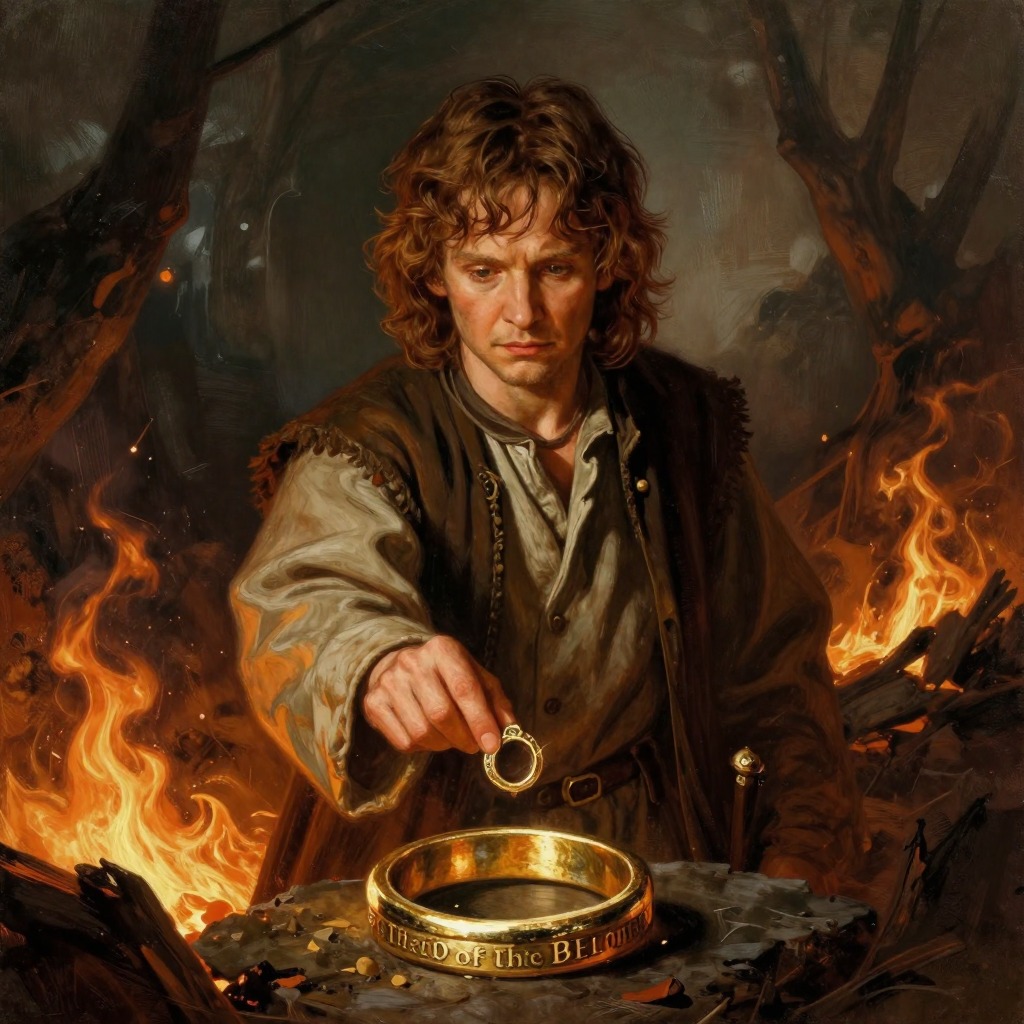
The One Ring was created by Sauron alone, in secret, during the Second Age. The Elven-smiths of Eregion, led by Celebrimbor, had forged the other Rings of Power with Sauron's guidance, but he betrayed them by making the One in the Mountain of Fire to be their master. The Ring is described as being made of pure and solid gold, perfectly round and unadorned, yet when cast into a fire, fiery letters appear on its surface, written in an Elvish script of Eregion but in the language of Mordor. These letters form two lines of a verse: "One Ring to rule them all, One Ring to find them, One Ring to bring them all and in the darkness bind them." This inscription is the mark of the Master-ring, and its revelation to Frodo by Gandalf confirms the Ring's true identity. The Ring is not inert; it possesses a will of its own, actively seeking to return to its master. Gandalf explains that "A Ring of Power looks after itself, Frodo. It may slip off treacherously, but its keeper never abandons it." It abandoned Gollum, for instance, only to be picked up by Bilbo, an event Gandalf describes as "the strangest event in the whole history of the Ring so far." The Ring's power is to dominate the wills of others, but it also grants invisibility to mortals by drawing them partially into the wraith-world. Its primary effect on a mortal bearer is not death but a prolonged, weary existence, a slow fading until the bearer becomes a wraith under the dominion of the Dark Lord.
The Ring's Effect on Bearers
The Ring corrupts all who possess it, but the nature and speed of that corruption vary. For Gollum, who held it for nearly five hundred years, the Ring twisted him into a wretched, murderous creature, utterly enslaved by his desire for his "Precious." Yet even he was not wholly ruined; a remnant of the hobbit Sméagol remained, a fact that proved crucial at the end. Bilbo Baggins carried the Ring for sixty years, and though he was able to give it up of his own accord—a unique feat in history—Gandalf notes that it had already begun to take hold of him, making him feel "thin, sort of stretched, like butter that has been scraped over too much bread." Frodo, the Ring-bearer, feels its weight grow heavier with every step toward Mordor. It becomes a physical and psychological burden, tormenting him with visions of the Eye of Sauron and nearly overwhelming his will. At the very Cracks of Doom, Frodo succumbs, claiming the Ring for himself and putting it on his finger. It is only Gollum's desperate attack and subsequent fall into the fire that destroys the Ring, fulfilling Gandalf's cryptic prophecy that Gollum still had a part to play. The Ring's power over others is also demonstrated by Boromir, a noble man of Gondor who is driven to madness by his desire to use the Ring against the Enemy, ultimately attacking Frodo in an attempt to take it.
The Ring's History and the Quest for its Destruction
The Ring's history is long and bloody. It was cut from Sauron's hand by Isildur at the end of the Second Age, but Isildur refused to destroy it, taking it as a weregild for his father and brother. It soon betrayed him, slipping from his finger as he swam in the Anduin, leading to his death by Orc arrows. The Ring lay lost in the riverbed for millennia until it was found by Déagol, who was murdered for it by his friend Sméagol, who became Gollum. It then abandoned Gollum and was found by Bilbo in the caves of the Misty Mountains. The Council of Elrond determined that the Ring could not be used by the Free Peoples, as it would corrupt any wielder, and that it could not be hidden or cast into the sea. The only hope was to return it to the fire of Mount Doom, where it was made, and destroy it. This task fell to Frodo, who, with his faithful servant Samwise Gamgee, journeyed into the heart of Mordor. The Ring's power grew as it neared its place of forging, becoming an almost unbearable weight and a constant temptation. In the end, it was destroyed not by Frodo's will but by Gollum's greed, as the creature bit off Frodo's finger and, in his triumph, fell into the chasm of fire. With the Ring's destruction, Sauron was utterly defeated, Barad-dûr crumbled, and the Third Age came to an end.