Théoden
The Lord of the RingsThéoden, son of Thengel, King of the Mark of Rohan, is one of the central figures of the War of the Ring, a ruler who passes from a state of withered despair under the influence of the traitor Saruman to a final blaze of heroic kingship. His arc is a story of restoration, sacrifice, and the rekindling of a royal line's ancient valour, culminating in his death on the Pelennor Fields after a charge that turns the tide of battle.
Identity and the Shadow of Wormtongue
When Gandalf, Aragorn, Legolas, and Gimli first arrive at Meduseld, the Golden Hall of Edoras, Théoden is a pitiable figure. He is described as a man so bent with age that he seems almost a dwarf, his white hair long and thick, his beard laid like snow upon his knees. He leans heavily upon a short black staff with a white bone handle. Yet his eyes still burn with a bright light, glinting as he gazes at the strangers. The hall itself is under a dark spell, and the king's counsellor, Gríma Wormtongue, sits at his feet, whispering poison. Wormtongue mocks Gandalf as "Láthspell" (Ill-news) and accuses him of being in league with the "Sorceress of the Golden Wood." Théoden himself greets Gandalf with bitter words, calling him a herald of woe and saying that troubles follow him like crows. He recalls that when he heard Shadowfax had returned riderless, he rejoiced at the lack of the rider. The king is trapped in a web of deceit, his will sapped by Wormtongue's constant whispering, which has chilled his heart and weakened his limbs.
The Healing and the Arming
Gandalf's intervention is dramatic and immediate. He casts aside his tattered cloak, stands tall, and speaks in a clear, cold voice, commanding Wormtongue to be silent. A roll of thunder shakes the hall, and the sunlight is blotted out. Gandalf reveals his power, declaring, "I am Gandalf the White, who has returned from death." He breaks Saruman's staff and casts him from the order. Then he leads Théoden out onto the high terrace before his doors. There, in the open air, Gandalf tells the king to cast aside his prop. The black staff falls clattering on the stones, and Théoden draws himself up, tall and straight, his eyes blue as he looks into the opening sky. He feels like one new-awakened. He takes up his sword, Herugrim, and gives a great cry, chanting a call to arms in the tongue of Rohan: "Arise now, arise, Riders of Théoden!" The guards, seeing their lord transformed, draw their swords and lay them at his feet. Théoden names Éomer his heir, and Éowyn is appointed to lead the people in his absence. The king then chooses a gift for Gandalf, giving him Shadowfax, the prince of horses, and declares him a lord of the Mark. The host of Rohan rides forth to war, with Théoden at its head, a king reborn.
The Ride to Helm's Deep and the Battle
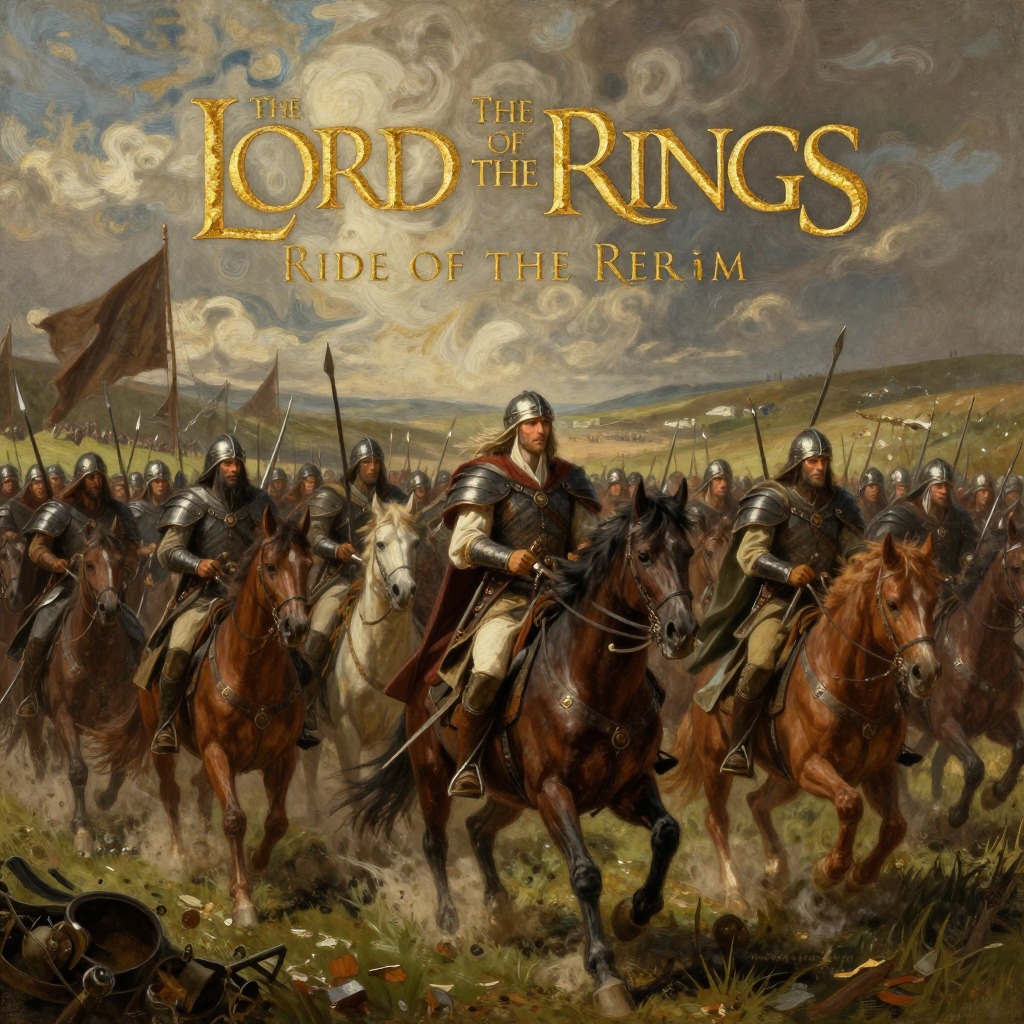
The host rides west to meet the forces of Saruman. On the second day, they encounter a weary scout who reports that Erkenbrand of Westfold has been driven back to Helm's Deep. Gandalf leaves the host, riding Shadowfax on a swift errand, and commands them to ride to Helm's Gate. The Riders arrive at the Hornburg as night falls, and the great battle begins. Théoden, however, is not in the thick of the fight at first; he is in the tower, fretting. He tells Aragorn, "I fret in this prison," and declares that he will ride forth at dawn, sounding Helm's horn, to cleave a road or make an end worthy of a song. Aragorn agrees to ride with him. At dawn, as the Orcs prepare to charge the broken gate, the great horn of Helm rings out from the tower. Théoden rides forth on Snowmane, his horse white as snow, his shield golden, his spear long. With a cry of "Forth Eorlingas!" he charges, and the Riders of Rohan sweep through the hosts of Isengard like a wind among grass. The battle is won, and Théoden meets Gandalf the White Rider again on the green grass beside the Deeping-stream.
The Ride to Gondor and the Battle of the Pelennor Fields
After the victory at Helm's Deep, Théoden rides to Dunharrow to muster the full strength of Rohan. There, the Red Arrow is brought to him from Denethor, Lord of Gondor, a token of war and a plea for aid. Théoden accepts the summons, declaring that he will come, though he may not ride back. The host of Rohan, some six thousand spears, rides east into the deepening shadow. On the morning of the battle, as the Witch-king breaks the Gates of Minas Tirith, the horns of the Rohirrim are heard. Théoden, rising in his stirrups, cries out his battle-rally: "Arise, arise, Riders of Théoden! Fell deeds awake: fire and slaughter! spear shall be shaken, shield be splintered, a sword-day, a red day, ere the sun rises! Ride now, ride now! Ride to Gondor!" He blows a great horn with such force that it bursts asunder. He charges ahead of his knights, borne up on Snowmane like a god of old, his golden shield shining like an image of the Sun. He leads the charge that breaks the siege, driving the Haradrim before him and slaying their chieftain. But in the moment of his triumph, the Witch-king descends upon him on a winged beast. Snowmane is pierced by a black dart and crashes to the ground, pinning the king beneath him.
Death and Legacy
Théoden lies dying, but he is not alone. His knight Dernhelm, revealed to be his niece Éowyn in disguise, stands guard over him. She and the hobbit Meriadoc Brandybuck slay the Witch-king, fulfilling the prophecy that he would not fall by the hand of man. Before he dies, Théoden opens his eyes and speaks to Merry. He says, "Farewell, Master Holbytla! My body is broken. I go to my fathers. And even in their mighty company I shall not now be ashamed. I felled the black serpent. A grim morn, and a glad day, and a golden sunset!" He forgives Merry for breaking his command and tells him to live in blessedness. He asks for Éomer, whom he names his heir, and for Éowyn, whom he calls dearer than a daughter, not knowing she lies nearby, seemingly dead. He bids Éomer ride to victory and bid Éowyn farewell. With that, he dies. His body is borne back to Edoras and laid in a great mound, the eighth of his line, where the white flowers of simbelmynë bloom thickly. The minstrel Gléowine makes a song for him, and the Riders sing of how he rode through the Shadow to the fire and died in splendour, even as the Sun gleamed upon Mindolluin in the morning. His death is a turning point in the war, a moment of great sorrow and great glory, and his name is remembered in the songs of Rohan for ever.