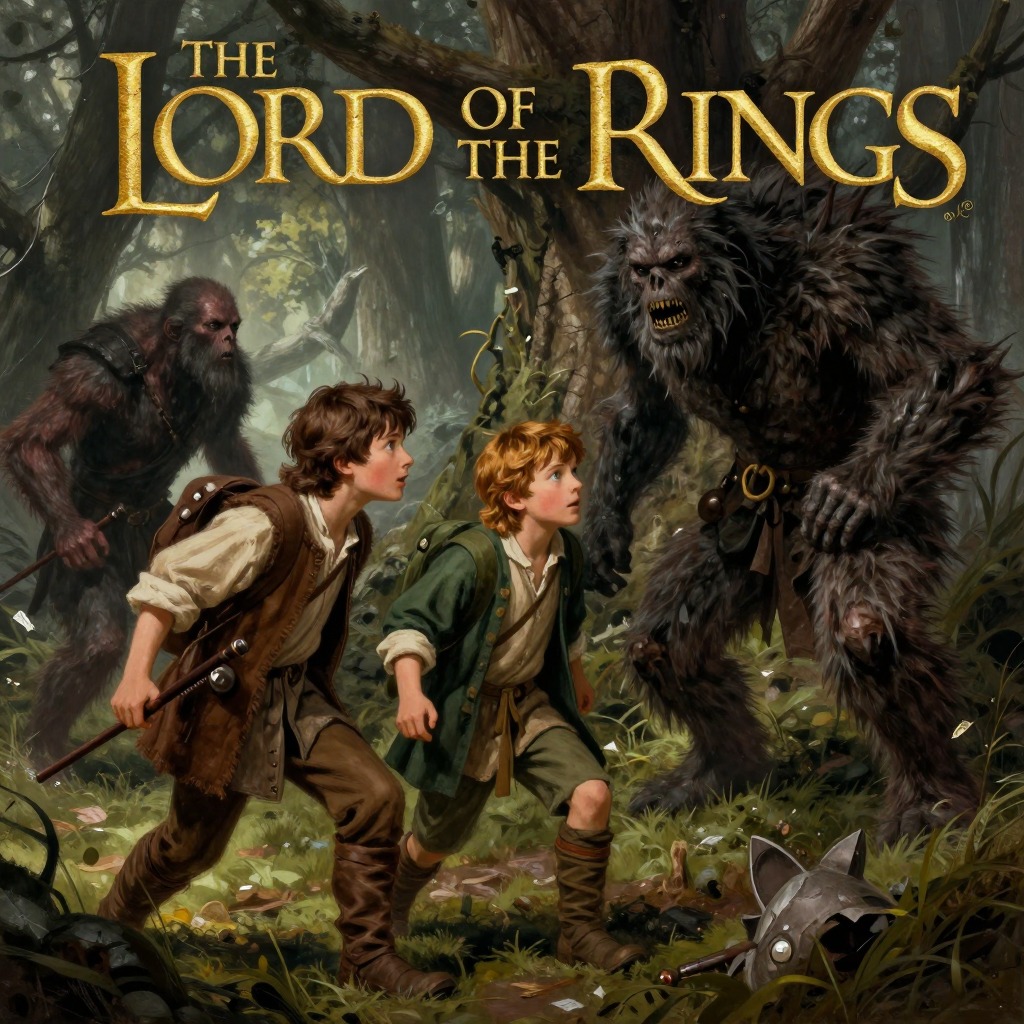
Treebeard
The Lord of the RingsTreebeard, called Fangorn by the Elves and the eldest of the Ents, is the oldest living thing that still walks beneath the Sun upon Middle-earth. He is the guardian of Fangorn Forest, a remnant of the vast primordial woods of the Elder Days. More than a mere creature of legend, Treebeard is a being of immense age and memory, whose slow, deliberate nature belies a terrible power when roused. His decision to march against Saruman marks a turning point in the War of the Ring, demonstrating that even the most ancient and patient powers can be driven to action by the malice of the Enemy.
Identity and Nature
Treebeard is an Ent, a shepherd of the trees, standing some fourteen feet high with a bark-like hide and a long, mossy beard. His most striking feature is his eyes: deep, penetrating brown shot with a green light, filled with the memory of ages. He is not hasty, a motto he repeats often, and his language, Old Entish, is a slow, sonorous tongue that takes a long time to say anything worth saying. He is the master of wood, water, and hill, a power older than the Elves or the Dark Lord, and he remembers the first raindrop and the first acorn. He is, as he tells Merry and Pippin, the "Eldest," a being who was here before the river and the trees, before the Kings and the Barrow-wights.
Role in the War of the Ring
Treebeard's initial encounter with Merry and Pippin, who have fled from the Orcs of Isengard, awakens him to the full extent of Saruman's treachery. He learns of the felling of his beloved trees, the wanton destruction of the forest, and the alliance between Saruman and the Orcs. This news, combined with the hobbits' account of Gandalf's fall, stirs a deep and ancient anger within him. He convenes an Entmoot, a rare gathering of the Ents, where after three days of deliberation, the decision is made to go to war. The Ents march on Isengard, a force of nature that no army can withstand. They tear down the walls, flood the valley, and trap Saruman in the tower of Orthanc, effectively ending his power in the North.
Relationships and Conflict
Treebeard's primary conflict is with Saruman, whom he once considered a friend but now sees as a traitor and a tree-killer. He is deeply grieved by Saruman's betrayal, as the wizard had once walked in his woods and listened to his lore. Treebeard's relationship with the hobbits, Merry and Pippin, is one of growing affection and respect. He finds them to be a "bundle of news" and a welcome change from the long, slow centuries. He gives them a draught of Ent-draughts, which causes them to grow taller, and he names them as friends, putting them into the Long List of the Ents. He also has a deep, abiding love for the Entwives, who were lost long ago, and his search for them is a recurring theme of sadness in his story.
Change and Ending
Treebeard's character undergoes a profound change from a passive, contemplative guardian to an active, wrathful force. The destruction of his forest and the treachery of Saruman force him to abandon his long-held patience and take decisive action. After the war, he oversees the restoration of Isengard, transforming it into the Treegarth of Orthanc, a garden of orchards and trees. He meets with Aragorn and Gandalf, and he releases Saruman, showing that even in his anger, he retains a core of mercy. He bids farewell to the hobbits, expressing a hope that they might one day hear news of the Entwives, and he accepts the gift of the valley of Isengard from the new King. His final parting with Galadriel and Celeborn is a poignant acknowledgment that the world is changing and that they will not meet again in Middle-earth.
Thematic Significance
Treebeard embodies the theme of nature's power and its slow, inevitable judgment against those who would destroy it. He represents an ancient, pre-industrial world that is fading, a world of deep memory and connection to the earth. His story is a cautionary tale about the consequences of pride and the abuse of power, as Saruman's technological and industrial ambitions are ultimately undone by the very forces of nature he sought to exploit. Treebeard's final, sad reflection on the loss of the Entwives and the changing of the world underscores the elegiac tone of the entire legendarium, a lament for a beauty and wonder that is passing away.