Weathertop
The Lord of the RingsWeathertop, called Amon Sûl in the Elvish tongue, is a conical hill rising from the Weather Hills in the central region of Eriador. It stands just north of the ancient East–West Road, roughly halfway between the village of Bree and the refuge of Rivendell. In the days of the North-kingdom of Arnor, a great watchtower was built upon its summit, serving as a fortress and a post for one of the seven palantíri, the Seeing-stones of the Dúnedain. The tower was burned and razed during the wars with Angmar, leaving only a tumbled ring of stone, like a rough crown on the hill's head. By the time of the War of the Ring, Weathertop was a desolate and windswept place, its ancient walls crumbling and overgrown with grass, its strategic value reduced to the wide view it commanded of the surrounding lands.
The Flight to the Hill
After leaving Bree, Aragorn led the hobbits on a path that deliberately avoided the main road, aiming to reach Weathertop from the north in a less open approach. The Company had been travelling for several days through the Midgewater Marshes and the barren lands beyond, and they were weary. On the fifth day of their journey from Bree, they reached the feet of the westward slopes of the hills. The next morning, they found a track that ran cunningly along the hillsides, screened by boulders and hewn stones, which led them towards the southern end of the path and the northward slope of Weathertop itself. Aragorn explained that the path had been made to serve the forts along the walls, and that the watchtower on the hill had been built in the first days of the North Kingdom by the Men of Westernesse. He told them that Elendil himself had once stood there, watching for the coming of Gil-galad out of the West in the days of the Last Alliance.
The Attack and the Wounding of Frodo
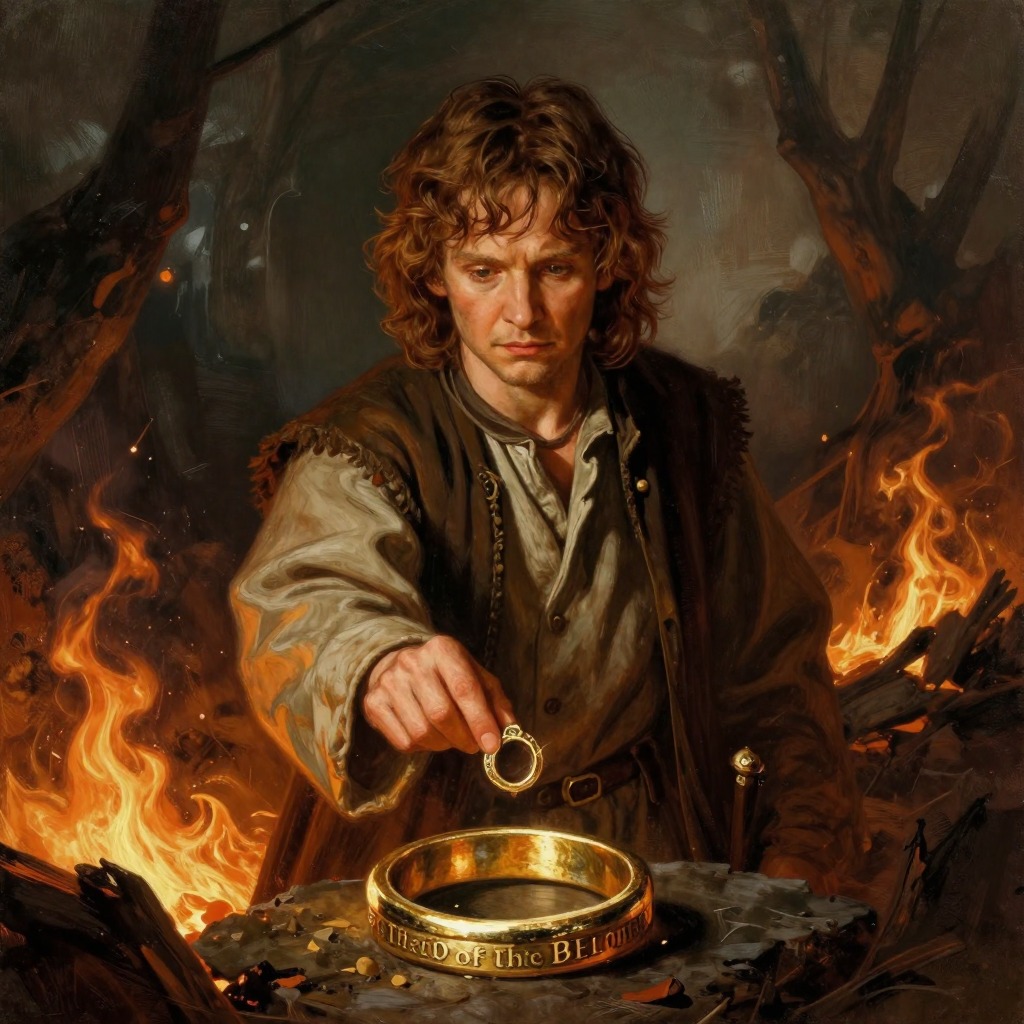
Aragorn, Frodo, and Merry climbed to the crown of the hill, finding a wide ring of ancient stonework and a central cairn of broken stones, blackened as if by fire. There was no sign of Gandalf, but Aragorn discovered a fresh mark on a flat stone—a G-rune with three strokes—which he interpreted as a sign that Gandalf had been there three days earlier and had been in danger. As they stood on the southward edge of the hill, Frodo saw black specks moving on the Road below: five Riders were assembling at the foot of the hill. The Company retreated to a small dell on the north side, where they lit a fire and prepared a meal. As night fell, Strider told them the tale of Beren and Lúthien to keep their spirits up. The attack came in the dead of night. Three or four tall black figures appeared on the lip of the dell, and Frodo, overcome by a sudden and irresistible temptation, put on the Ring. Immediately, he saw the Riders in their true form: five tall figures with white faces, keen merciless eyes, helms of silver, and swords of steel. The tallest, their captain, bore down on Frodo with a long sword and a knife that glowed with a pale light. Frodo cried out "O Elbereth! Gilthoniel!" and struck at the feet of his enemy, but the captain's knife pierced his left shoulder with a pain like a dart of poisoned ice. As he swooned, he saw Strider leaping out of the darkness with flaming brands of wood in either hand.
Aftermath and Significance
Frodo was found lying as if dead, face downwards on the grass with his sword beneath him. Strider tended his wound with athelas leaves, which he had walked far to find, but the Morgul-knife had left a deadly poison that would slowly draw Frodo into the wraith-world. The attack on Weathertop was the first direct and violent confrontation between the Ring-bearer and the servants of the Enemy. It marked the point of no return for Frodo, who was now visibly marked by the power of Mordor and whose survival depended on reaching the healing of Elrond in Rivendell. The hill itself, once a proud fortress of the Dúnedain, became a place of desperate flight and a symbol of the peril that now dogged the Company's every step. The encounter also revealed the terrible power of the Ringwraiths and the vulnerability of the Ring-bearer, setting the stage for the desperate race to the Ford of Bruinen.