Elena's Grief and Regression after Losing Her Doll
The Lost DaughterElena's grief after losing her doll becomes a sustained disturbance in her daily behavior and a test of how the adults around her understand and respond to her distress. Although her family finds her after she has gone missing, reunion does not console her: she is crying because the doll is gone. In the days that follow, her mother, Nina, describes a return to behaviors Elena had apparently outgrown, while Leda’s concealed possession of the doll makes the loss part of a larger conflict about maternal care and responsibility.
The Loss and the Failed Reunion
When Leda spots Elena on the beach, the child is sitting a few feet from the water beneath her straw hat, crying silently. To the adults, she has been found after becoming separated from her family; to Elena, the immediate catastrophe is that she cannot find her doll. Her distress is intense enough that she does not answer the situation as the adults expect. The family’s reunion with her therefore resolves the danger of her being lost without resolving the loss that matters to her. Elena is carried back toward the bath house, where Rosaria meets them and takes her with exuberant relief. Nina and other family members run over, eager to embrace and touch the child, and the group celebrates that she has been found. Elena nevertheless continues to weep. The family’s collective relief and her private grief occupy the same scene but do not match: the adults mark the end of a frightening episode, while Elena remains fixed on the missing doll. Leda withdraws to her umbrella and starts gathering her belongings before two in the afternoon. She sees the women pass Elena among them in an effort to quiet her, but none succeeds. Nina comes over to thank Leda, and Leda points out that Elena still will not calm down. Nina recognizes the contradiction in the day: her daughter has been found, but the doll has been lost. The exchange makes clear that the recovery of Elena herself cannot substitute for the object she is mourning.
A Loss That Persists
The distress continues beyond the beach. When Leda later sees Elena with Nina, the child looks tired and has a pacifier in her mouth. Nina says Elena is physically fine but has not recovered emotionally because she wants her doll. Elena takes the pacifier out to say that she has to take her medicine, a small sign that she can still participate in ordinary routines even as her fixation on the absent doll remains. Nina describes a broader change in Elena’s behavior since the loss. The child has regressed: she wants to be carried or pushed in her stroller and has returned to using a pacifier. The account connects these behaviors to the period after the doll disappeared, rather than presenting them as isolated habits. Elena’s distress is thus visible not only in crying but in a renewed dependence on forms of comfort and assistance associated with an earlier stage of childhood. The strain also affects Nina. She complains of the fatigue of recent days and says the child has been difficult to manage. While walking with Leda, she tries to put the pacifier away so that Elena will not make a bad impression, then looks for a quieter place and pushes the stroller toward the gardens. These actions show Nina managing the child’s behavior in public while coping with her own exhaustion. The doll’s absence has become a continuing practical burden as well as an emotional one.
The Doll and the Adults’ Responses
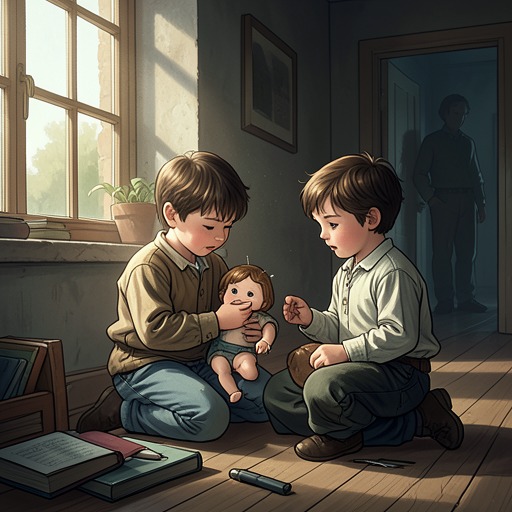
The doll matters within a story already shaped by the different meanings adults attach to children and caregiving. In recalling her own daughters, Leda describes pregnancy as a bodily process in which a life that is hers also seems to move away from her, and remembers feeling inadequate while caring for Bianca and Marta. Her recollections include exhaustion, interrupted work, and the effort to remain a good mother. That history does not explain Elena’s feelings away; it places Leda’s attention to the doll beside her complicated experience of maternal attachment and fatigue. Leda’s encounter with Elena gives the hidden doll a direct place in the child’s distress. When Elena is in Nina’s arms, tired and disheveled, Leda notices that the doll’s clothes in her purse seem heavier. She thinks this would be the right moment to tell Nina that she has Nani, but instead asks Elena whether she has found her doll. Elena reacts angrily, tries to hit Leda, and then hides her face against Nina. The episode shows that Elena’s distress has not passed and that Leda does not yet turn her knowledge into a disclosure. The contrast between Elena’s response and Leda’s earlier memories of her own children sharpens the question of what care requires. Leda remembers being physically present in Bianca’s play while feeling depleted and unable to study; she also recalls moments when frustration crossed into harshness. Those memories establish maternal ambivalence as part of Leda’s perspective, but they do not make her silence about the doll equivalent to Elena’s grief. Instead, the hidden object binds the child’s need to an adult’s choice to withhold information.
Exposure and the Unresolved Aftermath
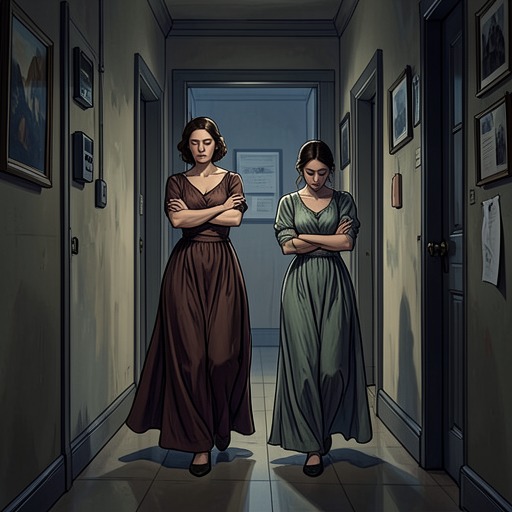
Nina eventually confronts Leda with the fact that she had the doll while Elena was crying and Nina did not know what to do. Nina’s reproach makes the concealment newly consequential: what Leda has treated as private knowledge is, from Nina’s perspective, a withheld chance to respond to her daughter’s distress. Leda calls herself an unnatural mother, and Nina agrees before taking the doll back from her. She ends the exchange by breaking off contact with Leda. This confrontation confirms that the doll’s absence was not simply an unexplained misfortune. Leda had kept it, and Nina had been left to manage Elena’s crying and regression without knowing that the object was in Leda’s possession. The ending records Nina’s recovery of the doll from Leda, but it does not describe Elena receiving it or show whether the child’s distress subsides. The distinction matters: the adults’ dispute over responsibility reaches a decisive rupture, while the emotional outcome for Elena remains unstated.
Narrative Significance
Elena’s grief and regression make a small object the center of competing experiences of motherhood. The family can celebrate finding the child, and Nina can provide practical care, yet neither action removes the loss as Elena experiences it. Her crying, renewed dependence, and demand for the doll give the absence a continuing shape in the narrative. The doll also links Elena’s visible need to Leda’s concealed action and to Leda’s memories of caring for her own daughters. The resulting conflict does not reduce maternal behavior to uncomplicated devotion or indifference: Nina is tired but actively tending to Elena, while Leda recognizes the moment to disclose the doll and still does not do so. The narrative leaves Elena’s eventual recovery open, but makes clear that her suffering has consequences for the relationship between the two women who might have helped her.