Elena’s Doll (Nani)
The Lost DaughterElena’s Doll (Nani) is at once a child’s beloved companion, a second daughter in Nina’s care, and the focus of Leda’s secret intervention. Its importance lies not in its appearance or value but in the relationships gathered around it: Elena treats it as a living partner, Nina tends to it alongside her child, and Leda’s decision to keep it draws her into memories of her own daughterhood and motherhood. The doll’s changing role turns an ordinary beach toy into a charged measure of care, loss, and the distance between a mother’s intentions and a child’s needs.
Identity and Appearance
Elena is rarely parted from the doll, whose name is heard in several affectionate forms, including Nani, Nanuccia, Nanicchia, and Nennella. The abundance of names initially confuses Leda, who has trouble distinguishing the names used for the child from those used for her companion. She eventually understands that Elena is the child and Nani is the doll, which Nina attends to as if it were a second daughter. The shifting names reflect the intimacy of play: the doll belongs to a family of endearments rather than to one fixed label.
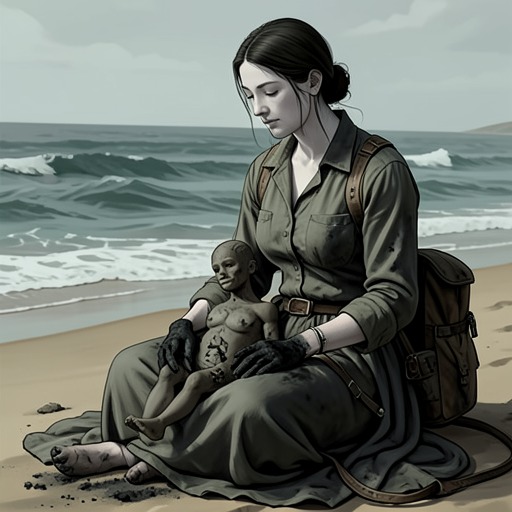
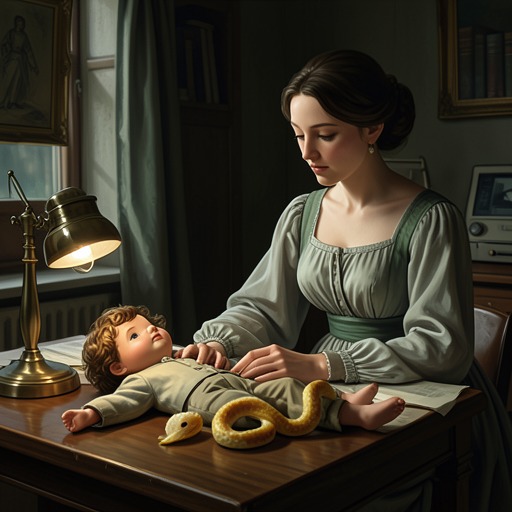
The doll is old and visibly worn. Leda notices its sparse, uneven blond hair and marks made with a ballpoint pen across its face and body. At the beach it lies beside Nina on the lounge chair, apparently sharing the mother’s place in the sun. Elena repeatedly carries water in a yellow plastic watering can and pours it over Nina and the doll, returning to refill it and continuing the same game. The doll’s plastic body sheds water differently from a person’s, but Elena includes both in the play as recipients of her care.
Elena’s Companion and Nina’s Second Daughter
The doll is central to the small rituals through which Elena expresses affection. While playing alone, she speaks to it by its many names and kisses it with an intensity that makes the shabby object seem, for a moment, animated by the relationship. Leda observes the game with discomfort as well as fascination. The doll’s worn surface does not prevent Elena from making it a participant in an imaginative bond; its emotional reality comes from the child’s attention, not from its condition.
Nina’s care reinforces that bond. On the beach she plays along with Elena’s repeated watering, responding as though both she and the doll need the child’s attention. Leda suspects that Nina may be performing the role of a beautiful young mother for the watching crowd, but this remains Leda’s interpretation, not an established fact about Nina’s feelings. What she can see is that the doll is incorporated into mother-and-child play. In Leda’s view, it guards the intimacy between Nina and Elena and stands as evidence of a maternal bond that she finds difficult to contemplate without comparing it to her own.
Loss, Concealment, and Search
When Elena is found sitting alone near the water, she is crying because she has lost the doll. Leda carries the child back toward the bathhouse, where Nina and the relatives rush to her and try to comfort her. The family’s relief at finding Elena does not end the child’s distress: she remains inconsolable, and Rosaria sets out to search for the missing toy. Leda withdraws and leaves the beach early, while the family continues looking.
The doll is not lost. Leda has put it in her bag. As she drives home, she first explains the act to herself as an impulsive attempt to help, imagining that she will return early the next morning and let Elena discover it in the sand. That plan does not settle her unease. At home she leaves the doll in the bottom of the bag, then takes it out and examines it, finding it heavier than expected because it is full of water. She considers buying clothes for it as a gesture of repair, and later a missing-doll flyer circulated by Nina and Rosaria reaches her: it shows Elena with the doll and offers a reward. Leda folds the notice and keeps it beside the doll’s new dress, a concrete reminder that the family is still searching while she holds the object back.
Leda’s Memories and the Doll’s Return
Possessing Nani leads Leda to recall Mina, the doll from her own childhood, and the difficult years when she cared for Bianca and Marta. Leda had given Bianca Mina in the hope that the old doll would comfort her, but Bianca did not want it. Their disagreement over the doll became part of a wider pattern of strain: Leda remembers exhaustion, interrupted study, and her sense that her own desires and work were being crowded out by motherhood. These memories do not make her present act a simple repetition of the past, but they help explain why a child’s doll can stir such powerful, contradictory responses in her.
Leda also remembers moments when care and anger coexisted in her relationship with Bianca. She recalls trying to be a good mother while feeling depleted, and recognizes that her actions toward her daughters could be hurtful even when she thought she was acting with authority. Nani therefore becomes more than a substitute child in her hands: it connects Elena’s visible attachment to Leda’s own unresolved experiences as a daughter who played with a doll and a mother who struggled to meet her children’s needs. The object holds these histories together without reconciling them.
Later, Leda takes the doll into the bathroom, removes its clothes, and shakes out the water. She discovers a small beach worm that Elena had placed inside its body during a game of pregnancy inspired by Rosaria. The discovery links children’s play to the adults’ family life and to Leda’s memories of her own pregnancies. She handles the doll carefully and, despite her aversion to crawling creatures, feels pity for what she finds. Her attention to Nani has shifted from concealment toward a kind of improvised care, but it does not undo the original loss she caused.
When Nina learns that Leda kept the doll while Elena was distressed and the family searched, she takes it back from Leda and ends their relationship. For Leda, the doll’s return is therefore not a simple restoration: it exposes the cost of her silence and brings her closeness with Nina to an abrupt end. Nani’s narrative function rests on this double movement. It is a cherished object whose meaning is made by a child’s play, yet it also becomes the material evidence of Leda’s intervention and of the unresolved divide between maternal attachment and maternal failure.