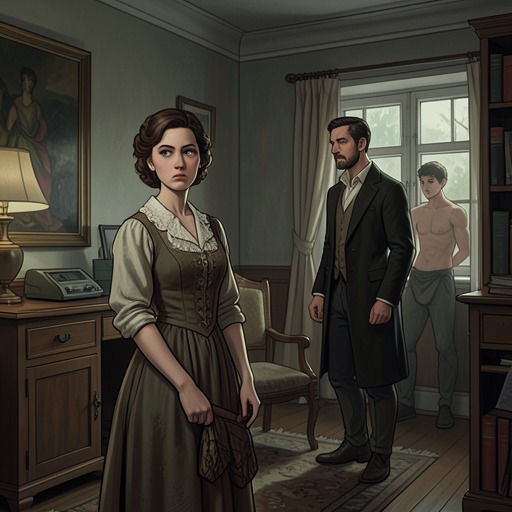
Gino's Infatuation with Nina
The Lost DaughterGino’s infatuation with Nina takes shape less through confession than through watching, waiting, and attempts to enter her field of vision. The narrator sees him studying Nina from a distance, desolate when her husband returns, and later using a dance with the narrator as a way to be seen by her. When he carries Nina’s request to borrow the narrator’s apartment, the attachment becomes harder to separate from his own desires: the narrator asks whether Nina’s request is truly the whole story, but receives no answer that settles the question.
Watching from a Distance
During the crowded weekend, Gino puts aside his textbook and watches Nina through binoculars, appearing to the narrator to fear an approaching wave. The scene makes his attention physical and directional: Nina is among the bathers, while he remains apart, tracking her from a distance. The narrator does not claim to know what he sees. Instead, she imagines what he may be picturing when Nina leaves the beach with her family: the hot afternoon, a conjugal bed in half-light, and Nina beside her husband. That imagined intimacy is the narrator’s interpretation, not a confirmed account of Gino’s thoughts, and the distinction preserves the uncertainty at the center of his fixation.
The next sighting confirms the pattern of looking without giving him access. Nina returns to the beach cheerful, with her husband beside her and Elena in his arms. Gino stares at Nina, desolate, then hides his gaze in his book. He turns toward the narrator from time to time but quickly looks away. The narrator understands them both to be waiting for the weekend to pass: the beach to quiet, Nina’s husband to leave, and Nina to come back into contact with them. Gino’s longing is therefore linked to a particular obstruction. Nina is present, but her family’s presence limits his approach; his attention turns toward the anticipated moment when that barrier will recede.
The Family’s Presence
At the square, Gino’s attachment appears alongside his awkward effort to be accepted in Nina’s family’s company. When the family arrives, he greets Nina and Rosaria, then addresses Tonino with particular deference. He clumsily tries to pet Elena as she eats cotton candy in her mother’s arms. After the greetings, he stays beside them, stiff and uneasy, saying nothing, yet seeming proud to be seen with them. The details do not show intimacy with Nina; they show how much significance he invests in proximity and visibility.
The narrator reads the scene closely: Gino’s silent place beside the family contrasts with the ease of Nina’s movements as she dances with her husband. Nina has handed Elena to Rosaria and is now making Tonino dance. Though the narrator sees him as graceless, Nina’s movements remain naturally harmonious in his arms. Gino’s presence at the edge of this domestic circle does not displace the husband or establish a claim on Nina. Instead, it sharpens the distance between the position he occupies and the closeness he appears to want.
Dancing to Be Seen
When Nina dances with Tonino, Gino suddenly leaps from a corner where he has been crouching and asks the narrator to dance. She initially says she is tired and hot, yet takes his hand. She enjoys dancing with him: he is slender and tall, with shining eyes, mussed hair, and dry palms. Their dance feels different from the earlier waltzes with Giovanni. The narrator experiences the difference in bodies and odors, as if the evening had split into two periods of her life. Gino’s attention to Nina thus unfolds in a scene that also awakens the narrator’s own bodily awareness of him.
The narrator quickly realizes that Gino is trying to guide her toward Nina and Tonino so Nina will see them together. She helps him, and does not mind being seen in the arms of Nina’s suitor. But the crowd makes it difficult to reach the couple, and both dancers abandon the attempt without speaking. His maneuver is clear; its meaning is less so. He may be using the narrator’s company to draw Nina’s attention, but the passage does not turn that possibility into a declaration or explain what he expects Nina to feel. The dance gives him a brief, public proximity to the woman he watches, while also bringing him close to the narrator in a way she registers as distinct from Giovanni.
After the music ends, the narrator says she is tired, and Gino offers to take her home. They leave the square, the seafront, and the music behind, talking about his exam and the university. At her door, he has difficulty saying goodbye. The episode ends with the narrator inviting him upstairs, but the evidence does not establish what follows from that invitation. The departure from the square shifts the focus from Gino’s effort to be seen by Nina to his direct, hesitant closeness with the narrator.
The Apartment Request
Later, Gino delivers a message: “Nina wants to know if you would be willing to lend us your place for a few hours.” The request makes him an intermediary between Nina and the narrator, but its wording immediately unsettles the narrator. She wonders whether Nina’s name conceals a wish of Gino’s own. Rather than agree or accept the message at face value, she tells him she would like to speak to Nina directly.
When the narrator asks, “Why did you decide to ask this of me in particular?” Gino answers, “Nina wanted it that way.” His reply assigns the decision to Nina but does not resolve the narrator’s suspicion. The apartment request therefore leaves the infatuation in an ambiguous state: Gino has watched Nina, sought her attention through a dance, and now carries a request that would bring Nina and her companion into the narrator’s private space. The narrator’s anger marks the moment as more than a practical favor. She recognizes that she may be entangled in a desire whose ownership and purpose remain unclear, and insists on hearing Nina’s own account rather than letting Gino’s message settle the matter.