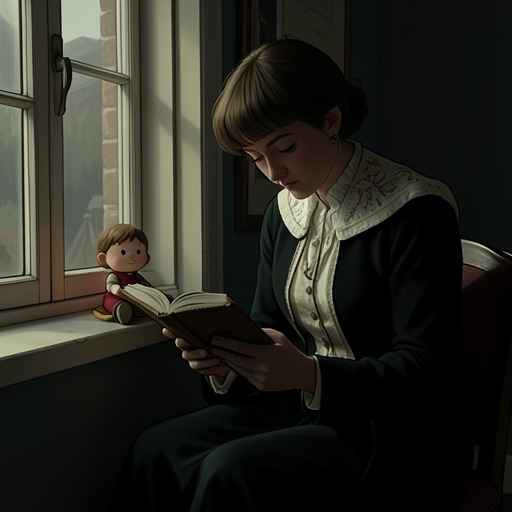
Leda
The Lost DaughterLeda is the first-person narrator of a story shaped by an unresolved conflict between motherhood and selfhood. She once left Bianca and Marta for three years, believing that love for them threatened her ability to become herself; years later, her growing involvement with Nina makes her reconsider what that history means and what Nina may be asking of her. An unexplained car crash, a concealed past, and a final call from her daughters bind together a life that Leda can describe more readily than she can fully explain.
Identity and Narrative Position
Leda recounts events from her own perspective, including moments when her understanding of her actions remains incomplete. After a car crash, she tells those around her that drowsiness caused her to leave the road, but privately rejects that explanation. She believes a gesture of her own was responsible, yet cannot make sense of it and chooses not to tell anyone. The gap between the explanation she offers and the knowledge she keeps to herself establishes a recurring feature of her narration: she reports what happened while acknowledging that its motive may remain obscure even to her.
Her account also moves between present events and memories that revise how those events appear. A sudden loss of control while driving gives way to an imagined beach: the water seems calm, but a red flag recalls a warning from Leda’s Mother that swimming under such a flag could mean drowning. Leda hesitates at the water’s edge as her mother calls to her from the dunes. On waking in the hospital, Leda remembers the hesitation and cannot settle whether the experience was a dream or an alarmed fantasy. The image makes the past present without resolving it; childhood fear returns at a moment when Leda herself has lost control.
The Crash and Its Unexplained Cause
The illness begins less than an hour into Leda’s drive, with a burning sensation in her side. She initially dismisses it, but becomes alarmed when she can no longer hold the steering wheel properly. Her head grows heavy, the headlights seem to dim, and she forgets that she is driving. The car ends up against a guardrail. Doctors report no critical consequences, although they identify an unexplained injury in her left side.
Leda’s account separates the physical event from her interpretation of it. To friends from Florence, and to Bianca, Marta, and Gianni, she attributes the crash to drowsiness. Inwardly, she insists that drowsiness was not the cause, while withholding the gesture she considers responsible. Her refusal is not presented as confidence in a clearer explanation: it follows precisely from her inability to understand what she did. The crash thus becomes both a bodily crisis and a narrative blank, one that Leda names but does not fill.
Leaving Bianca and Marta
When Nina challenges the idea that a mother could forget things about her children, Leda answers with the fact she has withheld: she left Bianca and Marta when the older daughter was six and the younger four. They grew up with their father. Later, when Nina asks why she left, Leda explains that she loved the girls so much that she thought their love would prevent her from becoming herself. The explanation does not cancel the abandonment; it states the contradiction in which Leda understands it.
Leda recalls that the three years away were not years of complete isolation. Professor Hardy loved her, and she had a small circle of friends who understood the culture and ambitions she shared with them. Gianni, though desperate when she left, did not persecute her; Leda describes him as attentive to other people’s needs. When the weight of being away became unbearable, she returned to Bianca and Marta. The return did not restore the earlier arrangement: some people had silently withdrawn, some doors had closed permanently, and her former husband later left for Canada. Leda contrasts the support available to her during her departure with the social losses that followed her return.
Daughters, Nina, and the Question of Care
Leda’s relationship with Bianca and Marta remains marked by their suspicion that she favors one over the other. She traces that sense of imbalance from childhood disputes about toys, candy, and the number of kisses each received to later arguments over clothes, vehicles, and money. Now she tries to give each daughter exactly the same material help, while believing that both keep private accounts of what they have received. In her view, concrete services have become a measure of affection because the daughters have long experienced her love as uncertain. On a sleepless night, she considers calling them, anticipates their complaints, and decides against it; at the same time, she wonders why they have not called her.
Nina’s request to use Leda’s apartment for time with Gino prompts a different kind of unease. Leda compares the request with the arrangements she made for Bianca and Marta as adolescents, when she would leave the apartment so they could have privacy. But she and Nina barely know one another, and Leda questions why Nina should expect her to make the same accommodation. As the night goes on, she imagines that Nina may want either refusal or permission: refusal might close off a risky course, while the keys might feel like authorization to pursue a different future. Leda comes to see the request as more than a practical favor. She suspects Nina is placing her own unsettled life in Leda’s hands and asking her to take responsibility for what follows.
Reversal and Ending
Seeing Nani on the kitchen table, Leda recognizes that she has helped shape Nina’s expectations. She had cast Nina as a perfect mother and successful daughter, while taking Elena’s doll and answering Nina’s anxious questions evasively. Nina, in turn, has regarded Leda as independent and courageous. Leda now sees that this image conceals her own history and that the two women’s apparent similarities do not erase the differences between their circumstances.
She recalls leaving her husband and daughters with a strong sense that she was entitled to do so, supported by friends and by Professor Hardy. Nina, she believes, has fewer defenses and faces greater risks. Remembering Brenda, an English woman she met briefly in Calabria, Leda recognizes a parallel: she had invested Brenda with a freedom she wanted for herself, just as Nina now seems to invest Leda with the experience and courage she needs. Leda concludes that she may help Nina without taking responsibility for Nina’s choices, as Brenda had once helped her with a small gesture and left her to decide her own life.
After Nina comes to the apartment, a brief confrontation ends with Nina leaving with the doll and without the keys. Leda is left with a small wound from the hatpin Nina used and begins packing her bags, moving cautiously. Then Bianca and Marta call together to ask why she has not called and whether she is alive. Leda answers that she is dead but fine. The response holds distance and attachment in the same breath: her daughters’ call moves her deeply, but the final exchange offers no simple resolution of the history that separates them.