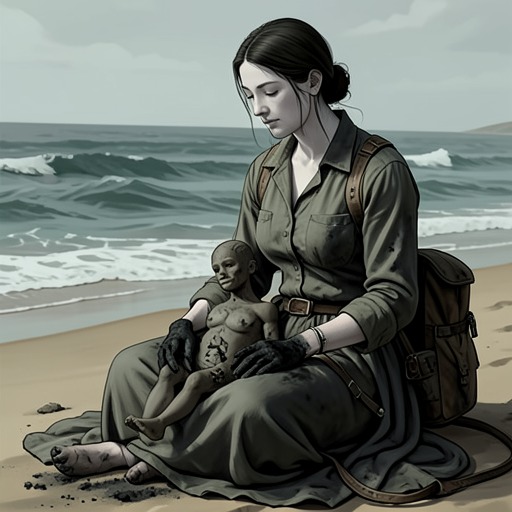
Leda Removes a Sandworm from the Doll’s Belly
The Lost DaughterLeda’s removal of the sandworm from Nani’s belly turns a child’s hidden object into a catalyst for recalling pregnancy. As she cleans Elena’s doll, she recognizes that the pretend baby inside it resembles the bodily substance she associated with carrying Marta, not the controlled, affirming experience she remembered from carrying Bianca. The event links Elena’s game to Leda’s family memories and to a loss of confidence in her own ability to make motherhood conform to an ideal.
The Doll and the Discovery
After returning to her apartment, Leda finds Nani on the terrace table, where the sun has dried the doll’s dress. She undresses it carefully. The small act of taking off the doll’s clothes leads her to remember Marta’s childhood habit of putting things into any opening she found, apparently so she could hide them and find them again. Leda recalls once discovering tiny pieces of uncooked spaghetti inside the radio. The memory gives her a familiar explanation for how something might have been placed inside a doll, but she still wonders what Elena has put there.
Leda carries Nani into the bathroom, holds the doll head-down by the chest, and shakes it. Dark traces of water come from its mouth. She parts the lips and rinses the inside, trying to clear the doll’s trunk and belly and retrieve what Elena has treated as a baby. When something remains lodged in the mouth, Leda fetches her eyebrow tweezers and works carefully. She holds the pliant lips open with her thumb while she extracts the object. The procedure is both practical and absorbing: cleaning a toy becomes a close encounter with a material presence that cannot be reduced to the game Elena has made of it.
Pregnancy Remembered Through Play
As Leda works, she reflects on how different the doll’s contents feel from her first pregnancy. When she was pregnant with Bianca, she had been glad to understand that life was reproducing in her and determined to manage the experience on her own terms. She distinguished herself from the women in her family, including her grandmother, who had seven children, her mother, who had four daughters, and her aunts and cousins. Where she understood their pregnancies as bodily transformations that continued to mark them after birth, she wanted her own pregnancy to be controlled, pleasurable, and integrated with her life.
Leda recalls following medical advice rigorously and remaining active, elegant, and happy during the pregnancy. She spoke to the child in her womb, played music for her, and read aloud the texts she was working on in their original language before translating them. Before Bianca was born, Leda already imagined her as a fully human, intellectual presence, rather than as a process of physical change. Even the long labor pains became, in memory, a difficult test she had prepared herself to meet. Holding Bianca for a few seconds after the birth, she felt an intensity of pleasure unlike anything she had known. This remembered success helps explain why the doll’s imagined pregnancy sends her toward a more painful contrast.
Marta and the Reversal of Leda’s Ideal
Leda’s second pregnancy, with Marta, did not allow her to repeat the first experience. She remembers it as an assault on her sense of control: instead of being able to shape the pregnancy into something beautiful or intellectually meaningful, she experienced her body as turned against itself. The language of the memory is far removed from the idealized account of Bianca’s pregnancy. Leda says that nothing she could draw on from writing, music, or other art could tame what she was carrying.
She also recalls having been unhappy before she knew how to recognize that unhappiness. In her view, Bianca had seemed to change after birth, becoming demanding in a way Leda had not anticipated while she was pregnant. Leda felt that she no longer had the strength to make a second pregnancy exalting as the first had been. What she identifies as the real breakdown was not simply the difficulty of the later pregnancy: it was the collapse of her ability to transform it through imagination, and the damage that collapse did to her happy memory of the first pregnancy and birth. The doll’s hidden contents therefore recall a history of maternal experience that Leda had once tried to order but could not make consistent.
The Sandworm and the Family’s Games
Leda identifies the object inside Nani as a beach worm of a kind amateur fishers dig from wet sand at twilight. She does not know its scientific name. The identification opens another memory, from roughly four decades earlier, of watching her older cousins collect such worms on beaches between Garigliano and Gaeta. They used the worms as bait and, once the fish had been caught, removed them from the hooks and left them on dry sand. Leda recalls having watched this with fascination mixed with revulsion. Now, although she says she has a horror of crawling things, the small creature in the doll prompts pity rather than disgust.
The connection to Elena’s game is specific: Leda understands the worm as the baby Elena put into her doll to play at being pregnant like her aunt Rosaria. The child’s pretend pregnancy thus touches several generations and versions of maternal experience without making them equivalent. Elena’s game gives the doll a role; the worm makes that role materially present; and Leda’s handling of it draws out memories that the game itself cannot explain. As she tells herself that girls should be told everything about childhood so they can later invent an acceptable world, she recognizes that she, too, is playing. The doll’s belly becomes a point where childhood play, bodily memory, and Leda’s reflections on motherhood meet.