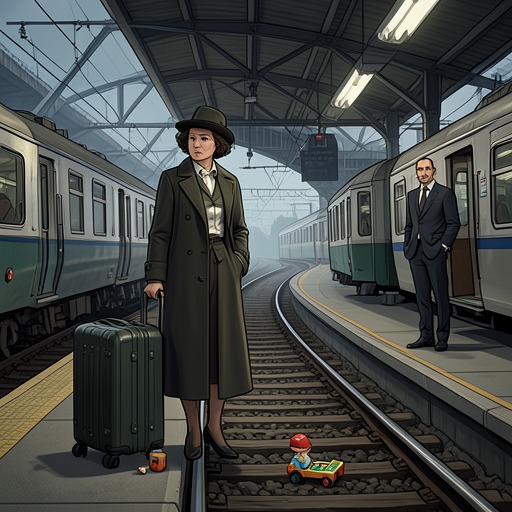
Leda Returns to Her Daughters
The Lost DaughterLeda’s return to Bianca and Marta ends a three-year separation but offers no simple resolution to the conflict that produced it. She had left the girls, then six and four, with their father, Gianni; three years later, she took them back and brought them to Florence. When she eventually tells Nina about the departure and return, she describes both as choices bound up with self-preservation. The return is decisive not because it proves that maternal love has overcome her desire for independence, but because Leda says she came back when life without her daughters seemed more unbearable than life with them.
Background: Motherhood and Exhaustion
Leda’s account of returning is framed by the earlier strain of caring for her young daughters while trying to sustain an intellectual life. She remembers becoming a mother at twenty-three, when Bianca was born, and planning a second child soon afterward because she and those around her believed Bianca needed a sibling. Pregnancy and motherhood did not feel like a seamless extension of herself: she experienced the developing child as part of her life and, at the same time, as a life moving away from her. That contradiction foreshadows the later tension between attachment and separation.
During the girls’ early years, Leda felt unable to study, without desire, and desolate. When Marta cried in another room, the interruption could feel like relief from Bianca’s demands. Leda would stop Bianca’s game to tend to her younger daughter, then feel temporarily innocent of having turned away from the elder child, as though Marta, rather than Leda, had caused the break. Such moments make visible the pressure beneath the later departure: care was real, but it could also feel like a narrowing of the time and attention Leda needed for herself.
Her gift of her childhood doll, Mina, to Bianca further exposes the unequal expectations and disappointments within that care. Leda hoped Bianca would cherish the doll and devote herself to it as she had devoted herself to Leda in their games. Bianca preferred another doll, and Leda was hurt. When she later found Bianca sitting on Mina, she reacted angrily and threatened to take the doll back. The incident is not the cause of Leda’s eventual departure, but it shows how maternal giving could become entangled with Leda’s own needs and attachments rather than bringing uncomplicated closeness.
The Separation and Its Costs
Leda tells Nina plainly that she left when Bianca was six and Marta four, and that the girls grew up with Gianni during her absence. She recalls being very tired and describes escape as necessary to keep herself from being overwhelmed. The account does not make that decision harmless: it establishes the children’s separation from their mother and leaves the reasons for Leda’s action emotionally complicated, rather than presenting a single, settled explanation.
Distance changed the ordinary texture of their relationship. Telephone calls were hurried and could seem unreal; because Leda could not intervene directly in the girls’ lives, responding to their requests became a light, occasional task rather than the constant work of daily care. Meanwhile, she worked on her own schedule, corrected papers at night, slept in the afternoon, and ate at a nearby trattoria. Her mood, habits, and appearance changed; she felt physically stronger and less irritated with students. This contrast makes the freedom of separation concrete: it brought her a measure of well-being and room to work, even as it left her daughters at a distance.
The separation also sharpened a fear rooted in Leda’s own history. She had left Naples at eighteen to study in Florence and had tried to distance herself from the habits and language of the family she had grown up among. She worried that Gianni might leave Bianca and Marta with her mother and relatives in Naples, exposing the girls to the life from which Leda believed she had fought to free herself. Gianni did sometimes take them to her mother’s home when work or travel overwhelmed him. Leda learned this had happened but did not return then. Her mother cared for the girls, yet after Leda reclaimed them, Leda accused her of passing on the same damage she believed she herself had suffered. Her mother defended herself, and died shortly afterward. The return therefore did not undo the cost of the separation; it brought Leda back into a family history she had hoped to escape.
Taking the Daughters Back
Leda’s return is described as an act of reclaiming: three years after leaving, she took Bianca and Marta back. The account gives no scene of the reunion and does not claim that the separation was repaired at once. Its emphasis instead falls on Leda’s explanation of why she returned, offered later in conversation with Nina. When Nina asks whether she went back because she felt well, Leda says she realized she could not create anything of her own that truly equaled her daughters. She then rejects Nina’s assumption that this means she returned simply out of love for them. Leda says she returned for the same reason she had left: love of herself. Without the girls, she felt more useless and desperate than she had with them.
That reasoning preserves the contradiction rather than resolving it. Leda’s return is neither a conventional renunciation of independence nor evidence that the years away had made her indifferent. She presents separation as a source of freedom and well-being, but also describes an absence she could not make good on her own. Her decision to take the girls back followed that recognition. In her account, self-preservation can lead both away from motherhood and back toward it; neither direction cancels the other.
Nina as Listener and Measure
The disclosure occurs while Leda is speaking with Nina, a young mother whose distress over Elena’s demands has become visible. Leda recognizes that Nina sometimes cannot cope, and she offers an acknowledgment grounded in her own past. When Nina responds with disbelief that a mother could forget anything about her children, Leda reveals that she abandoned Bianca and Marta and later took them back. Nina asks who raised them and whether Leda saw them again; Leda answers that Gianni cared for them and that she returned three years later. The exchange turns Leda’s private history into a response to Nina’s immediate experience, without making their situations identical.
Nina’s questions also make Leda’s return harder to reduce to a reassuring moral lesson. Leda does not claim that coming back erased her earlier choice, and her explanation does not offer Nina a formula for motherhood. Instead, the conversation puts exhaustion, attachment, absence, and self-interest alongside one another. Leda’s history helps explain why she can recognize Nina’s strain, but it also exposes a gulf between them: what Leda once did and what Nina is struggling to do are not interchangeable. The return matters as an event in Leda’s life and as a confession that unsettles the idea that maternal love must produce a single, predictable choice.