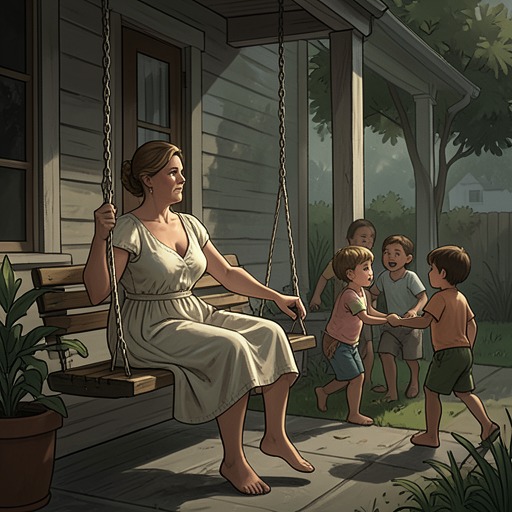
Leda Takes Elena’s Doll
The Lost DaughterLeda Takes Elena’s Doll turns an apparently minor act on the beach into a crisis of concealment and recognition. Leda takes the doll while Elena is separated from Nina, then leaves the beach with it hidden in her bag. Her shifting explanations—first an impulse to help, then an admission that she does not want to give it back—make the episode a concentrated portrait of her conflicted relation to care, attachment, and motherhood.
Background and Circumstances
Before taking the doll, Leda notices that Elena is alone on the sand, wearing Nina’s new hat and playing. The child’s eye is still red, and her nose is running. Leda reflects on the way adults look for parental likeness in a child, then turns to her own experience: Bianca was born when Leda was twenty-three, and Marta followed when she was twenty-five. She recalls feeling that a woman’s body could carry a life that was at once her own and already moving away from her. The children had been wanted, but the experience of pregnancy and motherhood did not resolve into uncomplicated joy.
Leda’s account of early motherhood adds a history of fatigue and divided attention to the beach incident. She remembers being unable to study, feeling that her body had become inert, and treating Marta’s cries as an escape from Bianca’s demands. She also recalls giving Bianca her own childhood doll, Mina, hoping to ease her older daughter’s jealousy, only for Bianca to prefer another toy. When Bianca later sat on Mina, Leda reproached her and declared the doll precious to her. The memory shows how a doll can become more than a child’s plaything: it can carry Leda’s own childhood and claim on an identity outside motherhood. That history does not explain away her later action, but it gives the doll an intimate significance for her.
The Taking and Its Immediate Aftermath
Elena’s distress becomes unmistakable when she writhes in her father’s arms, calling alternately for Nina and the doll. Rosaria sets out to search among the toys under the beach umbrellas, while Nina goes to her daughter. Leda walks back over the dunes and into the pinewood, apparently away from the search. There, she recognizes that the doll is in her bag. The act has already taken place, but she cannot recall the exact moment when she did it; in retrospect, it seems both almost comic in its senselessness and unsettling because it has happened without a clear decision.
On the drive home, Leda supplies herself with an explanation: perhaps she had been moved by the spontaneous compassion she says has often overtaken her. She imagines Elena abandoned on the sand and tells herself that she picked up the doll in an almost childish effort to help. She even forms a plan to return early the next day, put it back where Elena had left it, and let the child discover it. This proposed return would make the taking appear temporary and benevolent. At home, Leda empties the rest of her beach bag but deliberately leaves the doll at the bottom so she will not forget it.
Her account changes as the evening darkens and the weather turns. Looking out from the terrace, Leda imagines Elena still crying and Nina desperate as Rosaria searches the sand. She begins to understand the act not as generosity but as something mean, even if unintentional. The doll remains in the bag, and Leda abandons the plan to return it as she had imagined. When she takes it out and examines it, its weight and construction make it an actual, cumbersome object rather than an abstract token of compassion. Leda’s attention to the doll accompanies a change in her own account: she recognizes that no noble motive can settle what she has done.
The Doll and Leda’s Maternal Memories
Holding the doll brings Leda’s memories of her daughters into the present. She recalls how depleted she felt when they were small and how she experienced the demands of care as interruptions to study, work, and the possibility of a life of her own. In another memory, Bianca’s attempt to copy Leda’s precise way of peeling fruit ended in a cut. Leda remembers her frustration and her reluctance to comfort her daughter immediately, wanting instead to insist on the boundary between a child and the grown-up who knew how to do the task safely. These recollections do not make Leda’s taking of Elena’s doll a simple repetition of an earlier deed; they reveal a recurring strain between tenderness and refusal in her maternal experience.
With the doll on her knees, Leda thinks of her own daughters as far away and considers what the toy represents in Nina and Elena’s relationship. To Leda, it seems to guard their love and to testify to an ideal of motherhood. She brings it close and imitates the embrace she has seen Elena give it, while also feeling remorse and fear about keeping it. The contradiction is central: the doll draws Leda toward an image of maternal attachment at the same moment that she has secretly deprived a child of the object to which she is attached. She ultimately admits to herself that she does not want to return it, although she remains disturbed by that desire.
Confrontation and Consequences
The concealment ends when Nina discovers that Leda had the doll while Elena was crying and Nina did not know what to do. Nina confronts Leda with the difference between having seen the family’s distress and doing nothing to help: Leda had the doll, kept it, and had not told her. The accusation makes the consequences of the beach action plain. What Leda had privately recast as compassion or an inexplicable impulse has prolonged Elena’s distress and left Nina to search without knowing where the doll was.
Leda describes herself as an unnatural mother, and Nina agrees. Nina takes the doll from Leda in a forceful act of reclamation, says she wants nothing more from Leda, and leaves. The ending restores the doll to Nina and Elena’s side, but it does not repair the breach between the women. The event’s significance lies not only in the taking itself, but in the succession of explanations Leda gives, withdraws, and finally cannot sustain. Her act joins the child’s immediate loss to the narrator’s unresolved memories of motherhood, while Nina’s response refuses to let Leda’s private conflict replace the harm done to Elena.