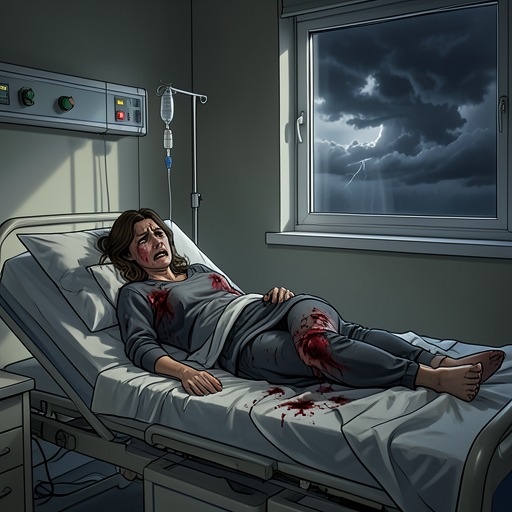
Leda's Inner Shattering and Turmoil
The Lost DaughterLeda's inner shattering and turmoil are not presented as a single crisis with a clean beginning and end. They recur across memories of pregnancy, exhausted care, frustrated work, and harm done to Bianca, while Leda struggles to name what is happening within her. The term shattering, inherited from her mother, gives the state a name without making it a resolved illness: Leda tells Nina that a person can live even if the feeling does not pass.
Origins in Ambition and Inheritance
Leda recalls a period when the hopes of youth seemed to have collapsed and she feared falling backward into the condition of her mother, grandmother, and a line of women who were silent or angry. Her ambition had not disappeared. It was still sustained by her youth and imagination, but she felt increasingly cut off from creative work by university dealings and the need to seize opportunities for an academic career. She describes herself as trapped in her own head, unable to test her capacities. The turmoil therefore grows from a conflict between a continuing desire to create and the limited room she feels she has to pursue that desire.
Her memories do not arrange themselves into a stable chronology. Leda says that the troubling episodes have no reliable before and after and return in a different order. This fragmented recurrence makes the past less like a settled account than a pressure that keeps resurfacing in the present. While sheltering from rain at a crowded market, she tries to understand what she had done years earlier; the act of remembering brings her back to the same sense of constriction rather than supplying a final explanation.
Pregnancy and the Demands of Care
Leda's account of motherhood begins with physical change that she experiences as both intimate and estranging. During pregnancy, a life she recognizes as her own seems also to be moving elsewhere, becoming another person's life. She had Bianca at twenty-three, when she and Gianni were struggling to keep university jobs. The people around them, including Leda and Gianni, believed Bianca should not grow up alone, so Leda planned to have Marta soon afterward. At twenty-five, she felt that other kinds of play had ended for her. The decision to have a second child thus belongs both to her own choice and to a social expectation about what a child needs.
Leda's account also shows how the work of raising the girls competed with her work and rest. Gianni travelled from one opportunity to another and gave the children little attention, though Leda calls him kind, notes that the girls loved him, and says that when necessary he did what he could. Leda, by contrast, remembers trying to study while caring for two small children. When Bianca played at being Leda's caretaker, Leda tried to participate and remain a good mother, but Marta's crying would interrupt them. Leda describes getting up from Bianca's game with a sense of release, then feeling innocent because she was going to the younger child rather than choosing to leave the older one. Bianca would cry as the play ended. The relief and the guilt coexist; neither cancels the other.
The Kitchen Memory
One winter afternoon, Leda was working in the kitchen on a short essay she had struggled for months to finish. She feared that the professor who had encouraged the project would not help publish it. Marta played beneath the table, while five-year-old Bianca sat nearby imitating Leda's reading and writing. When Bianca struck her, Leda reacted by striking her back. What began as an impulsive response became repeated punishment: Bianca initially treated it as a game, then understood that Leda was serious and began to cry. Leda continued before sending her out of the room and closing the door.
The door's frosted-glass panel shattered as it shut. Bianca stood unharmed beyond the broken pane, no longer screaming, and Leda was frightened by the extent of her own anger. Marta was also there, pulling at Leda's skirt. Leda remembers the scene not as an act she can explain away as discipline, but as a moment when she recognized that her controlled gestures had become real violence. The essay, dinner preparations, and limited time for research had already made her feel divided between intellectual work and domestic demands; the incident gives that division a consequence she cannot treat as abstract frustration.
Naming the Shattering
Years later, when Nina describes a feeling of vertigo and nausea as turmoil, Leda remembers that her mother used another word: shattering. Nina recognizes herself in the word and appears frightened. The exchange makes Leda's inheritance explicit, but it does not establish that Nina's experience is identical to Leda's or to her mother's. Leda says that with her own mother the feeling became a kind of sickness, while insisting that in the present someone can live even if it does not pass. Her answer holds open the possibility of endurance without promising recovery.
The conversation also creates a closeness Leda says she had not shared in the same way with Bianca or Marta: neither daughter had asked her questions with Nina's insistence. Leda searches for an answer that is truthful while withholding part of the truth. Nina seems to want physical comfort, and Leda feels that need in herself as well; Nina kisses her lightly before leaving. The exchange offers contact and recognition, but no cure. The word shattering makes a shared feeling speakable while leaving its history and consequences intact.
Maternal Conflict and Its Afterlife
Leda's later confrontation with Nina returns the state to the practical question of care. Nina confronts her over having kept Elena's doll while Nina was overwhelmed by her crying daughter and Leda watched without intervening. Leda accepts Nina's judgment that she is an unnatural mother; Nina takes the doll back and leaves, saying she wants nothing more from Leda. The episode does not explain all of Leda's motives, but it sets her passivity beside Nina's immediate distress and shows that Leda's choices continue to affect other mothers and children.
Across these memories, turmoil is bound to contradictions rather than a single attitude toward motherhood. Leda wanted children and planned Marta's birth; she also recalls pregnancy as alienating, care as exhausting, and the interruption of work as a source of resentment. She tried to comfort Bianca through play, yet struck her in a moment of frustration; later, she could observe Nina's distress without acting. Her mother's word gives this repeated division a name, while Leda's insistence that life can continue without the feeling passing leaves the ending deliberately unresolved.