Leda’s Car Crash into the Guardrail
The Lost DaughterLeda’s Car Crash into the Guardrail turns an apparent driving accident into a scene of bodily failure and deliberate silence. Leda survives after her car strikes the guardrail, but the account she gives others—that drowsiness caused the crash—conceals what she herself recognizes as its immediate cause: a gesture she cannot understand and refuses to discuss.
On the Road and at the Shore
Less than an hour into her drive, Leda feels ill as the burning in her side returns. At first she dismisses it; alarm comes when she realizes she can no longer hold the steering wheel. Within minutes her head grows heavy, the headlights seem dimmer, and she forgets that she is driving. The narrative moves from the road into an uncanny image of an empty beach at midday: the water is calm, yet a red flag waves from a pole near the shore.
The flag brings back her mother’s childhood warning that swimming beneath it could mean drowning in rough seas. Although the water before her looks like translucent paper stretching to the horizon, Leda remains anxious. She urges herself to swim but stays on shore, cautiously testing the water with her toe. Her mother appears at the top of the dunes and calls out the same warning as if Leda were still a child. The remembered voice and the hesitation at the water’s edge give the episode the shape of a return to childhood, even as Leda’s body is failing on the road.
The Crash and Its Physical Aftermath
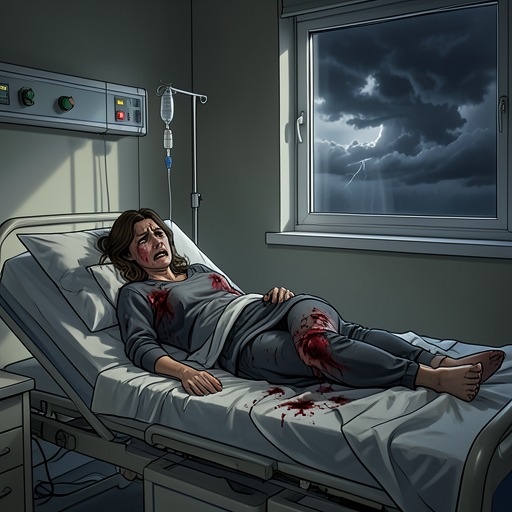
Leda opens her eyes in a hospital room and recalls herself hesitating before the flat sea. Unsure how to classify the experience, she later persuades herself that it was not a dream but a fantasy of alarm lasting until she woke. The doctors tell her that her car ended up against the guardrail, though the crash had no critical consequences. The only serious injury is a lesion in her left side, which they cannot explain.
The injury links the physical episode to the burning pain that preceded it, but the account does not resolve its cause. Nor does Leda present the beach scene as a definitive explanation. Its uncertainty remains part of the event: the scene is vivid enough to recur in her recollection, yet she can only offer a tentative account of what it was.
The Account Leda Withholds
Leda’s friends from Florence come to see her; Bianca and Marta return, and Gianni visits as well. To them, she attributes the crash to drowsiness. Privately, however, she knows that sleepiness was not to blame. She identifies a gesture of her own as the event’s origin, but says that it made no sense and immediately decides not to tell anyone about it.
That concealed gesture is the crash’s decisive unresolved fact. Leda does not explain what she did, and the episode offers no grounds for supplying an answer. Instead, her recognition that the public explanation is false sits beside her inability to make sense of her own action. The crash thus ends not in an account that restores certainty, but in a silence Leda actively maintains: the hardest things to speak about, she reflects, are those people themselves cannot understand.