Leda’s car crash
The Lost DaughterLeda’s car crash turns an ordinary drive into a crisis whose physical consequences are limited but whose cause remains hidden even from Leda herself. As her body fails at the wheel, the scene shifts into a vision shaped by childhood fear; afterward, she offers others an explanation she knows is false and keeps silent about a gesture she cannot understand.
The Drive and the Vision
Leda has been driving for less than an hour when a burning sensation returns in her side. At first she dismisses it, but concern takes hold when she realizes she no longer has the strength to grip the steering wheel. Within minutes her head feels heavy, the headlights seem to dim, and she loses awareness that she is driving.
In its place comes the impression of standing beside the sea in the middle of the day. The beach is empty and the water calm, yet a red flag flutters on a pole a few meters offshore. Leda’s Mother had warned her as a child never to swim when a red flag was raised, because the sea might be rough and she could drown. The warning persists despite the vision’s tranquil water, which appears like a translucent sheet reaching to the horizon: Leda stays on shore, tests the water with her toe, and cannot bring herself to enter.
Her mother appears at the top of the dunes and calls out to her as if she were still a child, repeating the warning about the flag. The image places Leda between an invitation to disregard her fear and the inherited caution that holds her back. The remembered warning does not explain the crash, but it gives the disorienting episode its emotional shape: even in the vision, Leda hesitates at the edge of danger.
The Crash and Its Immediate Aftermath
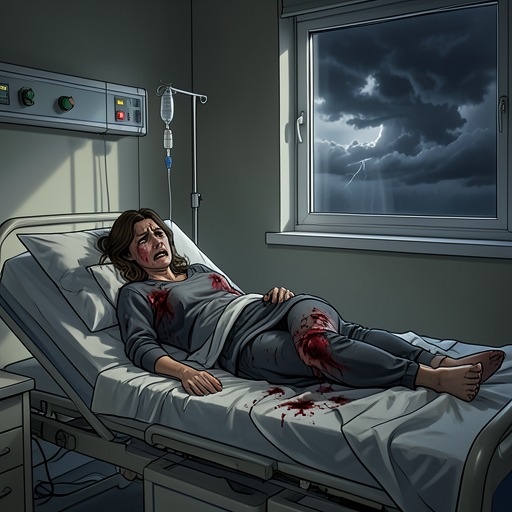
Leda wakes in a hospital room and sees herself again hesitating before the flat sea. She later wonders whether this is why she persuaded herself that the experience was not a dream, but a fantasy of alarm that continued until she opened her eyes. The account leaves the boundary between bodily crisis, memory, and dreamlike vision unsettled rather than resolving it.
Doctors tell her that her car ended up against the guardrail, but that the crash had no critical consequences. The serious physical finding is a lesion in her left side, which they cannot explain. The injury echoes the burning sensation that began during the drive, connecting the accident’s bodily warning to its aftermath without supplying a medical cause.
What Leda Tells Others—and Withholds
Friends from Florence come, Bianca and Marta return, and Gianni comes as well. Leda tells them that drowsiness sent her off the road. That account gives those around her a straightforward explanation, but it is not one she believes: she knows drowsiness was not to blame.
Leda privately locates the beginning of the crash in one of her own gestures, which she describes as making no sense. She decides not to tell anyone about it precisely because it is senseless. The narrative does not disclose what the gesture was, or establish its mechanics; its force lies in the gap between Leda’s certainty that it mattered and her inability to understand or communicate it.
Narrative Significance
The accident is narrated retrospectively by Leda, but its central cause remains withheld. The red flag, the childhood warning, and the unexplained gesture offer fragments rather than a complete account: the vision can be recalled, the physical injury named, and the cover story identified, while the decisive action stays obscure.
That silence shapes the event’s aftermath. Leda’s explanation separates what she says from what she knows, while her admission that the hardest things to discuss are those she herself cannot understand makes the crash a scene of unresolved self-knowledge as well as physical danger. The car’s collision with the guardrail is concrete; the gesture that preceded it remains an absence around which her account turns.